- Home
- Media Kit
- MediaJet
- Current Issue
- Past Issues
- Ad Specs-Submission
- Reprints (PDF)
- Photo Specifications (PDF)
- Contact Us
- PRIVACY POLICY
- TERMS OF USE
Loading

ONLINE

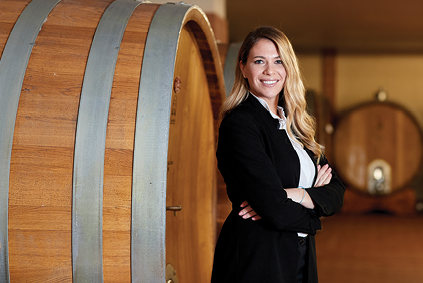
Marzia Varvaglione
An Expression Of Puglia
Editors’ Note
Born in 1989 in Taranto, Marzia Varvaglione represents the fourth generation of Varvaglione 1921, her family’s winery in Leporano, Puglia. Since joining the business in 2013, she has helped transform the company into one of Puglia’s leading internationally recognized wineries, championing native varieties such as Primitivo while combining tradition with innovation. Before entering the wine industry, Varvaglione competed in Italy’s Women’s Serie A Basketball League, an experience that shaped her leadership, discipline, and team-building skills. She studied business strategy and marketing management at universities in Milan, Lugano, Lausanne, and London, and holds a WSET Level 3 certification. A passionate advocate for the next generation of wine professionals, Varvaglione was elected President of AGIVI in 2023 and President of CEEV in 2025 (the European Committee of Wine Companies), where she represents the voice of the European wine sector. In these roles, she has helped address key industry challenges, including sustainability, climate change, evolving consumer trends, and international competitiveness. At Varvaglione 1921, Varvaglione serves as Head of Business Development, leading the winery’s growth, international expansion, and commitment to innovation and sustainability.
Winery Brief
Varvaglione 1921 (varvaglione.com) is a historic, family-run winery located in Leporano within the Salento and Manduria regions of Puglia, Italy. Founded in 1921, it spans four generations of winemaking and ranks among Southern Italy’s oldest and fastest-growing cellars, producing about five million bottles distributed across more than 60 countries.
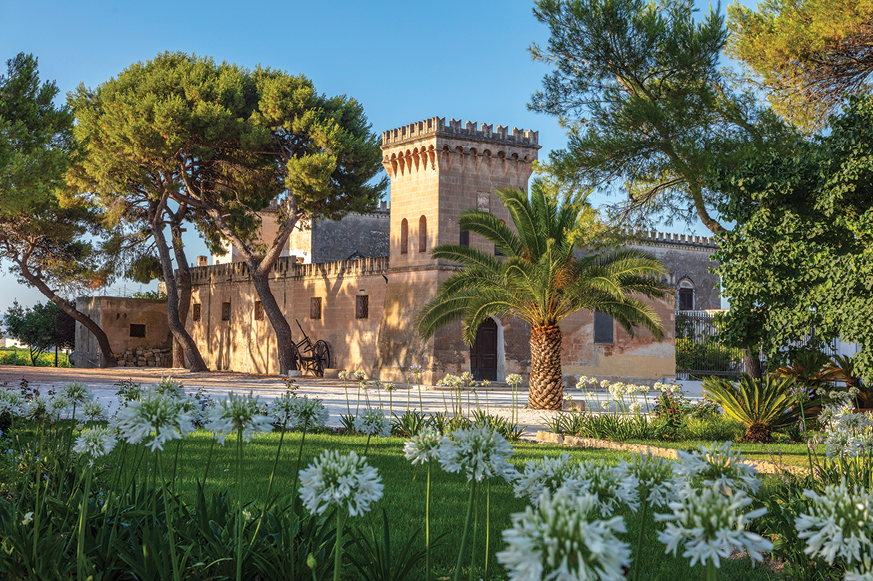
Varvaglione 1921
Will you discuss your career journey?
I joined the family business in 2013, but my journey into wine was not necessarily a straight line. Before entering the winery, I was a professional basketball player in Italy’s Women’s Serie A, and that experience shaped me enormously. Sport taught me discipline, resilience, how to work as part of a team, and how important it is to have a common goal. I also studied business strategy and marketing management in Milan, Lugano, Lausanne, and London, and later obtained my WSET Level 3 certification. When I joined Varvaglione 1921, I brought this combination of business, marketing, international experience, and teamwork into a family company with more than a century of history.
Today, as Head of Business Development at Varvaglione 1921, my role is focused on developing the company internationally while helping to shape its future. At the same time, my career has increasingly expanded beyond the family business. In 2023, I was elected President of AGIVI, the Association of Young Italian Wine Entrepreneurs, and in 2025, I became President of the CEEV, the European Committee of Wine Companies. These roles have given me the opportunity to represent the interests of the Italian and European wine sectors and to engage with some of the major challenges facing our industry, from sustainability and climate change to changing consumer habits and international competitiveness.
Being part of the fourth generation of Varvaglione 1921 is both a privilege and a responsibility. I have the opportunity to build on the work of the generations before me, but also to help prepare the company, and the wider wine industry, for the future.
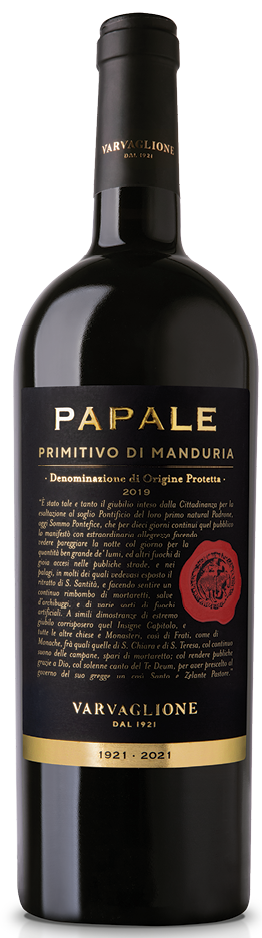
Varvaglione wine from the Papale collection
Will you highlight the history of Varvaglione 1921?
History is fundamental to who we are. The winery was founded by my great-grandfather, Cosimo Varvaglione, in 1921 in Pulsano, near Taranto. My grandfather, Angelo, later built the first cellar in Leporano in 1958 which is still part of our story today. We celebrated our centenary in 2021, and today we are still a family-owned winery, now in its fourth generation. What I find particularly meaningful is that the family history is closely connected to the history of Puglia and Salento. Our wines are a way of expressing that territory and its traditions.
At the same time, our history has always involved evolution. We have grown from a small family winery into an international company exporting to more than 60 countries, while continuing to focus strongly on Puglia’s native varieties and the character of our territory.
Will you provide an overview of Varvaglione 1921’s offerings?
Our portfolio is very much an expression of Puglia, with a strong focus on native grape varieties such as Primitivo, Negroamaro, Susumaniello, alongside international varieties such as Chardonnay and Sauvignon. We have several collections, each telling a different part of our story. Papale, for example, is centered on Primitivo di Manduria and represents one of the most iconic expressions of the variety. Terra focuses on single-varietal wines made from native grapes and celebrates the relationship between the wines and the culture and history of Taranto. Our Family Collection connects individual wines with members of our family and our history.
We also have 12 e Mezzo, which is particularly interesting because it combines a contemporary approach with traditional Puglian varieties. The collection includes wines with a lower alcohol level and modern, accessible positioning, while remaining rooted in our territory. Within the collection we also have an organic Primitivo.
So, overall, our portfolio is about showing the diversity of Puglia while remaining firmly connected to our identity.
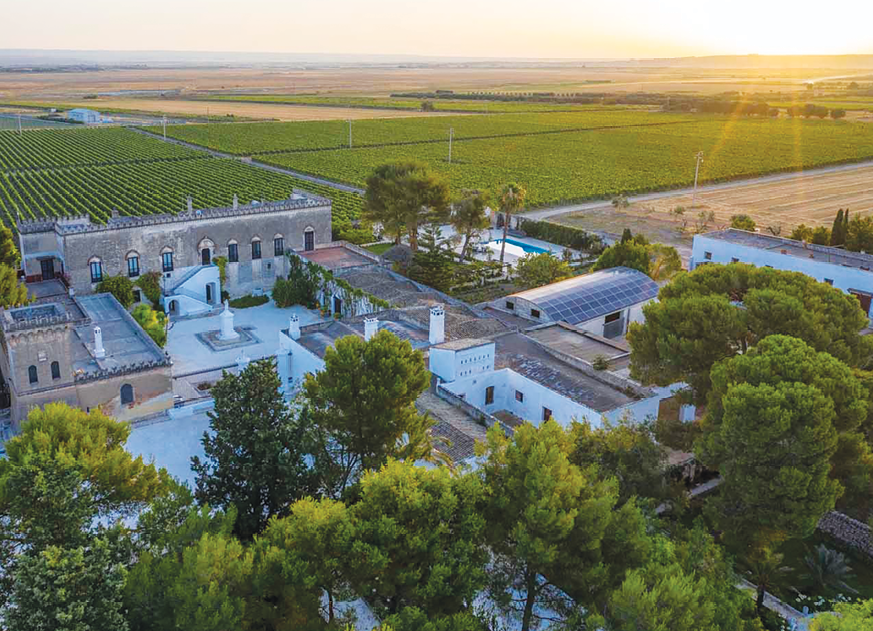
A broad view of the Varvaglione 1921 estate
How critical is sustainability to Varvaglione 1921’s culture and values?
It is increasingly central to our way of thinking about business. For us, sustainability isn’t simply a trend or something we communicate about – it has to be considered throughout the process, from the vineyard to the bottle. We have developed specific sustainable wine projects, including 12 e Mezzo, which Varvaglione describes as a sustainable project extending from the vineyard to the bottle. We have also invested in research and technology and work with universities on quality control and research and development.
Being sustainable in Puglia also means understanding our environment. We have to think about how we manage our vineyards, water, soil and resources, and how we can continue producing quality grapes while adapting to a changing climate.
I think the most important thing is that sustainability has to be a long-term commitment. We are a family winery, and when you think in generations, you naturally think about protecting the land and the resources that the next generation will inherit.
How critical is it for family wineries to preserve tradition while embracing innovation?
I think it is absolutely essential, but I don’t see tradition and innovation as opposites. Tradition gives us our identity. At Varvaglione, that means our family history, our connection to Puglia, our native grape varieties, and our understanding of the territory. But innovation allows us to protect and strengthen that identity in a changing world.
Our own history is an example. We have maintained our focus on varieties such as Primitivo and Negroamaro, but at the same time we have embraced new winemaking technologies, new approaches to sustainability, new packaging, new markets, and new ways of communicating with consumers. The company itself describes this as a synergy between experience and tradition and innovative winemaking technology.
Preserving tradition doesn’t mean keeping everything exactly as it was. It means understanding why certain traditions matter and finding new ways to carry them forward.
What has made the wine industry so special for you?
For me, it is the combination of people, territory and constant learning. Wine brings together so many different worlds: agriculture, culture, business, hospitality, food, communication and international markets. Every bottle has a story behind it, and every market is different.
Coming from professional basketball, I also appreciate the team aspect of wine. A winery is never the work of one person. It takes people in the vineyards, the cellar, sales, marketing, logistics, export markets and many others working toward the same goal.
And being part of a family winery makes it even more personal. I am working with something that was started by my great-grandfather more than 100 years ago, but I also have the opportunity to contribute to what the fifth generation will eventually inherit. That sense of continuity is very special to me.
Do you feel there are strong opportunities for women in leadership roles in the industry?
I believe there are, and I also believe the opportunities are growing. But I think it is important that we continue creating an industry where women can develop their careers at every level, from the vineyard and cellar to management, ownership, marketing, and leadership. My own experience has taught me that leadership is not about gender. It is about competence, preparation, resilience, collaboration, and the ability to inspire people around you. My years as a basketball player taught me a great deal about this: you can have individual talent, but you achieve something meaningful as a team.
My roles within AGIVI and CEEV have also given me the opportunity to support greater collaboration and to encourage more young professionals and women to take an active role in shaping the future of our industry. I believe that bringing different perspectives to the table makes the wine sector stronger, more dynamic, and better equipped to navigate the changes ahead. For me, supporting young professionals and creating opportunities for women is part of building a stronger wine industry for the future.