- Home
- Media Kit
- MediaJet
- Current Issue
- Past Issues
- Ad Specs-Submission
- Reprints (PDF)
- Photo Specifications (PDF)
- Contact Us
- PRIVACY POLICY
- TERMS OF USE
Loading

ONLINE

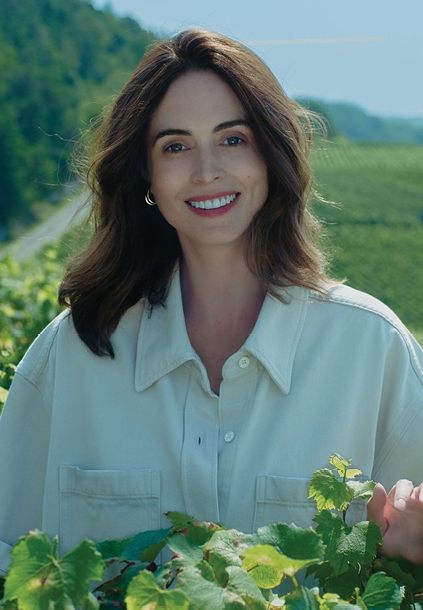
Maggie Frerejean-Taittinger
Terroir In A
Non-Alcoholic Bottle
Editors’ Note
Long-time friends, Constance Jablonski and Maggie Frerejean-Taittinger, who lived on opposite sides of the Atlantic, met again in Paris in 2019. Maggie, Director of the Michelin Guide, is pregnant with twins. Constance pursues her career as a top model. Both of them are driven by a quest for well-being against all odds. During social gatherings, they soon realize how non-alcoholic, festive and sophisticated drinks are non-existent. The idea for French Bloom was born. Fast forward, French Bloom has become a history of firsts. From its strategic partnership with Moët Hennessy – which marked the group’s first investment in the 0.0% alcohol segment – to becoming the first non-alcoholic wine brand to own an estate, French Bloom continues to set new benchmarks for the category. The maison has also secured a series of industry-first milestones, including becoming Formula 1’s first official alcohol-free sparkling wine partner, the first alcohol-free sparkling wine served at Roland-Garros and since 2023 it has been the exclusive non-alcoholic sparkling wine at the Coachella Music Festival.
.png)
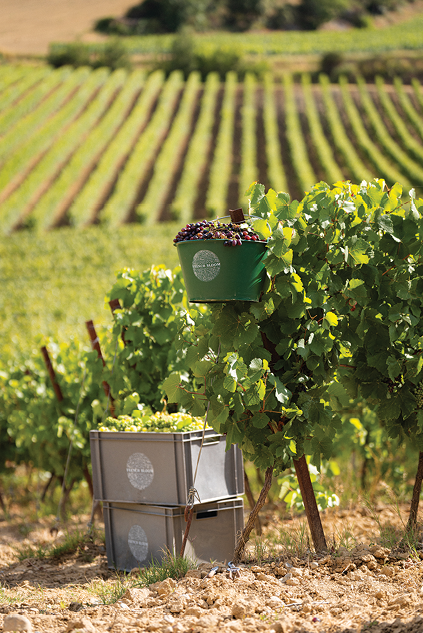
French Bloom vineyards and alcohol-free wines
(above and below)
Will you discuss your career journey?
My career has always been driven by curiosity and by a fascination with hospitality, culture and the way people come together. I spent several years at the Michelin Guide working internationally, immersed in the worlds of gastronomy and hospitality.
French Bloom came from a much more personal experience. When I was pregnant, I suddenly realized how limited the choices were when you wanted to participate fully in a celebration without alcohol. The emotional weight of the occasion was there, but there was nothing in my glass that matched it.
When I met my co-founder, Constance Jablonski, we realized we shared the same conviction: choosing alcohol-free, whether for one evening or every evening, should never mean choosing less. That became the starting point for French Bloom.
What was the vision for launching French Bloom?
The vision was never simply to create an alcohol-free alternative. We wanted to create something people would genuinely desire, whether they drink alcohol or not. When we launched in 2021, the category was largely defined by compromise. We wanted to approach alcohol-free wine with the same standards and ambition as fine wine, from sourcing and craftsmanship to gastronomy, design and the ritual around the bottle.
Five years later, French Bloom is present in more than 70 countries, served by partners including Air France, Soho House and Auberge Collection, and backed by LVMH. Those milestones reinforce our belief that alcohol-free wine can fully belong within the worlds of fine wine, gastronomy and luxury.
How do you define French Bloom’s mission?
Our mission is to make sure everyone has a place around the table and something exceptional in their glass. We are not building French Bloom only for people who don’t drink. What is particularly exciting is the rise of the flexi-drinker, someone who may enjoy Champagne one evening and French Bloom the next, or even have both during the same dinner. Consumers increasingly want the freedom to choose what they drink according to the moment, without compromising on taste, experience or celebration.
For generations, alcohol and celebration have been almost inseparable. We believe celebration is really about connection. French Bloom exists so that everyone around the table can participate in the same ritual, regardless of what they choose to drink.
Will you provide an overview of French Bloom’s offerings?
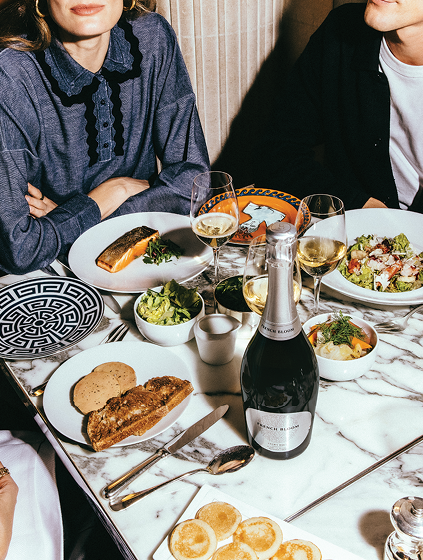
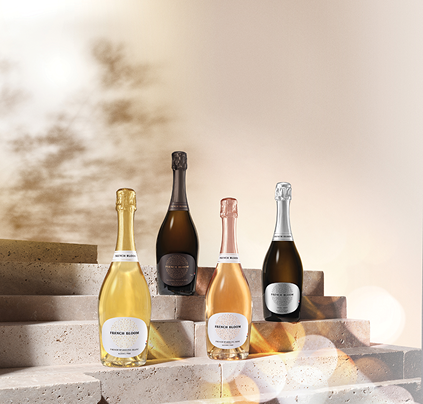
We have deliberately built French Bloom as a collection rather than simply one alcohol-free sparkling wine. Le Blanc and Le Rosé are at the heart of the Maison and are designed to be incredibly versatile, from the aperitif through to the table. L’Extra Brut is our zero-sugar expression, with only one calorie per glass, and represents a much drier, gastronomic style. At the highest end of the collection is La Cuvée Vintage 2023, which demonstrates where we believe alcohol-free winemaking can go: greater complexity, provenance and a genuine fine-wine experience without alcohol.
Everything is organic and alcohol-free. But ultimately, our first criterion has always been complexity and balance. And that approach is starting to pay off. French Bloom has been named the World’s Best Alcohol-Free Sparkling Wine three times, and we were recently nominated by Wine Enthusiast for 2026 Innovator of the Year, something that would have felt almost unimaginable for a brand in our category just a few years ago.
How critical has it been to educate the market about French Bloom as a naturally alcohol-free alternative?
Education has been critical, and one of the first things we explain is that French Bloom is not naturally alcohol-free. We are wine first. We believe that wine is terroir in a bottle. We start with organic grapes, make wine through a traditional vinification process, and only then carefully remove the alcohol. That distinction is fundamental to who we are. From the beginning, our ambition has been to bring the same attention to terroir, craftsmanship and taste to alcohol-free wine that you would expect from fine wine.
The other part of education is around who French Bloom is for. It isn’t simply for people who don’t drink. We see the future as increasingly flexi-drinking, where someone might choose a glass of wine at one moment and French Bloom at another. What matters is that there is no compromise in the experience. That is why seeing French Bloom now leading the category and served in more than 500 Michelin-starred restaurants around the world feels particularly meaningful. It demonstrates that alcohol-free wine can sit naturally alongside the world’s great wines and Champagnes.
Will you highlight French Bloom’s commitment to sustainability?
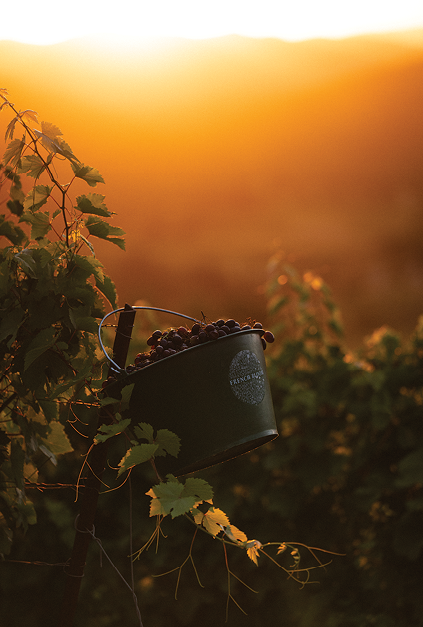
Sustainability has been part of French Bloom from the beginning rather than something we added later. Our wines are made from organically grown grapes, and we think carefully about sourcing, production and packaging. But for us, sustainability also means longevity. We are building a Maison that we hope will exist for generations, and that requires respecting the agricultural ecosystem on which everything begins.
Wine starts with the land. As French Bloom grows, our responsibility is to grow while protecting that relationship.
How valuable is it for French Bloom to have its own fully functioning Maison in Limoux?
It is transformative because it gives French Bloom roots. Limoux has an extraordinary history with sparkling wine, and having our own Maison there allows us to go even deeper into what we believe: wine is terroir in a bottle.
We are not starting with dealcoholization. We are starting in the vineyard. Having our own Maison allows us to think about the entire process, from the soil and grape varieties through vinification, blending and ageing, before we ever remove the alcohol.
For a long time, the conversation around alcohol-free wine has focused primarily on the technology of removing alcohol. We want to move that conversation upstream, toward terroir, grapes and craftsmanship.
For me, that represents the next chapter of the category. The future of alcohol-free wine won’t simply be about becoming better at removing alcohol. It will be about becoming better at making wine.
How do you focus your efforts leading French Bloom?
As a founder, my role changes constantly, but I spend most of my time thinking about four things: product, brand, people, and where the consumer is going next. I am very involved in how French Bloom shows up in the world, from our creative direction and partnerships to distribution and the places where consumers discover us.
As we’ve grown across markets, protecting the standards and desirability of the brand while continuing to scale has become incredibly important. LVMH’s investment has been an important milestone in that journey, but we remain very entrepreneurial in how we operate.
I also recently relocated to the United States because it has become our largest market. I believe enormously in being physically present in the markets you are trying to build.
What are your priorities for French Bloom as you look to the future?
We are still at the beginning. The most exciting shift isn’t simply that more people are giving up alcohol. It is that the rules around drinking are changing. Consumers are becoming much more flexible. They may drink alcohol sometimes and choose alcohol-free at other times, without feeling the need to define themselves by either choice.
Our priority is to lead that evolution. That means continuing to grow internationally beyond the 70+ countries where French Bloom is already present, accelerating the United States, investing in our Maison in Limoux and continuing to push the boundaries of what alcohol-free wine can be.
Having LVMH invest in French Bloom and seeing the brand served by partners such as Air France are important milestones, but they also raise the bar for what comes next.
Five years ago, we had to explain why a luxury alcohol-free sparkling wine should exist. Our ambition now is for the choice between an exceptional wine and an exceptional alcohol-free wine to feel completely natural. Both belong on the same table.