- Home
- Media Kit
- MediaJet
- Current Issue
- Past Issues
- Ad Specs-Submission
- Reprints (PDF)
- Photo Specifications (PDF)
- Contact Us
- PRIVACY POLICY
- TERMS OF USE
Loading

ONLINE


Florencia Palmaz
The Fusion Of Tradition
And Technology
Editors’ Note
Originally from La Plata, Argentina, Florencia Palmaz’s energy is the result of her California sunny attitude, Texas big sky thinking, and Latin American flair. A serial entrepreneur in the food and wine industry, her career started from her dorm room in college. While many of her roommates were forging their future in tech, she was drawn to traditions of the dining table. In 1996, Palmaz and her mother Amalia began their adventures in food establishing one of Texas’ first premier gourmet food delivery companies, Haute @ Home Cuisine, that delivered nationally hand-made delicacies ranging from Langoustine Canapés to Foie Gras Stuffed Quail and even elaborate house-made pastries like Croquembouche from their commercial kitchen in San Antonio, Texas. The gourmet foods catalog company eventually evolved into a foundation kitchen where many of the country’s premier restaurants and supermarkets partner with the mother and daughter team to create their signature dishes. Still cooking up great foods today, the company continues to be San Antonio based and 350 associates strong. In 2003, Palmaz relocated to Napa Valley to help launch the family vineyard and estate. Her culinary and technical background has served her well as the creative force behind the brand. Her passion for food has always been in the background at Palmaz Vineyards. The wines are known for their complex nuanced textures making Palmaz Cabernet renowned for its versatility in food pairing. Today, Palmaz guides the wines’ style and directs the culinary program at Palmaz Vineyards.
Winery Brief
Palmaz Vineyards (palmazvineyards.com) is nestled at three different elevations, from the hills around the estate to the crest of Mount George, and feature 46 distinct vineyard blocks. The complexity of the terrain results in a variety of micro-climates, all of which influence grapes in unique ways. Each parcel features a distinct rootstock and clonal combination that contributes a special characteristic to the resulting wines..png)
Palmaz Vineyards
Will you highlight the history of Palmaz Vineyards?
In 1881, Henry Hagen founded Cedar Knoll Vineyard and Winery on this land, against the forested ridges of Mount George. He became one of Napa’s true pioneers – his wines poured at the San Francisco Opera House, with his brandy taking a silver medal at the 1889 Paris Exposition. He died in 1895, his descendants did not share his passion, and Prohibition finished what indifference started. The winery sat abandoned for the better part of a century.
When my parents found the property in 1996, the vineyard had lain fallow for 86 years and held more rusted-out washing machines and box springs than vines. What looked to most people like a dilapidated hillside looked to my family like a place worth the work, so we restored it and replanted it – and discovered that winemaking history was literally in the drawers of the furniture, down to a barrel brand bearing the original Cedar Knoll logo, which we revived as a label.
Arriving in Napa in the 1990s was a tremendous time to enter this industry. Academia was producing compelling scientific evidence that many of the habits the Napa wine industry had held until then were holding back the potential of the wines. Two areas of great improvement stood out at that time. The first was a renewed respect for the variability in soil and microclimate, and the understanding that a vineyard should be parceled into individual components and farmed uniquely. The second was a refocus on the advantages of gravity flow winemaking methods. It was confirmed back then that removing the turbulence and forced aeration of the wine during the vinification process would improve both the mouthfeel and the ageability of the wines.
Since our property was abandoned for so long, we were essentially able to revive a historic vineyard site while replanting it in a new way, respecting the terroir of each location. We spent nearly three years simply studying the land and selecting the appropriate rootstock and clones for the location. Once that was completed, we had established a highly complex vineyard in a relatively small space. We then set out to custom build the winery to accommodate all the micro-parcels we had established and integrate a complete gravity flow winemaking process at the same time. The winery was set inside Mount George, flanking our lower elevation vineyard. The task of digging this highly complex network of caves was far more taxing than we had anticipated. Seven years later we were finally finished, and the result is still a joy to work in.
The winemaking happens underground, in a cave complex carved into the mountain where the wine moves by gravity alone rather than by pump. And the estate is not only a winery – there is a culinary garden, our own olive oil, and a splash of non-alcoholic grape juice for the children.
Our first released vintage was 2001. We are simply the latest thread in a long line of caretakers of this estate – and I would love to tell you the full story of Cedar Knoll and Henry Hagen properly one day, but that is a deep dive of its own.
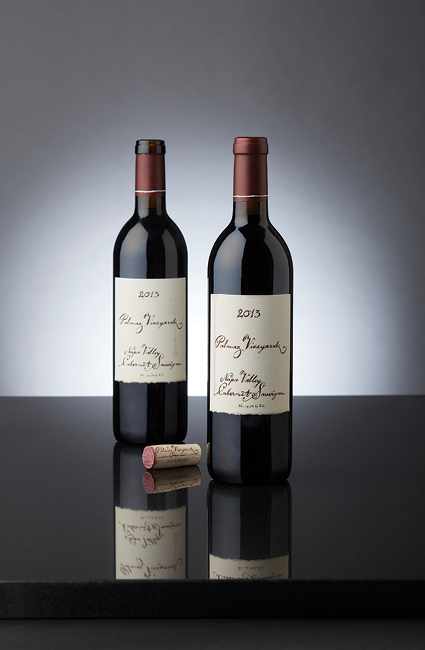
Palmaz Vineyards Cabernet
Will you provide an overview of Palmaz Vineyards’ offerings?
We farm 64 acres of vineyard within a 600-acre estate on the slopes of Mount George in Coombsville AVA, where we live. All of us - my parents, my brother and his wife, our children, all on this hillside, working the same land and eating at the same table most days.
Our Cabernets are entirely estate grown: the Palmaz Cabernet Sauvignon is the primary Bordeaux style blend. This wine is the pinnacle of our efforts in the vineyard representing the best harmonized blend of what the vineyard represents each vintage. Then select lots are set aside as Gaston, a 100 percent parcel-focused Cabernet Sauvignon. After about 15 years of cooking elaborate Argentine style asados on property we decided to make a wine just for the purpose of fire cooking. Brasas is a Cabernet-Malbec blend we built for one purpose – to stand up to the fire and the food.
Alongside this collection of reds, we make our Amalia Chardonnay, Louise Riesling, and Florencia Muscat. You may notice a pattern in the names – they are named for the women of this family, to celebrate the lighter side of a great meal – and to poke a little fun at the Cabernet chauvinism we all fall victim to. Like the women in our family, these wines are no ordinary “girly” white wines; they are each complex, focused, and nuanced with a splash of fun.
Last but not least, to ensure that we keep the quality of the primary label exceptional, we carry a second label, where most of our secondary lots are sent. This wine is a resurrection of Henry Hagen’s Cedar Knoll Vineyard and Winery label, using a barrel brand we found on the property bearing his original logo. Considering that we do not pre-determine which lots are declassified until the primary wine is made, Cedar Knoll is a tremendous value with estate fruit, 100 percent French oak, and 18 months of aging.
How critical is sustainability to Palmaz Vineyards’ culture and values?
I would put it differently than most people do: we are not sustaining this land; we are restoring it, with the purpose of reviving a legacy estate that can sustain itself for generations to come. Our mission statement is “Love the Land, Know the Grape, and Make a Wine that Honors Both.” So I would say yes – sustainability is our core value.
Securing a sustainable water supply was the first problem we set our focus upon. As the winery was being designed, the question started as how to simply minimize our consumption in the winery and quickly escalated into whether we could eliminate it altogether. Winery process water is genuinely difficult to treat – the pH is very low, and the chemicals normally used to correct it leave salts behind that raise soil salinity over time, which is unacceptable in a vineyard you intend to farm for generations. So we built our own water treatment plant: fully computerized, sited underground so we lose nothing to evaporation, running on a custom bacterium with an affinity for grape by-products. It came online in 2003. The result is significant: we are a net-zero water-consuming winery, reclaiming 100 percent of the water used in sanitation and processing and returning it to the land for irrigation.
And rather than irrigate block by block, we irrigate vine by vine. To ensure that we are mindful to not waste our ground water, my brother built a program called VIGOR that reads infrared imagery flown over the vines twice a week and pairs it with soil moisture, insect mapping, and petiole data, so the team can respond to what each vine actually needs instead of watering for the thirstiest one in the row. In its first year, it cut our water use per acre by 18 percent. Since then, we continue to optimize our irrigation system dialing in the deficit farming mindset to great results in our net water usage and the quality of our wines.
And the most obvious sustainability program is the winery cave itself, all 100,000 square feet of it, in the living rock of Mount George, so the building disappears into the hillside and the viewshed of these mountains is left as we found it. Barrel storage in caves is the most energy-efficient way to cellar wine – the mountain holds temperature and humidity all year without wasting energy on climate control.
The vines outside my kitchen window will outlive me and my children. You farm differently when you think that way.
What has made the wine industry so special for you?
Two sides, and they are very different pleasures. The first is the infinite complexity of honing a craft like winemaking. Every year hands you weather you did not choose. You are tending a living thing – a grapevine is far more complicated than people imagine – and doing it in a way that leaves this land better than you found it. The variables never fully resolve. I am someone far more interested in the pursuit of perfection than in its attainment, and this is the perfect Rubik’s Cube to spend a mind on. Twenty-five vintages in, I have not run out of turns.
The second is what happens when the bottle reaches a table. The wine is the pin in an evening – often the way a host confers honor on a guest, without anyone saying so out loud. That is why the precision on our side matters so much. Every decision we make in the vineyard and the cave is love and respect being poured into a bottle, so that it is there to be bestowed when a collector opens it at their own table for the people they care about.
One craft I will never finish, in service of one moment I will never tire of.
As Palmaz Vineyards celebrates its 25th anniversary, how important is it for the team to take moments to reflect on the brand’s impact?
Twenty-five years is a good place to pause, take a deep breath, and take stock. We worked hard for these first 25. Restoring a vineyard abandoned for 86 years and bringing it to a world-class collector’s standard took time – a full decade alone to settle the vineyard management process, 10 years of learning what this land wanted. The cave was a tremendous effort of a different kind: designing and physically digging a gravity-flow winery out of a soft, crumbling mountain. Honestly, 25 years feels like only the first tick of the generational clock that I hope will run for many more Palmaz generations to come.
But the most satisfying part of a milestone like this is the chance to honor the vineyard and winemaking teams who actually make the wine each year. We have been extraordinarily lucky in the length of those relationships. Tina Mitchell led our winemaking team for 22 years, from 2003 until she passed the torch this year to her son, Doug, who joined the cellar in 2007 and has worked alongside her ever since. A mother and son, more than 15 years side by side in our cellar – that is not something you can plan for or hire.
So there are chunks of time to commemorate here, and there are people to thank. Mostly it is the second one.