- Home
- Media Kit
- MediaJet
- Current Issue
- Past Issues
- Ad Specs-Submission
- Reprints (PDF)
- Photo Specifications (PDF)
- Contact Us
- PRIVACY POLICY
- TERMS OF USE
Loading

ONLINE


Federico Bricolo
The Growth Of
Italian Wine
Editors’ Note
Born in 1966 in Verona, Federico Bricolo boasts a long career in institutions which led him to hold leading positions in the Italian Government and Parliament, as well as in international organizations: Deputy from 2001 to 2008; Undersecretary for Infrastructure and Transport in 2005-2006; and group leader of the Lega Nord in the Senate from 2008 to 2013. At the international level, he is part of the delegation to the parliamentary assembly of the OSCE, an organization for security and cooperation in Europe, and became Vice President of delegations in the parliamentary assembly of the Council of Europe and the Western European Union. As a parliamentarian, he participates in various missions abroad, meeting government representatives and diplomats from nations such as the United States and Afghanistan. For five years he held the position of Chairman of the Board of Editoriale Nord and was responsible for the political secretariat and the legislative office of the Lega Nord. In 2020, he became a member of the Board of Directors of Verona Catullo Airport. In May 2022, he was elected President of Veronafiere.
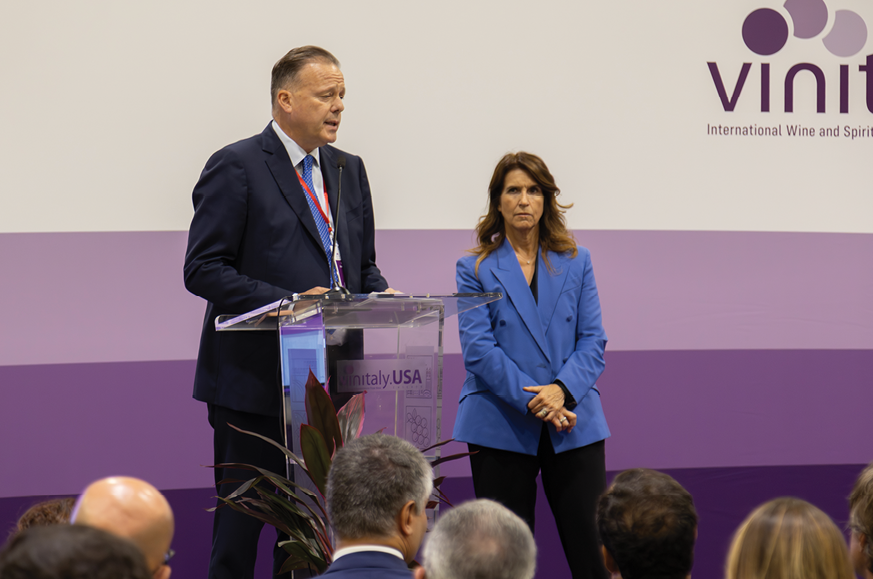
Vinitaly.USA Chicago 2025 edition (above and below)
How would you define Veronafiere’s mission?
Veronafiere was founded in 1898 and, over more than a century, has established itself as one of Italy’s leading trade fair organizers. We have evolved alongside the Made in Italy industries and companies we represent, consolidating a clear mission: to create business opportunities, foster relationships, and support companies in accessing international markets.
Today, a trade fair organization cannot simply organize events but must operate as a platform for promotion, internationalization and dialogue, working year-round alongside companies, trade associations, and institutions.
Vinitaly fully embodies this evolution. Since 1967, it has supported the growth of Italian wine and today operates as an integrated system that extends from Verona to key international markets such as the United States, Asia, and South America. Our mission is to bring supply and demand together, engage qualified industry professionals, develop knowledge, and enhance the competitiveness of Italian companies.
The work of Vinitaly is complemented by Vinitaly Tourism. Through it, we extend our promotional efforts to the territories where wine originates. Wine, after all, creates value not only through the bottle itself, but also by generating value for tourism, restaurants, hospitality, culture and services, contributing to the economic development of local communities.

What are the key elements needed for the wine industry to remain relevant to today’s consumers?
The first element is the ability to understand a consumer who is changing rapidly. Today, consumers are not simply looking for a good wine; they are seeking authenticity, transparency, and a more mindful approach to consumption. Wineries need to communicate these values in an accessible way without losing the cultural depth and sense of place that make wine a unique product.
It is also essential to make wine more approachable to younger generations by adapting the language we use and the consumption occasions. This does not mean simplifying wine or diminishing its identity, but rather finding new ways to communicate and introduce it to consumers while investing in education, innovation, and responsible consumption.
Last but not least, the very concept of the wine experience needs to be broadened. Visiting a winery, meeting a producer, discovering a landscape, or appreciating a wine and food pairing can create a much stronger connection than product communication alone. Vinitaly, through the Vinitaly Tourism format, is focused precisely on connecting wine producers, territories, and tourism professionals.
What makes Italian wine so compelling to U.S. consumers?
Italian wine offers a unique combination of quality, diversity, history, and sense of place which is difficult to replicate. Italy has an extraordinarily rich wine heritage and a wide range of denominations that allow consumers to travel through extremely different regions, landscapes, cultures and traditions, across a broad price point spectrum. In the United States, we witness a particularly strong connection between Italian wine and the Italian lifestyle. Wine is experienced within a bigger frame that includes gastronomy, conviviality, design, and Italy’s ability to transform quality into an experience. UNESCO’s recognition of Italian cuisine further strengthens this cultural heritage and the natural relationship between wine, food, and territory.
From our perspective, we know that established success should never be taken for granted. Despite the challenges, the U.S. remains one of Italy’s main markets, one that requires a consistent presence and continued education. Vinitaly also focuses on this by supporting companies along this path and bringing to the United States not only Italian wines, but also the richness and diversity of the territories they represent.
What current wine trends should U.S. consumers be paying closer attention to?
The feedback we receive from U.S. industry professionals reveals several broader trends that extend beyond any specific grape or category. There is growing interest in wines that express a recognizable origin, an authentic story, and a direct connection to their birthplace. At the same time, we are seeing greater attention to moderation and increased curiosity about lesser-known wine regions. American consumers today have access to far more information than ever before. Vinitaly and Veronafiere support producers in making their stories, and therefore their wines, easier to communicate.
Another important trend is the shift from product to experience. Wine is increasingly discovered through food, travel, events, and visits to the places where it is produced. This is why Vinitaly Tourism is an integral part of our strategy: it creates a connection between what consumers experience in the glass and the territory where the wine originates.
How is wine tourism evolving in Italy?
A 2026 study conducted for Vinitaly Tourism by the Italian Association of Food and Wine Tourism and tourism expert Roberta Garibaldi, based on a representative sample of 750 U.S. travelers, confirms the significant potential of wine tourism. Sixty percent of respondents had participated in at least one wine tourism experience in the previous three years. Among those who had, wine was the primary motivation for the trip for 42 percent, while an additional 38 percent considered it one of the main motivations for their trip. Furthermore, 47 percent of respondents said they intend to visit Italy within the next 24 months and include a wine tourism experience in their trip. Italy is particularly well positioned: 79 percent of respondents believe the country offers authentic food and wine experiences, while 71 percent associate Italy with premium or luxury wine experiences.
There is, however, room for improvement, particularly in how these experiences are organized and marketed. Fifty-five percent consider the ability to book winery visits and experiences online important, while 64 percent say that having access to a comprehensive official national wine tourism portal would make them more likely to visit Italy.
What opportunities does Italy offer American travelers who want to explore wine regions beyond traditional destinations such as Tuscany?
The same Vinitaly Tourism study reveals some very interesting trends. Sicily shows an 82 percent propensity to visit, one percentage point ahead of Tuscany at 81 percent. This confirms that U.S. travelers are ready to broaden their understanding of Italy’s wine geography and discover destinations beyond the country’s most established regions.
Fifty-four percent of respondents prefer a trip that combines visits to cities with wine experiences, while 37 percent favor itineraries centered around wine regions. These preferences are particularly well suited to a country like Italy, where wineries, landscapes, art, historic villages, and cuisine come together to create a highly integrated travel experience.
What has made the world of wine so special to you?
Wine is a unique sector because it brings together business, agriculture, culture, and human relationships. Behind every bottle there is a territory, a family, expertise built over time, and a community that contributes to preserving its identity. At the same time, wine is one of the Italian products with the greatest ability to connect with the world. Over the years, I have had the opportunity to meet producers, buyers, and industry professionals from many different countries. What continues to strike me is wine’s ability to immediately create a connection and a sense of sharing, while at the same time generating significant economic value and employment.
For those of us leading Veronafiere, working with the wine sector therefore comes with a responsibility: to support companies in international markets, protect the value of the sector, and help pass on to future generations a heritage that belongs not only to the business community, but to Italian culture itself.