- Home
- Media Kit
- MediaJet
- Current Issue
- Past Issues
- Ad Specs-Submission
- Reprints (PDF)
- Photo Specifications (PDF)
- Contact Us
- PRIVACY POLICY
- TERMS OF USE
Loading

ONLINE

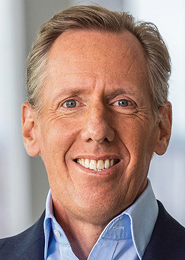
James Brocklebank
Building Real
Local Roots
Editors’ Note
James Brocklebank joined Advent in 1997 and is a Managing Partner, serving as Co-Head of Europe. He advises on investments in the business and financial services sector. Brocklebank has advised on 22 investments while at Advent. Prior to joining Advent, Brocklebank worked on international mergers and acquisitions in the London office of investment bank Baring Brothers and its affiliate, Dillon, Read & Co., in New York. Brocklebank holds an MA degree in geography from Cambridge University.
Firm Brief
Advent (adventinternational.com) is a leading global private equity investor committed to working in partnership with management teams, entrepreneurs, and founders to help transform businesses. With 17 offices across five continents, Advent oversees more than $109 billion in assets under management and has made 448 investments across 44 countries. Since its founding in 1984, it has developed specialist market expertise across five core sectors: business and financial services, consumer, healthcare, industrial, and technology. This approach is bolstered by deep sub-sector knowledge, which informs every aspect of the firm’s investment strategy, from sourcing opportunities to working in partnership with management to execute value creation plans. Advent brings hands-on operational expertise to enhance and accelerate businesses. As one of the largest privately-owned partnerships, Advent’s 655 colleagues leverage the full ecosystem of Advent’s global resources, including its Portfolio Support Group, insights provided by industry expert Operating Partners and Operations Advisors, as well as bespoke tools to support and guide portfolio companies as they seek to achieve their strategic goals.
Will you discuss your career journey?
After studying at Cambridge University, I joined Barings, and spent part of my induction in their venture capital division. It was this that piqued my interest in private equity as a career. Fortuitously, after the collapse of Barings in the mid-1990s, I saw an advert in the Financial Times for an international private equity firm I’d never heard of – Advent. I applied and got the job – a leap of faith that ended up shaping the next three decades of my career.
When I joined Advent in 1997, private equity in Europe was still incredibly nascent – the deal sizes we were doing back then were roughly what we’d pay in fees on a transaction today. I’ve now spent close to 30 of Advent’s 40-plus years here, and the industry and the firm have grown dramatically over that time – I’ve had the privilege of being part of that.
I started out in the UK as part of the Deal Origination Group (at the time known as “the DOG team”). I loved the feet-on-the-street, get-out-there approach from day one: cold-calling senior leaders taught me early on just how much of this business comes down to creative sourcing and relationship-building. That culture of learning from each other, as much from our mistakes as our successes, has always fed directly back into our investment thinking and, importantly, our culture.
The instinct for backing and developing new areas has since taken me further afield: today that means supporting our European teams on deals and traveling regularly to see our investors, especially in the Middle East and Asia.
If there’s a thread running through all of it, it’s relationships – getting in front of founders and management teams, our investors, building trust over decades, and increasingly, helping develop the next generation of dealmakers coming up behind me.
“Advent is a place for people who love investing and creating value in equal measure – sourcing the right opportunity, and partnering closely with management teams to make it better once we own it.”
How do you define Advent’s mission, and what has allowed the firm to remain distinctive as it has grown?
Our distinctiveness traces back to how the firm began. Peter Brooke, Advent’s founder, described starting the firm in 1984 as a “noble experiment” – a genuinely new idea in private equity at the time. His goal wasn’t simply to invest in businesses, but to establish local venture capital and private equity firms in different regions around the world, so that private capital could act as a tool for economic development. That founding thesis – building real local roots rather than parachuting in – still underpins how Advent operates today. Since inception the firm has completed 448 private equity transactions across 44 countries.
While many traditional PE firms are branching out into new strategies and product offerings, we firmly believe that our core focus should remain in private equity and pursuing alpha for our investors. We want to double down on what we’re good at: sourcing and executing investments, and helping management teams transform and accelerate their businesses. Advent is a place for people who love investing and creating value in equal measure – sourcing the right opportunity, and partnering closely with management teams to make it better once we own it.
Being privately owned, and independent, and having a truly collaborative and humble culture is a big part of why we attract and retain top talent. People who want to build something as part of a team, not be a standalone superstar, thrive here – and as most Advent people stay long-term (like me), their expertise compounds, helping us do more interesting deals and attract more talent in turn.
What have been the keys to the strength and leadership of Advent?
Peter Brooke, our founder, handed down his shares to the partners as he believed everyone who helped build the firm should share in what it became, and that system remains in place today. Advent is a private partnership – owned and led by its 14 Managing Partners globally – which keeps us aligned with our LPs and intensely focused on investing well. As owners of and investors in our own business, we have to stay entrepreneurial and keep continuously improving – that mindset runs through everything we do, from how we make decisions to how we operate.
Fostering entrepreneurship internally is encouraged: if you have a good idea and a credible plan, you’ll find sponsorship. Our recent up to $1 billion commitment to next-generation defense technology, including Shield AI and Saronic, started exactly that way – with a team that spotted an opportunity and built the case, informed by the work they were doing with our portfolio companies Cobham and Ultra.
Combining local presence with true depth in five select sectors and over 30 sub-sectors, as well as being operationally focused, is at the heart of Advent’s secret sauce. Our sector and sub-sector focus drives proactive sourcing and our domain depth converts into conviction and speed. In competitive processes, having already underwritten adjacent assets in the same sub-sector shortens the diligence learning curve and supports firmer pricing. Sector specialists work directly with local teams so an opportunity is underwritten by our combined expertise.
We seek out complexity as an opportunity, not an obstacle. These are the deals where we can really add operational and transformational value. We’ve completed more than 30 public-to-private transactions and over 75 corporate carve-outs, refining our operational playbook rather than reinventing it deal by deal. Many of our best deals are also proprietary, built on relationships with founders, families, and corporates who want to choose their partner rather than just maximize price – a different skill set than winning at auction, and one we’ve spent decades building.
2026 has been one of our strongest-ever years for realizations. That’s a credit to our teams’ ability to build great businesses through extensive operational support while also creatively evaluating exit opportunities – whether that be an IPO or sale to a strategic or sponsor. This year we’ve signed and closed deals across 28 businesses including the sale of Prisma and Newpay to VISA, TK Elevator to KONE, Ultra Cyber Ltd to Airbus, and OLAPLEX to Henkel. We also took INNIO public on the Nasdaq stock exchange, representing the largest all-secondary US industrials IPO of all time.
“Combining local presence with true depth in
five select sectors and over 30 sub-sectors, as well as being operationally focused, is at the heart of
Advent’s secret sauce.”
Will you highlight Advent’s global footprint?
Our global teams collaborate to share their industry and regional perspectives in sourcing and executing deals. These qualities have allowed us to differentiate ourselves in the market, and today we have more than 305 investment professionals globally, across 17 offices in 14 countries, with assets under management of $109 billion (assets under management as of March 31, 2026 and include assets attributable to Advent advisory clients as well as employee and third-party co-investment vehicles).
More recently, we’ve expanded meaningfully in Asia Pacific. We’re really excited about this, because the region is expected to account for roughly half of global GDP growth in the years ahead. We believe replicating our playbook: pairing our deep local knowledge with global sector expertise, will lead us to differentiated deals in the region.
Our current focus areas in Asia Pacific include India, Greater China – where we’ve had longstanding presences – and new offices in Australia and Japan. In June, we signed a definitive agreement for our first investment in Japan, the acquisition of Japan Wellbeing Corp, and have executed two deals in Australia.
How is AI impacting the way Advent operates?
At Advent, we prioritized Data Science and AI long before it became mainstream. That early focus has produced a growing suite of powerful proprietary tools. Among them is AdventGPT, our AI orchestration platform, blending leading commercial models with Advent’s own data, workflows, and knowledge to deliver firm-specific intelligence and automation. Another is Edge – our “IC Robot” – trained on 13 years of investment committee papers, investor questions, deal outcomes, portfolio performance, value creation plans, and deal precedents. It is designed to help us flag risks, surface relevant precedents, spot patterns, and sharpen our decision-making.
When a new opportunity comes up, the IC Robot reviews the underlying assumptions and can flag where, based on Advent’s prior experience, we should take a closer look. A margin assumption that hasn’t previously been achieved in a comparable business is a good example of the kind of thing it flags. It’s a great alternative opinion that helps us test our judgment and sharpen our discussions. I’ll be clear: AI does not replace the decision-making process or judgment; it seeks to make our collective judgment reusable and scalable and speed up decision-making.
Across Advent’s portfolio, our dedicated Portfolio Support Group helps our companies organize their data, address any cultural changes required, and build AI into how they operate. We think of it as another mechanism by which we institutionalize knowledge and learnings across deals.
What do you feel are the keys to effective leadership?
Humility comes first. It’s what sustains a healthy sense of caution and keeps you from ever assuming you’re the smartest person in the room.
Beyond that, I’d point to qualities that define Advent’s culture more broadly: excellence, integrity, collaboration, and a relentless commitment to continuous improvement. We also see hiring as a leadership skill in its own right: the people who do best here tend to be relentlessly curious, unafraid to push back, and just as comfortable stepping back and letting someone else lead.
Over my career I’ve come to realize that leadership sets culture, and culture drives performance. So, leadership is something that we must actively invest in, particularly as an organization scales. Leaders have a responsibility not only to deliver a culture today that drives business results, but to help develop the team members who will carry the institution forward tomorrow.
What advice do you offer to young people beginning their careers?
Stay open-minded. Finance is a broad field, and I’m careful not to be overly prescriptive to people who come to me for advice about which path to pursue.
More than anything, I’d encourage young people to remain distinctly human. We’re entering a world where AI functions as a kind of superpower available to nearly everyone, which means the real differentiator is shifting away from raw analytical capability and toward relationship-building and judgment. These characteristics, which we used to call “soft skills,” will become the true differentiators.
The more powerful technology becomes, the more valuable our humanity becomes.