- Home
- Media Kit
- MediaJet
- Current Issue
- Past Issues
- Ad Specs-Submission
- Reprints (PDF)
- Photo Specifications (PDF)
- Contact Us
- PRIVACY POLICY
- TERMS OF USE
Loading

ONLINE

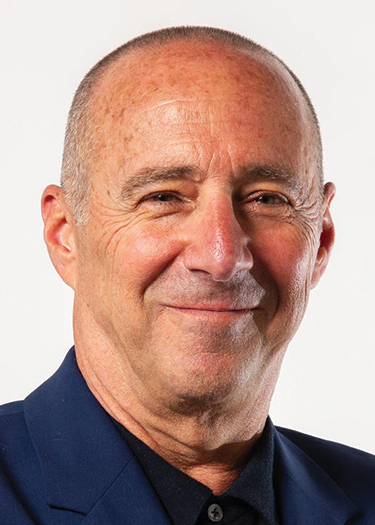
Bob Beitcher
Taking Care
Of Its Own
Editors’ Note
Bob Beitcher has been the President and Chief Executive Officer of MPTF since July 2011 and has served on the organization’s Board of Directors since 2007. Previously, he was president and chief executive officer of Panavision and vice-chairman of the MacAndrews and Forbes Media Group. He joined Consolidated Film Industries in 1997 as president and chief executive and served in that position until 2000 when the company was acquired by Technicolor. At Technicolor, he created and became CEO of the Creative Services Group, Technicolor’s first entry into digital production and post-production services, and built the first digital intermediate facility in Hollywood. Earlier in his career, Beitcher worked closely with George Lucas, Jim Henson, and Francis Coppola and their respective production companies, and was the Executive Vice President of the Motion Picture Group at Paramount Pictures. He is also on the board of directors of Exokinetics, and serves on the advisory board of Providence’s Institute for Human Caring, and on the advisory boards of ProdPro and the Jewish Graduate Initiative. He is a lifetime Associate Member of the ASC and a member of the Academy of Motion Pictures Arts and Sciences since 1999.
Organization Brief
MPTF (Motion Picture & Television Fund) supports working and retired members of the entertainment community with a safety net of health and social services, including temporary financial assistance, case management, and residential living. With a focus on living and aging well, with dignity and purpose, MPTF (mptf.com) is there to guide the industry workforce through the enormous obstacles life presents. For more than 100 years, the extraordinary generosity of the entertainment community has enabled MPTF to deliver charitable services to industry members in need.
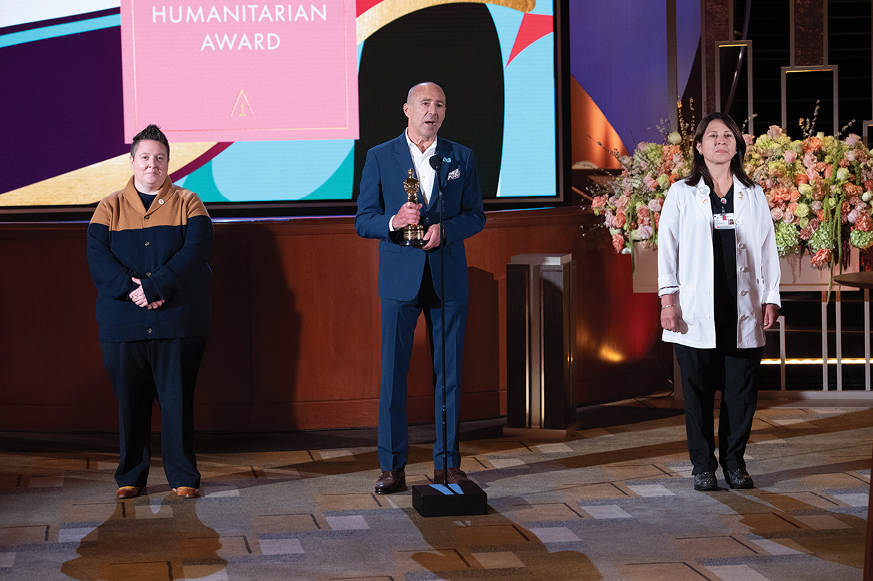
Bob Beitcher (center), Jennifer Jorge, LCSW (Director of Community
Social Services) (left), and Norma Carranza (Clinical Supervisor,
Long-Term Care) (right) accept the Jean Hersholt Humanitarian
Award at the Academy Awards on April 25, 2021
Will you discuss your career journey?
I’m an accidental tourist in the entertainment industry. My first job out of Columbia Business School came about not by aspiration, but rather from a random call the CFO of Columbia Pictures made to the school’s placement office because another b-school grad had left the company unexpectedly. If not for that call, a few interviews, and a job offer, I might have been launching a career in commercial banking. As evidence of how smart I was to make that last-minute pivot, on the day I started at Columbia Pictures in January 1982, it was sold to Coca-Cola. From there on in, I would describe my career journey as marked by good luck, hard work, a sense that failure was never an option, and a willingness to put my hand up to take on any assignment that was offered that would help me learn more and become more valuable. From the now Coca Cola-owned Columbia Pictures, I jumped to a newly created position at a relatively young company in northern California called Lucasfilm – yes, the holding company for George Lucas of Star Wars and Indiana Jones fame. The opportunity there started with a dear friend and former college housemate who was working at the company. Four years later, I got the assignment to find $8 million of needed financing to produce LABYRINTH, a film that Jim Henson was directing and George Lucas was producing. I spent time on the set in the UK with Jim and potential funders and in the end was offered a job to run Jim’s company in New York. I was all of 32 years old, had never managed a team of more than a few, but why not? It goes on from there and I don’t want to walk you through each step after that, so I will jump to running and owning part of a film lab (CFI) in the late 1990s and selling it to a competitor (Technicolor) right as the wave of digital was beginning to crest. Three years later, after starting up a very successful digital business for Technicolor, I moved to the CEO role at Panavision just as digital cinematography was entering the picture (so to speak). We had great success launching the first film quality digital camera, the Genesis, but carried too much debt from the original acquisition of the company by the current owner, and struggled every quarter to satisfy bank covenants. In the end, I loved the company and the people who I worked with but not the constant challenges of the debt and demands to reduce overhead beyond the point of good business.
By this time I had realized a few things about myself: I liked the excitement of building or re-building companies more than being a caretaker of what already was; I liked being at the top of the leadership pyramid, providing vision, inspiration, and a sense of urgency, and a knowledge that I could drive needed change; I liked walking into challenges, whether they were rebuilding a brand or pivoting to adapt to changing technology or, in the case of MPTF, of both and more. I was on the board of MPTF when I parted ways with Panavision for two years of “golden handshake” leisure, when I was asked by the other directors to step in on an interim basis to replace a CEO we had recently terminated. Two days a week became three days became full-time and interim became permanent and in the process I have discovered a final chapter in my professional life that is the most gratifying and soul-satisfying chapter of all – helping those in the entertainment industry whose shoulders we stand on today live purpose-driven, healthy, and safe lives.
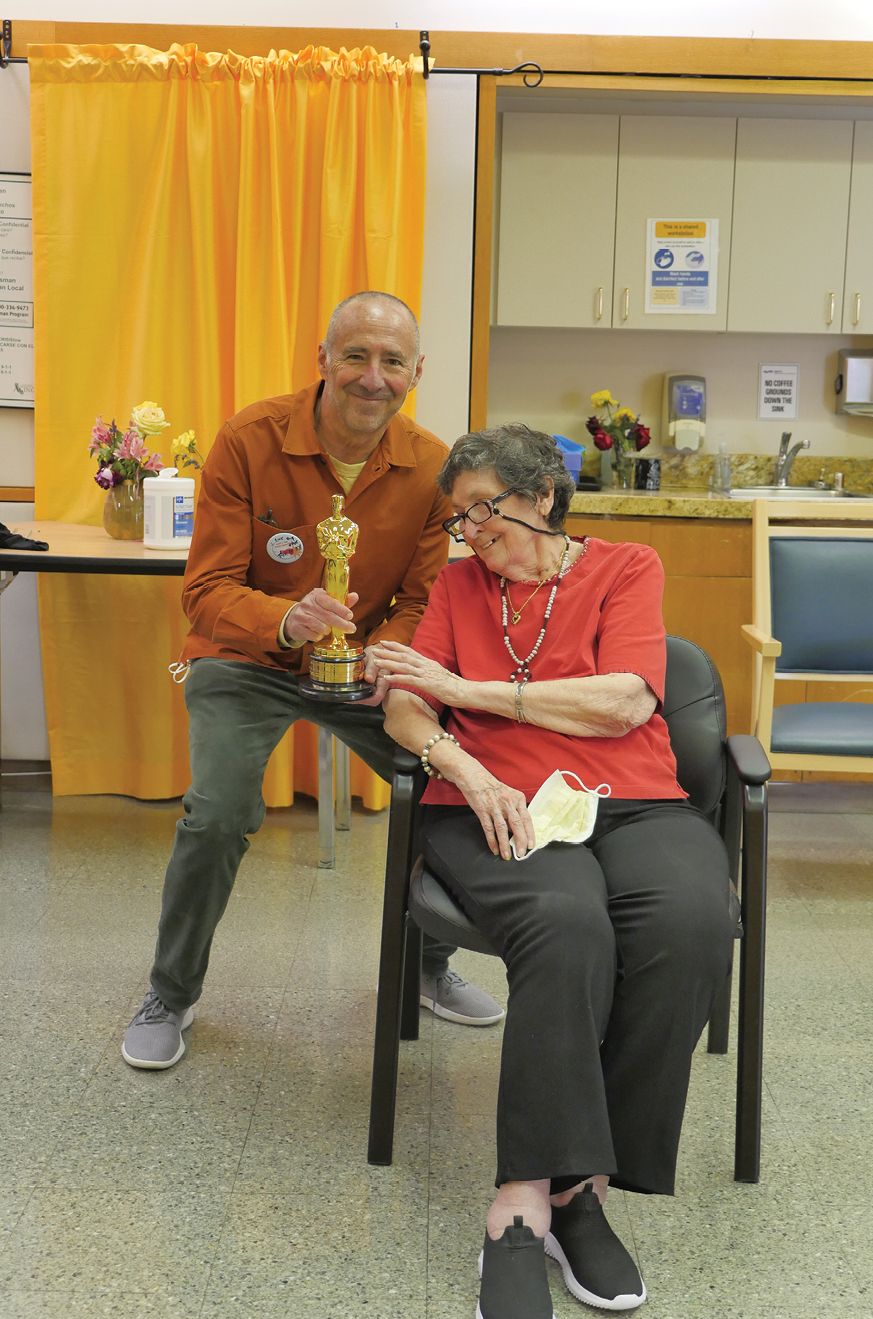
Bob Beitcher with actress and MPTF resident Anne Faulkner
How do you define the Motion Picture & Television Fund’s mission?
The mission of MPTF (Motion Picture and Television Fund) is simply stated: “we take care of our own.” This is the underpinning of the organization since its founding by Mary Pickford in 1921. It deserves some unpacking, though, to truly understand what we are all about. The “we” in the mission is both MPTF the organization as well as the entertainment industry itself as it is the primary source of the philanthropy that has sustained us for over 105 years. We like to think of this almost as a virtuous circle where philanthropy comes into MPTF, we deploy it according to our understanding of the needs of the community and with a high-quality team, and in turn our good works engender additional giving. This was the true genius of Mary Pickford: she understood that the structure of the film industry workforce was and would remain primarily freelance and that the very real vagaries of subsisting on freelance work could result in fallow periods of low or no income and consequently needs for financial and emotional support. Much of the workforce in the early years of Hollywood had just returned from serving our country in World War I and found themselves without stable employment. The charity of MPTF got them and their families through the rough patches and enabled the industry to grow and thrive. We have been there since then for the industry workforce through many other upheavals – silent films to talkies, WW2, the advent of television, black-and-white to color film and transmission, cable, home video, analog to digital. The industry knows it can count on us.
Will you provide an overview of MPTF’s programs and services?
MPTF’s programs and services are delightfully many and cover a wide expanse of what we would call the social determinants of health. Stepping back, until 2014 we were heavily invested in providing direct healthcare services – primary care for 60,000 industry members, outpatient surgery, radiology, lab, physical therapy. At that time, we took a significant decision to divest from this very time-consuming and capital-intensive enterprise and sold the business to UCLA Health. We felt that scale mattered when it came to healthcare and that a much larger organization with more resources would do a better job for the entertainment workforce in the long run than we could. Instead, we stepped up our focus on the social determinants of health – financial, emotional, social, spiritual. Today we have 20 social workers providing case management to several thousand industry members and their families every year; we have a palliative care program, one of the largest community-based programs in the country and for many years a national model for its interdisciplinary approach; we have a veterans benefits assistance program helping industry members and their families who were military veterans claim the VA benefits that are due them; we have a social calling program (The Daily Call Sheet) reaching out to our industry family who have been identified by others as being vulnerable to loneliness and social isolation; we have a corps of over 450 individuals providing 45,000 hours of volunteer time every year; we have a health insurance program that is helping our industry members navigate a very complex world of insurance and placing them in appropriate plans; we have intergenerational programs connecting older, frequently retired, industry members with high school students from underserved communities. And on and on. “We see a need and we fill it,” is something we often say, and if we have or can find the funding to bridge a gap in the lives of our community members, we’re all in.

MPTF residents show support during a household goods and
food giveaway for industry workers at MPTF in 2023
How do you measure success for MPTF’s work?
We are a very data-centric organization with performance metrics across most of our programs and services. Some of these success metrics are financial oriented – occupancy in our residential and long-term care community, labor costs, staff turnover – and some are more oriented toward “softer” measures like food quality (and yes, the same meal can concurrently be too hot, not hot enough, too salty, and not salty enough). In other cases, success is measured by the level of interest we attract in programs: how many industry members show up for webinars on retirement planning or caregiving, for example. From time to time, and we haven’t done this in a while because of the various other challenges we’ve been dealing with (pandemic, strikes, wildfires, industry contraction), we survey the industry across a bunch of variables, including how well they know us and the services and programs we provide. That is sort of the ultimate measure: we are here to serve and need everyone in the industry to know the various ways we can help them and how they can find us.
How critical has it been to build the MPTF team?
When I joined MPTF as an executive 16 years ago – I had been on the board for three years prior to that – it was an organization desperately reckoning with the gravity of old ways of thinking and acting. Morale was very low, we were mired in the mess caused by some bad decisions by senior leadership and, quite frankly, the board itself, and we had a cohort of management and staff that had lost faith in our ability not only to take care of our own, but also to recognize what that really meant. For financial reasons, we had to look at every service, every program, every manager, and every staff member and measure them against what we could afford, what was aligned with our goals, and, ultimately, what MPTF could and should be doing. Over a few months, we restructured, said good-bye to managers and staff, and put ourselves on a stronger footing. Since then, I’ve had the opportunity to build a truly wonderful team that works together toward shared goals. Like any organization, we’ve had a few fits and starts and a few misses, but all in all I’m very happy with the quality of the team. We demonstrated our resilience and commitment during the pandemic, both on and off our campus, and we continued to do that during the work stoppages in 2023, and then in the aftermath of the wildfires in 2025.
How do you focus your efforts leading MPTF?
Like any CEO, my focus is split across many priorities, and part of doing the job well is sensing where I’m needed most at any time and jumping in to support the wonderful team at MPTF. I am obsessively well-organized in reviewing and resetting my own priorities on a daily basis: I have a weekly to-do list, a daily to-do list, and a shorter daily to-do list with only urgent matters. I compose the weekly list on Sunday mornings and sort of plot out my week and what will be required of me, where I need to be, and evaluate whether all of that makes sense. Before I leave the office for the day, I prepare tomorrow’s to-do list so I have a running start when I arrive the following day. And finally, when I arrive in the office, I make a short list of “must-do” items for the day culled from the daily to-do list. In all, all of this takes less time than it sounds and I feel like it grounds me and gives me purpose every day.
In a larger sense, though, the priority overlay for all of this is always on the mission – taking care of our own – and making sure that I am committing the right amount of time and energy to doing just that. It’s too easy to get caught up in a lot of “stuff” that needs to get done but doesn’t move my work or the organization forward. Wrapped around all of this, because I have limited capacity to do much on my own, is building and sustaining a workforce culture that appreciates what executing on the mission means on a day-to-day basis, and sharing with our philanthropic community what MPTF needs from it to execute its commitments to the industry at the highest level.
What are your priorities for MPTF as you look to the future?
As the entertainment industry continues to evolve, part of our responsibility is to understand where it’s moving, why and how it’s moving, and how fast change is taking place, and to understand its implications for the industry workforce. In hockey terms, we want to skate to where the puck is going, not where it is today. We need to keep pace with systemic change and be nimble and flexible enough to be there to support the workforce with a holistic and compassionate approach to delivering care broadly defined.
Another priority is to develop the MPTF workforce, to make certain that everyone has all of the resources and training they need to do their best work, and to provide opportunities for personal growth. The demographics of our workforce tend to skew older because MPTF is a great organization to work for and our staff tends to stick with us through long careers. They provide great role models for the younger workers, but they can also be impediments to career progression so we need to be clever about that dynamic. It’s not unusual for organizations our size – we have staff of about 500 – to struggle as well with succession planning and that has become a focus.
And finally, and always a priority for a non-profit, we need to ensure that successive generations of industry leaders understand and appreciate the importance of the work we do and want to provide financial support. At different points in the past 105 years that support has waned and the organization has suffered as a result. I want to leave MPTF with a strong financial hand and an ability to face future challenges from a position of strength.