- Home
- Media Kit
- MediaJet
- Current Issue
- Past Issues
- Ad Specs-Submission
- Reprints (PDF)
- Photo Specifications (PDF)
- Contact Us
- PRIVACY POLICY
- TERMS OF USE
Loading

ONLINE

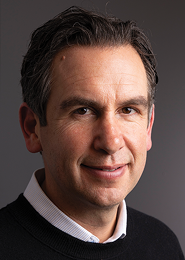
Steven M. Fulop
A Clear Voice For
New York City
Editors’ Note
Steven Fulop is the President and Chief Executive Officer of the Partnership for New York City and a former three-term mayor whose leadership combined civic reform, economic growth, and public service. A Marine veteran, public servant, and civic innovator, Fulop spent three terms leading one of the most significant urban revitalization stories in the country. Elected in 2013 in a landmark upset, he guided Jersey City for more than a decade with record private investment, population growth, and job creation – transforming it into an economic powerhouse. A first-generation American and descendant of Holocaust survivors, Fulop’s life has been shaped by service. After the September 11 attacks, he left his job at Goldman Sachs in Lower Manhattan to enlist in the U.S. Marine Corps, deploying to Iraq in 2003. Fulop is a graduate of Binghamton University and holds an MPA from Columbia University and an MBA from New York University. He serves on the board of the Jewish Community Relations Council of New York and is a member of the Council on Foreign Relations.Organization Brief
Focused on advancing the city’s standing as a global center of economic opportunity, upward mobility, and innovation, the Partnership for New York City (pfnyc.org) is a nonprofit organization of more than 300 preeminent corporate, investment, and entrepreneurial firms. It works in partnership with government, labor, and the civic sector to advance the interests of the city. Its priorities include maintaining New York’s competitive position, strengthening its talent pool and public education system, and fostering public-private partnerships to address the challenges facing the city. The Partnership Fund is its investment arm, supporting entrepreneurs and innovators whose work strengthens the city’s economy, creates jobs, enables infrastructure, and expands opportunity.
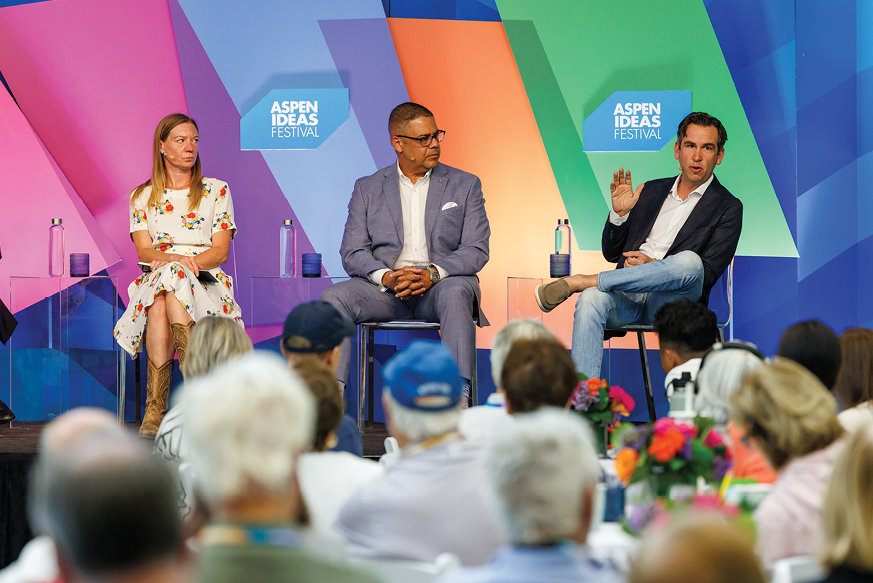
Steven Fulop speaks on the “America at 250: Economic Leadership”
panel at the 2026 Aspen Ideas Festival
Your career has spanned military service, finance, and more than a decade in public office. Which experiences have most shaped your approach to leadership and prepared you for this next chapter?
My career has taken me through very different environments, and each one shaped a different part of how I lead. I started in finance at Goldman Sachs, where I saw how quickly capital and talent move and how much confidence, predictability, and execution influence decisions.
September 11 then changed the direction of my life. It gave me a much stronger sense of service and ultimately led me to enlist in the Marine Corps Reserve and serve in Iraq. The military taught me discipline, accountability, and the responsibility you have to the people around you.
Local government brought those lessons together. As mayor, there is very little distance between a decision and its consequences. People expect the city to work, and they hold you accountable when it does not. You learn to make decisions with imperfect information, surround yourself with capable people, admit when something is not working, and adjust.
Across all three experiences, I came to value the same basic approach: understand the objective, make the decision, execute well, and own the result. That is the perspective I bring to this next chapter.
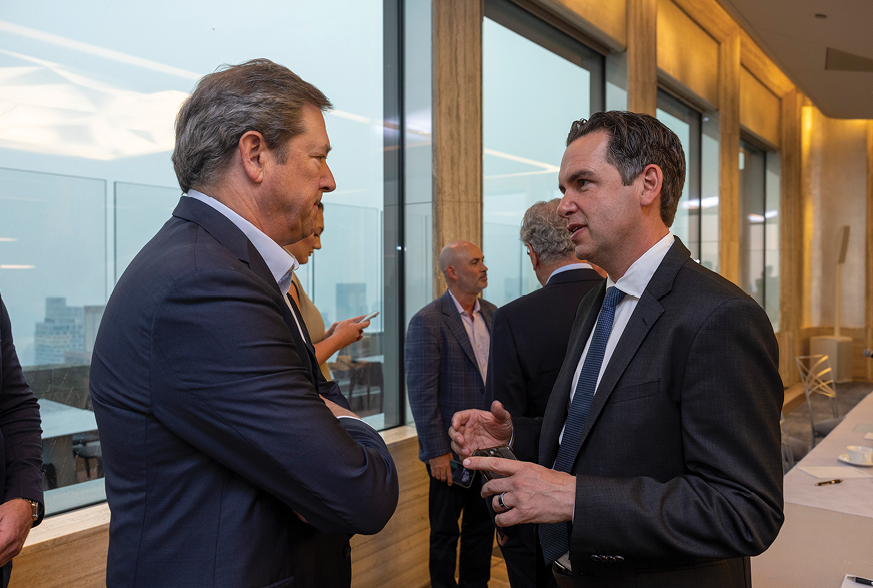
Fulop in conversation at one of the Partnership’s
leadership gatherings in New York
What drew you to the Partnership for New York City, and what role do you believe the organization is uniquely positioned to play in shaping the city’s future?
After 12 years as mayor, I knew I wanted to step away from politics without stepping away from the issues that determine whether cities succeed. The Partnership offered a very different way to stay engaged. It brings together more than 300 of New York’s leading corporate, investment, and entrepreneurial firms, including many of the city’s largest employers. That membership gives the Partnership a unique position at the intersection of business, government, and civic life, with the ability to bring very different people around the same table.
What attracted me was the potential to put that reach to work. Our members have enormous expertise, resources, and a direct stake in New York’s future. I want the Partnership to help channel those assets toward practical solutions while giving the business community a clear voice in the decisions shaping the city.
I also come to the role with the perspective of having spent 12 years running a city just across the Hudson. New York and New Jersey are part of the same regional economy, and sometimes an outside perspective can be useful. I hope to bring some of that pragmatism with me.
The Partnership’s 300-plus member companies position it at
the intersection of business, government,
and civic life,
tackling
issues including housing, infrastructure, and competitiveness
How do you define the Partnership’s mission, and how must that mission evolve as New York responds to changing economic, political, and social conditions?
The Partnership’s mission is to help keep New York a place where people can build businesses, create jobs, raise families, and pursue opportunity. Economic competitiveness is central to that mission, and today it reaches into almost every part of life in the city. The cost of living, the ability to move around reliably, public safety, and access to opportunity all influence whether people and businesses choose to stay and invest here.
We have an important role as a credible voice for the business community when policy affects investment and job creation. Our influence also comes from the quality of our ideas. Serious research, practical recommendations, and constructive engagement give the Partnership the ability to shape a conversation rather than simply react to it.
I want more New Yorkers to see themselves in that work. Our member companies employ hundreds of thousands of people whose daily experiences are directly affected by the strength of the city’s economy. The connection between competitiveness and their lives should be clear in everything we do.
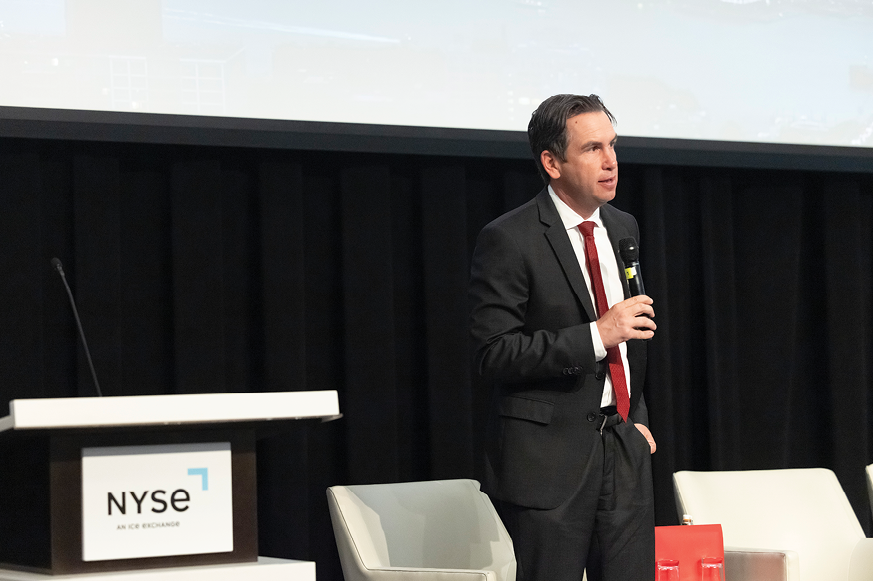
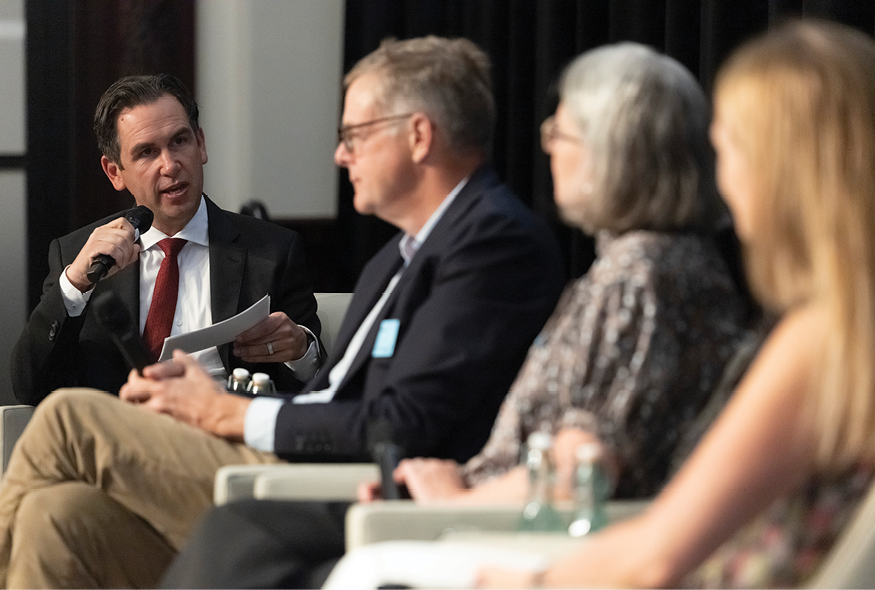
Fulop moderates the “America at 250” panel at the
New York Stock Exchange with leaders from the
business community
New York’s success has long depended on collaboration among business, government, labor, and civic institutions. What does an effective public-private partnership look like in practice, and where is greater alignment needed today?
The phrase “public-private partnership” gets used so broadly that it can lose its meaning. The effective ones start with a clearly defined problem, an honest assessment of what each party can contribute, and clarity about who is responsible for delivering the result. Government sets policy and protects the public interest. Business brings capital, operating experience, technology, and the ability to execute at scale. Labor, community organizations, and civic institutions contribute expertise and a close understanding of how decisions affect workers and neighborhoods. Bringing those perspectives in early usually leads to stronger decisions and fewer problems later. That approach is particularly important on challenges that cross traditional lines of responsibility, from housing to mental health. Government may lead, but implementation often depends on institutions working together.
Healthy collaboration also leaves room for disagreement. The Partnership will sometimes support City Hall, Albany, or the City Council, and sometimes we will take a different position. Strong relationships should be able to withstand both.
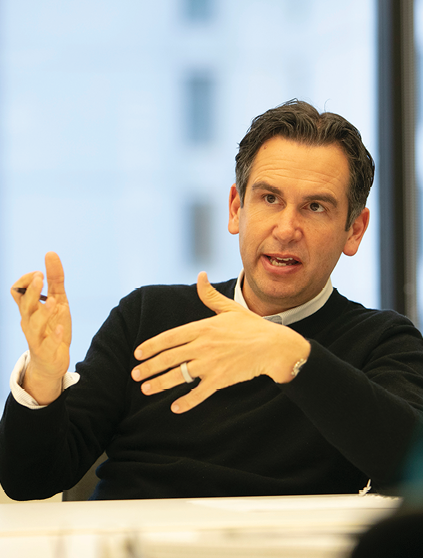
Fulop spent 12 years as mayor of Jersey City,
just across the Hudson from New York
What do you see as the most significant challenges affecting New York’s competitiveness, and which issues require the most urgent attention from the city’s business community?
The greatest risk is the cumulative pressure of doing business and building a life in New York. Housing is scarce and expensive. Infrastructure needs investment. The regulatory environment can be difficult to navigate, and concerns around public safety and the direction of public policy affect confidence. Any one of those challenges may be manageable. Together, they influence where companies put their next dollar and where people choose to build their future.
New York starts from an extraordinary position. Few places can match its concentration of talent, capital, universities, industries, culture, and ambition. The danger is assuming those advantages are permanent while other cities compete aggressively for the same people and investment.
The business community can be most useful by being specific about where New York is losing ground and where changes would make a meaningful difference. Housing supply, infrastructure, the cost and predictability of doing business, and the ability to attract and retain talent deserve particular attention.
How can New York continue to generate economic growth and attract investment while also addressing affordability, infrastructure, public safety, and quality of life?
Growth and affordability are closely connected. A growing economy creates jobs, generates tax revenue, and gives the city the capacity to invest in the services and infrastructure people depend on. The real challenge is making sure growth improves the city around it.
We learned a lot about that in Jersey City. We wanted investment, while also pushing development beyond the waterfront and connecting it to housing, parks, cultural institutions, infrastructure, and neighborhood improvement. The objective was to use growth to strengthen the city as a whole.
New York has an enormous opportunity to do the same at a much larger scale. Clear, predictable rules encourage investment. More housing expands where people can live. Better infrastructure opens new areas to jobs and development. When those decisions reinforce one another, economic growth becomes part of the affordability strategy rather than a separate conversation.
What responsibility do business leaders have to engage in the city’s broader civic life, particularly at a time when confidence in institutions is under pressure?
Business leaders are citizens of the city as well as leaders of their companies. Their organizations depend on New York’s people, institutions, infrastructure, neighborhoods, and culture. With that comes a responsibility to participate in the broader civic life of the city.
Part of that responsibility is listening. The people working inside our member companies experience New York very differently depending on where they live, what they earn, and what pressures they face. Business leaders need to understand those experiences if they want to contribute credibly to public debates.
Trust is also earned through participation and results. Companies that invest in communities, open pathways to opportunity, lend their expertise to difficult problems, and stay engaged when there is no immediate commercial benefit demonstrate that they have a stake in something larger than their own balance sheet.
How will the Partnership balance the immediate concerns of its members with the longer-term investments required to strengthen New York’s economy and expand opportunity across all five boroughs?
The distinction between immediate business concerns and long-term civic challenges is often smaller than it appears. A housing shortage becomes a recruiting problem. An unreliable commute affects productivity. A weak pipeline into good jobs eventually becomes a talent problem. The pressures facing New Yorkers show up inside companies as well.
The harder task is deciding where the Partnership can have the greatest impact. We should be selective, set clear objectives, and concentrate our members’ time and resources where they can change an outcome.
There will also be moments when leadership requires looking beyond the next quarter or the next legislative session. The Partnership can help its members make investments whose value may take years to become fully visible. New York’s long-term strength is itself a business interest.
What are your priorities for the Partnership in the coming years, and how will you measure whether the organization is having a meaningful impact?
My first priority is focus. The Partnership should identify a limited number of areas where its membership and influence can materially change the trajectory of an issue, set clear goals, and organize around them.
Protecting New York’s employment base and its ability to attract investment will remain fundamental. Housing and infrastructure require sustained attention. We also need to prepare for changes that are coming quickly, particularly the impact of artificial intelligence on New York’s industries and workforce.
I want us to measure ourselves by what changes, not by how busy we are. A policy improved, an investment unlocked, a project moved forward, or an opportunity created tells us far more than the number of meetings we held or statements we issued. The Partnership has extraordinary access. The test is what we accomplish with it.
Looking ahead, what gives you the greatest confidence in New York City, and what will be required to ensure that it remains a global center of commerce, innovation, and opportunity?
What gives me confidence is that people still want to be here. New York continues to attract ambitious people because of a combination of talent, culture, capital, creativity, and opportunity that is very difficult to reproduce anywhere else. The city has also shown an extraordinary ability to absorb shocks and reinvent itself.
The challenge is to make it possible for people to turn that opportunity into a life here. New York has to work well enough for a young person to imagine a future here, for an entrepreneur to build here, and for an established company to make its next investment here.
None of that happens automatically. New York has earned its global position repeatedly over generations, and each generation has had to earn it again. If we pair the city’s appetite for reinvention with serious execution and a willingness to make difficult choices, I am very optimistic about what comes next.