- Home
- Media Kit
- MediaJet
- Current Issue
- Past Issues
- Ad Specs-Submission
- Reprints (PDF)
- Photo Specifications (PDF)
- Contact Us
- PRIVACY POLICY
- TERMS OF USE
Loading

ONLINE

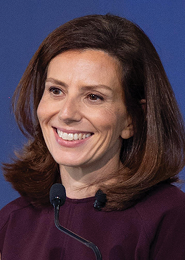
Dr. Keren Yarhi-Milo
Solving Real-World Problems
Editors’ Note
Dr. Keren Yarhi-Milo is the dean of Columbia University’s School of International and Public Affairs (SIPA) and the Adlai E. Stevenson Professor of International Relations. She is a world-renowned and award-winning expert in international security and crisis decision-making and the youngest dean in SIPA’s history. Yarhi-Milo joined the tenured faculty at Columbia University in 2019 after a decade at Princeton University. Before becoming dean in July 2022, Yarhi-Milo served for two years as director of SIPA’s Arnold A. Saltzman Institute of War and Peace Studies. As a scholar and professor, Yarhi-Milo bridges the worlds of academia and policy, focusing predominantly on how leaders make foreign-policy decisions regarding the use of force. She is the author of two award-winning books: Who Fights for Reputation? The Psychology of Leaders in International Conflict, and Knowing The Adversary: Leaders, Intelligence Organizations, and Assessments of Intentions in International Relations and has published extensively in the top academic journals in the field of political science. In 2023, Yarhi-Milo founded and launched the Institute of Global Politics (IGP), a new, world-class institute at Columbia SIPA with a faculty advisory board chaired by former Secretary of State Hillary Rodham Clinton. Yarhi-Milo is a series editor of Princeton Studies in International History and Politics from Princeton University Press. She is a member of the Council on Foreign Relations. Yarhi-Milo earned her PhD at the University of Pennsylvania and a BA, summa cum laude, from Columbia University.
Institution Brief
Columbia SIPA (School of International and Public Affairs) is Columbia University’s graduate school for public policy, international affairs, and public administration. Located in New York City, SIPA prepares leaders for careers in government, international organizations, nonprofits, media, consulting, finance, and the private sector through interdisciplinary training in policy analysis, economics, management, and global affairs. Founded in 1946, SIPA is recognized for its strong focus on international relations, public policy, sustainable development, security studies, economic policy, and global governance. The school brings together academics, policymakers, diplomats, business leaders, and practitioners to address complex global challenges.
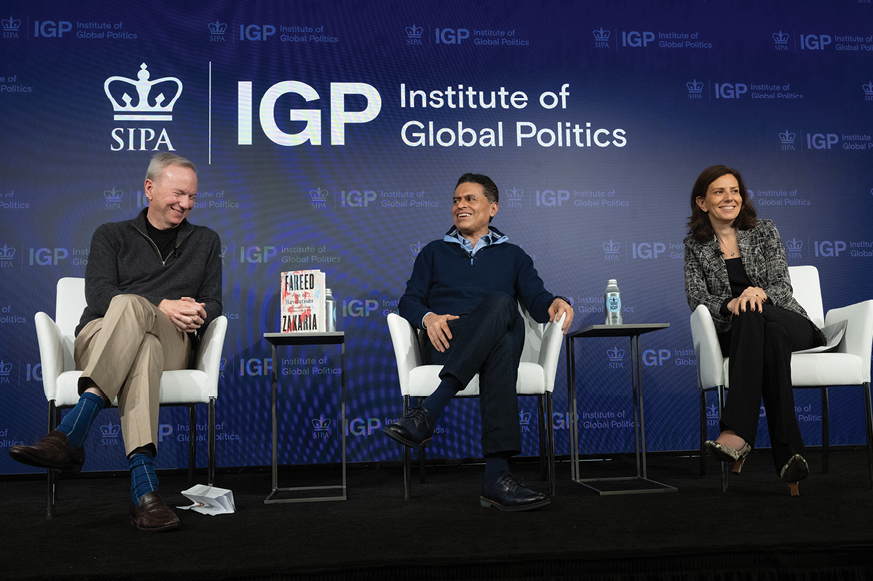
Former Google CEO Eric Schmidt and CNN anchor and
author, Fareed Zakaria, offer advice at an April 19, 2024 SIPA event
with Keren Yarhi-Milo
Will you discuss your career journey?
Looking back, I realize there’s much more continuity in my career than I appreciated. I grew up in Israel, and one of my heroes was Madeleine Albright. She was the first woman Secretary of State and the first woman U.S. ambassador to the UN. I loved global affairs, international relations, and diplomacy from an early age, and watching her help shape history during the Oslo process on the White House lawn, I became fascinated not just by diplomacy, but by the people making the decisions. I knew I wanted to be her one day. I looked her up, saw that she had gone to Columbia, and that became my dream. I enrolled as a first-generation undergraduate, and the rest is history.
From my very first political science class at Columbia, my scholarship has focused on the psychology of leadership and judgment under uncertainty; specifically asking why exceptionally intelligent, experienced leaders sometimes make profound mistakes, and why we see the same patterns of failure recurring across governments, intelligence agencies, and institutions.
I spent ten years at Princeton and earned tenure there, but I always considered Columbia my home. I came back as a scholar and soon after was appointed Dean of SIPA. My research on decision-making and judgment under uncertainty now shapes how I lead. Every day I draw on what I have studied about judgment, adaptability, and decision-making as universities navigate an era defined by geopolitical competition, technological disruption, climate change, polarization, and AI.
Will you provide an overview of SIPA?
SIPA was founded on a powerful idea: that rigorous scholarship and public service are mutually reinforcing. Established in the aftermath of World War II and in response to the failures that preceded it, the school was born out of a recognition that good intentions are never enough; effective public service requires leaders who combine analytical excellence with a deep commitment to improving lives around the world.
At SIPA, we’re redefining the role of policy schools by engaging more directly with the world’s most pressing challenges. We bring a global lens to everything we do – our scholarship, our teaching, and the students we train – all in service of solving global policy challenges. That’s why, for example, we’re not organized around disciplines like most universities, but around problems. The world’s biggest challenges – whether geopolitical, economic, technological, or environmental – don’t fit neatly into one academic discipline. SIPA brings together expertise across economics, political science, law, engineering, history, ethics, and more because solving complex problems requires multiple ways of thinking. Our goal is to equip students to solve real-world problems.
“Universities should not aspire to political neutrality; they should aspire to intellectual fairness. What we can offer is a disciplined method for handling disagreement, built on four principles: excellence, freedom, pluralism, and relevance.”
How do you define SIPA’s mission?
I believe policy schools are entering one of the most consequential moments in their history. Producing excellent scholarship and training future leaders will always remain our core mission, but today that is no longer sufficient. We also have a responsibility to engage directly with the world – bringing together the private sector, policymakers, NGOs, civil society, and academia – not simply to analyze problems, but to help solve them. We have a responsibility to improve people’s lives, not simply publish about them.
AI makes the stakes clear. Engineers are building technology that will transform society, with little opportunity to study its political, ethical, legal, and geopolitical implications. Policymakers are asked to regulate systems whose technical foundations they do not fully understand. The result is innovation disconnected from society and regulation disconnected from technological reality, serving no one well. A strong public policy school closes that gap: it becomes the place where those communities come together and where leaders learn to bridge technology, policy, and society.
What was your vision for founding Columbia’s Institute of Global Politics?
The idea for IGP came out of a conversation I had with Secretary Hillary Clinton when we first met, drawing from frustrations I had accumulated over years in academia. The program rests on three convictions. First, universities produce extraordinary research, but they are often not very good at translating that knowledge for the people making consequential decisions. IGP connects our scholarship to the policymakers, business leaders, and practitioners who can use it. Second, one of the greatest pathologies in decision-making is groupthink. Better decisions require genuine diversity of viewpoint, brought together in conversations that are honest, intellectually rigorous, and civil rather than performative. IGP’s “Across the Aisle” series was built to model exactly that kind of engagement. Third, we think about every issue from the local to the global, not only from a New York or American perspective. That combination has helped make IGP a trusted convening place for leaders across the political spectrum and around the world, including for track-two diplomacy.
What role can universities play in bridging divides?
The question every one of us in higher education should be asking is whether we can preserve the strengths of the research university while preparing leaders for a more politically complex world. Universities do not operate apart from our polarized society; we are participants in it, and we have to take criticism seriously, even when we do not fully agree with it.
Universities should not aspire to political neutrality; they should aspire to intellectual fairness. What we can offer is a disciplined method for handling disagreement, built on four principles: excellence, freedom, pluralism, and relevance. Excellence is the foundation of legitimacy. Freedom is what excellence requires in practice, because scholars must be free to follow evidence wherever it leads. Pluralism means genuinely encouraging disagreement. The goal is not consensus but better ideas. Relevance means stepping outside our comfort zone to make our work useful to the people actually solving these problems. Held together, these principles will allow universities to emerge from the current crisis in higher education more resilient, more trusted, and ultimately more relevant than before.
How do you focus your efforts as Dean of SIPA?
My ambition is not simply to make SIPA the leading public policy school in the world, because it already is. It is to help redefine what a policy school should be in the twenty-first century. That starts with our curriculum: preparing students not just for today’s job market, but for the one they will inherit a decade from now. It also means living out our key principles – academic excellence, pluralism, relevance, and freedom – in everything we do, in the classroom and beyond.
A major part of this work has been building and expanding the Institute of Global Politics – most recently adding the undergraduate degree and broadening its scope to include everything from AI and democracy to geopolitics in the Middle East and Ukraine, emerging technology, the future of foreign assistance, and new approaches to economic statecraft. We are truly global, but deepening our footprint in New York and across the United States is also a strategic priority.
None of this happens without talent. We have been fortunate to recruit exceptional faculty, outstanding students, and remarkable practitioners, even during a period of enormous uncertainty for higher education.
What do you feel are the keys to effective leadership?
Leadership is fundamentally an exercise in judgment. Most important decisions are made with incomplete information, competing priorities, and significant uncertainty. The quality of leadership is therefore determined less by certainty than by the ability to make sound decisions despite ambiguity.
The first is moving constantly between the telescope and the microscope. The telescope lets you articulate a compelling vision and anticipate change. The microscope keeps you grounded in the people, culture, incentives, and execution that determine whether that vision actually happens. Vision without execution is aspiration; execution without vision is just administration.
The second is adaptability. Leaders often become trapped by their own assumptions, particularly after success or failure. One of the hardest things we ask of leaders is to update their beliefs when the evidence changes. We underestimate the power of confirmation bias, and that failure to update explains many of the policy failures I have studied.
The third is self-awareness: knowing precisely what you are good at, what you are not, where your blind spots lie, and building advisory structures that challenge your thinking rather than reinforce it. Self-awareness is what makes better judgment possible.
What advice do you offer to young people beginning their careers?
Find the overlap between what you are genuinely passionate about and where you have a real comparative advantage. The earlier you can see that clearly, the better. But hold it loosely. Your interests, your strengths, and even your definition of success will evolve. It comes back to self-awareness: know what you are drawn to, know what you are actually good at, and stay honest with yourself as both continue to change.
Careers rarely unfold in straight lines. Mine certainly didn’t. Looking back, my career makes much more sense than it did as I was living it. What has mattered is staying intellectually curious, being willing to update my assumptions, and recognizing opportunities when they align with both my values and my strengths.