- Home
- Media Kit
- MediaJet
- Current Issue
- Past Issues
- Ad Specs-Submission
- Reprints (PDF)
- Photo Specifications (PDF)
- Contact Us
- PRIVACY POLICY
- TERMS OF USE
Loading

ONLINE


Dr. Jianyu Zhang
Excellence For You
Editors’ Note
Dr. Jianyu Zhang is the Chairperson of the ICBC US Region Management Committee and the CEO of the US Region. In her multifaceted leadership role, she also serves as the General Manager of the ICBC New York Branch and the Executive Chairperson of the Board of Directors of ICBC (USA) NA. In May 2026, Zhang was elected as the Chair of China General Chamber of Commerce-USA (CGCC-USA). Zhang began her career at the ICBC Head Office in 2000, holding multiple leadership roles within the Personal Banking and Private Banking Departments. Since her assignment to the U.S. in 2016, where she served as President & CEO of ICBC (USA) NA and General Manager of the New York Branch, she has developed extensive expertise in U.S. banking management and regulatory expectations. Zhang holds a doctoral degree in Economics from the Central University of Finance and Economics in Beijing, China.
Company Brief
The Industrial and Commercial Bank of China (ICBC) was established on January 1, 1984, and successfully completed its dual listing on the Shanghai and Hong Kong stock exchanges in 2006. For the 13th consecutive year, The Banker ranked ICBC (icbc-us.com) first among the Top 1000 World Banks. ICBC considers the U.S. market a pivotal component of its international growth strategy. Since opening its New York Branch in 2008, the bank has maintained a formal presence in the United States for nearly two decades. Today, ICBC operates multiple U.S. entities – ICBC New York Branch, ICBC (USA) NA, and ICBC Standard (New York) – with a network spanning from the East to the West Coast. The bank provides a comprehensive suite of financial services, including corporate and retail banking, financial institution services, project and CRE finance, and securities and commodities trading. As of 2025, ICBC’s U.S. region held approximately $40 billion in total assets and facilitated nearly $90 billion of corporate bond issuances.
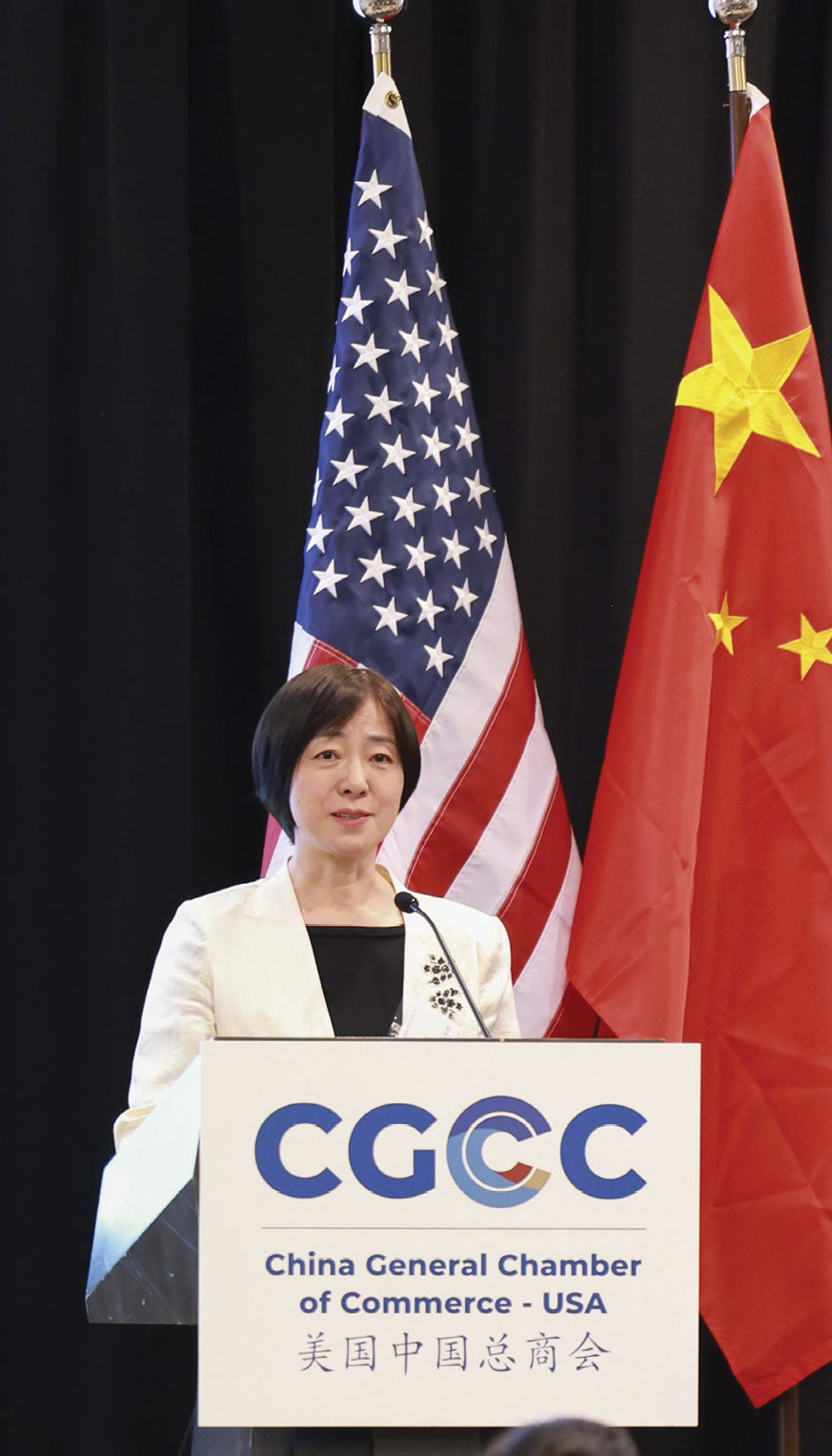
Dr. Jianyu Zhang speaking at
China General Chamber of Commerce – USA event
ICBC has established a powerful global footprint. How do you define its core mission today, and how has this mission shaped the history and evolution of ICBC’s multi-license platform in the U.S. Region?
ICBC’s core mission is rooted in our “Excellence for You” philosophy – responsibly leveraging our global capabilities to create enduring value for our clients, shareholders, and communities. In the U.S., this translates into serving as a cross-border financial institution while building a highly localized, professional institution deeply rooted in U.S. markets and business practices. This mission drove us to establish the only multi-license platform among Chinese financial institutions in the U.S., covering both the East and West Coasts. Over nearly two decades, we have built a coordinated ecosystem combining the wholesale banking strengths of our New York Branch in corporate banking, institutional banking, project and CRE finance, and USD clearing, with ICBC USA’s retail banking, and ICBC Standard’s securities and commodities services. Leveraging this comprehensive network, our platform delivers seamless, end-to-end financial solutions across the country.
ICBC’s strength is globally recognized, yet the U.S. market is uniquely competitive. What have been the keys to ICBC’s deep localized growth and infrastructure financing here?
The U.S. market is uniquely competitive, and our growth here is anchored in a dual-engine strategy: deep localized expertise backed by the global financial strength of ICBC Group. Operating not just as an international bank, we are a committed, long-term stakeholder in the U.S. economy.
The key to our localized growth lies in our deep integration into the market. Today, over 90 percent of our clients are local, U.S.-domiciled entities. Complementing this local execution is our global network which enables us to provide comprehensive cross-border support for U.S. enterprises investing globally. Moving forward, we will continue to deepen strategic partnerships with U.S. institutions and multinational corporations to foster sustainable, shared economic prosperity.
How do you leverage ICBC’s geographic position here to drive its broader global network from New York?
New York sits at the center of global finance, and we leverage this strategic position to serve as a key hub for ICBC’s global network. Our core role in New York is to bring together ICBC’s broad capabilities in meeting a client’s specific needs – whether coordinating multiple institutions, drawing on cross-market sector expertise, or managing complex financial activities across currencies and jurisdictions. Drawing on ICBC’s extensive global reach, we connect U.S. enterprises to Asian and international markets with comprehensive cross-border solutions. Ultimately, we support this role through consistent, structured collaboration with our global head office and affiliates, delivering an integrated financial framework for our clients.
Beyond transactional banking, how does ICBC view its strategic role as a cross-border bridge, particularly in fostering economic dialogue and fulfilling corporate social responsibility within the U.S.?
At ICBC, we believe that a global bank must serve as a trusted partner, a constructive participant, and a responsible corporate citizen. In the U.S., our mission extends to supporting economic activity by facilitating robust two-way trade and financial flows.
Equally important is our role in fostering constructive dialogue. Through active engagement with U.S. regulators, government agencies, business chambers, and policy think tanks, we support open communication and practical financial cooperation, reinforcing a stable and predictable business environment.
Finally, our commitment to corporate social responsibility is integral to our long-term presence in the U.S. In accordance with the Community Reinvestment Act (CRA), we actively invest in the well-being of the communities we call home. From supporting local educational and cultural exchanges to supporting financial literacy, employee volunteerism, and partnerships with local nonprofits, we strive to build inclusive growth. Looking forward, ICBC remains dedicated to acting as a stable, professional, and constructive participant in U.S.–China economic relations.
You recently assumed the role of Chair of CGCC. How will you focus your efforts in this role?
It is an honor to serve as Chair at this important stage in CGCC’s development, not only for our member companies but for the broader relationship between the United States and China. As Chair, my priority is to strengthen the practical value that CGCC provides to its members and its engagement with stakeholders in the U.S.-China business relationship. CGCC has developed an important foundation over the past two decades. Our responsibility is to build on this foundation through practical programs, stronger engagement and continued attention to members’ operating needs.
Our first priority is practical support. Companies operating across the U.S. and Chinese markets face complex questions involving compliance, regulation, market entry and local business practices. CGCC should help members understand those issues, learn from one another, and identify credible external resources. Our second priority is constructive dialogue. We will seek to convene a wider range of business leaders, industry organizations, policy experts, academic institutions, and local stakeholders. Those conversations should be grounded in objective information and the actual experiences of companies, employees, and communities. For example, our recent “Path Forward 2026” forum in New York brought together about 100 participants from business, policy, academia and the nonprofit sector to discuss opportunities for mutually beneficial U.S.-China economic and trade relations. Our third priority is strengthening CGCC itself. This means increasing member engagement, ensuring that our programs reflect the diversity of the companies we serve and maintaining the professional capabilities required to support them effectively. I will evaluate our progress by whether members receive more practical support and whether stakeholders gain a clearer understanding of the economic relationships connecting our two countries.
What do you see as CGCC’s role in representing the U.S. and Chinese business communities?
One of CGCC’s most important roles is to share the experience and economic contribution of Chinese companies operating in the United States. CGCC’s Chinese member companies have invested more than $140 billion across the nation, employ more than 230,000 people and indirectly support more than one million jobs. Those figures reflect relationships with U.S. employees, suppliers, customers and communities across the country.
CGCC must also provide practical support. A company entering or expanding in the United States needs a credible professional network, a working understanding of the regulatory and business environment, and opportunities to learn from companies that have had similar operating experiences. CGCC can provide this professional network while helping members build durable local relationships.
Finally, CGCC should remain an independent, nonpartisan and nongovernmental forum for business dialogue. That independence allows the organization to provide credible information, communicate members’ experiences and convene stakeholders even during periods of change in the bilateral environment. Its value is to provide a stable forum where companies and other stakeholders can discuss practical issues, identify areas of common interest, and support productive commercial relationships.