- Home
- Media Kit
- MediaJet
- Current Issue
- Past Issues
- Ad Specs-Submission
- Reprints (PDF)
- Photo Specifications (PDF)
- Contact Us
- PRIVACY POLICY
- TERMS OF USE
Loading

ONLINE

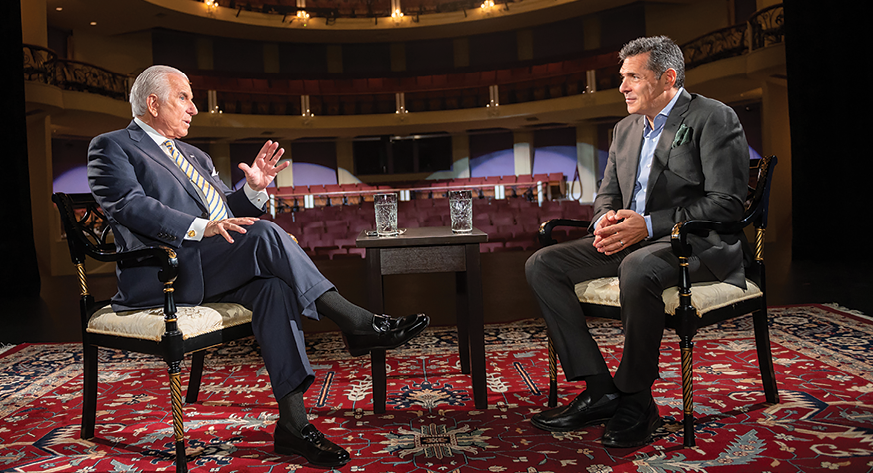
Nido R. Qubein and Daniel Lubetzky
Creating A Kind Movement
Editors’ Note
Nido Qubein is the longest-serving active college president in the state of North Carolina. Named HPU’s seventh president in January 2005, he has led his alma mater with vision and dedication for more than 21 years. He rose to prominence as an internationally known author and consultant who has given more than 7,500 presentations worldwide. He has served on the corporate boards of several Fortune 500 companies, including Truist – the sixth-largest bank in the nation, La-Z-Boy, and Savista Healthcare. He is also executive chairman of the Great Harvest Bread Company. During his more than two decades and counting as HPU’s president, enrollment has quadrupled, the campus has expanded from 90 to 560 acres, and academic schools have grown from three to 14. Among numerous honors and recognitions that he has received, Qubein is an inductee of the Horatio Alger Association for Distinguished Americans, along with Oprah Winfrey and Colin Powell. He converses with some of the world’s most influential thought leaders and change agents, many of whom are drawn to HPU’s innovative campus. Their conversations focus on leadership, life skills and values that prepare HPU students to lead lives of success and significance. Below is a transcribed excerpt, edited for clarity and brevity, of Qubein’s 2023 conversation with Daniel Lubetzky, founder of KIND Snacks, on HPU’s campus.
Qubein: You can’t go anywhere and not see KIND Snacks in airports, in stores and on airplanes. How did you get the idea and what made you start a company called KIND?
Lubetzky: The idea came because I had started a company before then called PeaceWorks to bring neighbors together to use business through economic cooperation, and through that company I had kind of learned the natural food business. But I was very frustrated that when I was going up and down the streets selling my products and I was looking for a healthy snack, I couldn’t find something that I could feel good about. So, I had the idea to create a product that was versatile, that could travel with you, that was nutritionally dense, healthy and tasty. And that’s how it all began.
Qubein: How did you decide on KIND as the name?
Lubetzky: I called it KIND in honor of my father.
Qubein: Your father, a Holocaust survivor who inspired you immeasurably in your life.
Lubetzky: Yes, my dad was far and away my best friend and mentor, and he was a Holocaust survivor. And in spite of what he went through with all the darkness that he witnessed, he was a very, very kind person. He was very kind to everybody. Everywhere he went, he was trying to brighten people’s lives, and so it was an inspiration to him. The company was launched the year he passed away, and it was a very difficult but interesting year because it was also a year of a lot of growth for me, even though I missed him a lot. I did a lot of prayer and a lot of introspection and a lot of meditation, and I grew a lot while suffering, missing him, but trying to emulate him and doing a very, very small part to try to live up to who he was.
But also, KIND is the name because we were looking for a human adjective that would describe our three core attributes. It’s kind to your body, meaning very helpful; kind to your taste buds – it has to be delicious; and kind to the world in that we try in a small way to make this world a little kinder one snack at a time.
“KIND is the name because we were looking for a human adjective that would describe our three core attributes. It’s kind to your body, meaning very helpful; kind to your taste buds – it has to be delicious; and kind to the world in that we try in a small way to make this world a little kinder one snack at a time.”
Qubein: Did you think of it just one morning while you were shaving or did you get a focus group, an advertising company, and a whole host of talented people together?
Lubetzky: Definitely no focus group, but it was a journey. I started thinking about it - for years I was looking for healthy snacks. I knew there was an opportunity in that space because I was very frustrated with my own snacking options, but it took a long time to figure out what product would work. It took a long time – if you had seen the names that we were considering instead of KIND. Now it’s KIND. It’s almost funny to think about other alternatives, but we had all sorts of terrible brand ideas until we stumbled upon KIND. And even our mission and the way I explained it took us many years to refine until we really understood exactly what we were. But from the very, very beginning, we did have very clear guardrails about what we were not and what we were going to be. So, in contrast to my prior company, PeaceWorks, where I was young and I was making a ton of mistakes because I wanted to be everything to everyone, at KIND, from day one, we were very disciplined about never sacrificing our core attributes. It always had to be nutritionally dense. It always had to lead with healthy ingredients like almonds or whole fruit or whole nuts or whole grains. It always has to be tasty, even if it’s nutritious - if it’s not tasty, we won’t launch it and vice versa. And as far as our social mission, from the beginning when we called it KIND, the aspiration was to make this world a little kinder. But the mission evolved a lot because at the beginning we thought we needed to do kindness to others. So, we were a motley crew of 12 people trying to carry people’s groceries, and that’s how we were manifesting our kind mission. And then we realized that it was much more powerful to help others unleash their kindness and to create a kind movement, and that’s when it really took off.
Qubein: In your book, Do the KIND Thing, you write about being an actionist, not an optimist. How did your “actionist” philosophy create a brand that is known worldwide?
Lubetzky: It really was hard work, day in, day out, creating a commitment and a culture. I was on a date with my wife and I would pass a supermarket and say, “Do you mind just two minutes to check if the products are on the shelves?” She was very patient and loving and encouraging our team to do the same and for everybody to just always be thinking, are we in the right set? So, it was just a lot of knocking on doors, walking up and down the streets, waking up at 6:00 AM in the morning. It was not an overnight success. People felt that way because eventually they started discovering it, but it was a lot of hard work.
And then really the biggest part of the success, I think, is the product. The standards of quality are very high. I mean, the No. 1 ingredient in our products are almonds, which are very nutritionally dense and expensive ingredients compared to our competitors, whose number one ingredient might be sugar or some form of filler. And the cost there is 19 cents per pound; ours is $3 per pound, so people can sense the difference in terms of quality.
“The creative process is where nothing other than innovation has to be on your mind. You have to come up with disruptive ideas, and if people think they’re stupid, that’s probably even better. You have to encourage that creativity.”
Qubein: I’ve heard you speak about the three C’s of entrepreneurship. What are those?
Lubetzky: The three C’s are about when you’re thinking of launching a venture, how do you conceive the venture? There are three very distinct phases. There’s the creative, the critic and the crusader, and if you mangle them and mix them up, you’re going to end up with a mess. You have to separate them. The creative process is where nothing other than innovation has to be on your mind. You have to come up with disruptive ideas, and if people think they’re stupid, that’s probably even better. You have to encourage that creativity.
Then, once you’ve come up with a really, really disruptive idea that questions and challenges assumptions, you need to enter the critical phase. At that time, you need to literally change your hat and your mindset and be your own worst critic and really kick it around and say, “OK, this is a really creative idea, but will it work? Can I stand up to the competition? Does the consumer really want this creative idea? And is it really, really what the world needs and can I actually execute it?” You need to be your own worst critic.
And then if you go through that trial by fire and intellectual fire and you survive, then you need to flip the switch for the third phase which is the crusader. Once you go to the third phase, nobody can stop you. You have to make it work, and you cannot hesitate and start having doubts. You should listen and calibrate, but you need to get to the destination because it’s going to take longer to get to your final journey, to get to the destination. And you have to have the staying power to listen, to pivot, but to continue - continue fighting until you breakthrough.
Qubein: Along this journey, there is something we all know called risk. How does Daniel Lubetzky, especially in the early days, manage risk?
Lubetzky: Two answers to that. First of all, I’m lucky that I didn’t know how hard it would be. Once I had one of my mentors tell me that he loved how naive I was, and I got very upset that he called me naive. This was when I was starting the OneVoice Movement to empower moderates in the Middle East to fight against extremism. And he said, “No, no, I don’t mean it in a negative way. I mean that if you knew how hard this journey was, maybe you wouldn’t pursue it.” But sometimes the power of not knowing is what is going to propel you to actually try it.
The other thing, though, is that I am an entrepreneur. I definitely am comfortable with risk, but it’s very calculated risk. It’s things where I have enough knowledge to feel comfortable with risk. I’m not gambling. I’m thinking strategically, and then I have enough confidence in myself to try to pursue it and I’m just going to work really, really hard and then work harder. And so, it is true that entrepreneurs tend to have much greater comfort with risk, but the good entrepreneurs are not just going to be gamblers. They’re actually going to think very carefully about how to maximize the chances of success and prepare for the worst. Some of my transactions have some sort of hedge, or they were designed to hopefully maximize the upside and limit the downside.