- Home
- Media Kit
- MediaJet
- Current Issue
- Past Issues
- Ad Specs-Submission
- Reprints (PDF)
- Photo Specifications (PDF)
- Contact Us
- PRIVACY POLICY
- TERMS OF USE
Loading

ONLINE


Willis Loughhead
A Bastion Of Creativity
Editors’ Note
After receiving a bachelor’s degree in film production from Boston University, Willis Loughhead began his hospitality journey as a chef in esteemed restaurants in Southern California, Florida and the Northeast. He worked as the Executive Chef at the Palm Grill restaurants in Key West and Miami, both of which received the title of “Best New Restaurant” by Miami Metro Magazine. Loughhead went on to become the Executive Chef at Tantra Restaurant and Lounge where he was voted Rising Star Chef by Ocean Drive Magazine. In the early 2000s, his career transitioned to hotels, where he opened The Ritz-Carlton Coconut Grove, Miami. He relocated to New York City in 2004 to open The Modern’s Bar Room at the Museum of Modern Art, which was awarded a Michelin Star and rated three stars by The New York Times. Soon after, he was selected by celebrity Chef Geoffrey Zakarian to operate all food and beverage concepts at lauded Country Restaurant at the Carlton Hotel, a 3-star New York Times and 1 Michelin Star operation with a Wine Spectator award-winning wine list. In 2010, Loughhead became the Executive Chef at the illustrious Plaza Hotel, designing the hotel restaurant to meet the desires of, its elite patrons. Loughhead has been brought on to spearhead major operational overhauls to a multitude of service visions, including the private Union League Club of New York, the remodeled InterContinental New York Barclay Hotel, and the Crowne Plaza Times Square, host hotel for Dick Clark’s New Year’s Eve experiences. For the past five years, Willis has been at the helm of The Algonquin Hotel on Club Row between 5th Avenue and 6th where he has reinvigorated the hotel’s reputation as an epicenter for the city’s cultural scene by hosting performances by Broadway stars, literary events, and curating a variety of art exhibits. Loughhead spearheaded its recent renovations, unveiled new menus for the Blue Bar Restaurant & Lounge, and is constantly engaging the hotels literary locals and tourists alike by paying homage to The Algonquin’s esteemed history while providing innovative twists on modern tastes and industry trends.
Will you discuss your career journey?
A scene from Casablanca (1942) summarizes it well:
Captain Renault: What in heaven’s name brought you to Casablanca?
Rick: My health. I came to Casablanca for the waters.
Captain Renault: The waters? What waters? We’re in the desert.
Like Rick, I was “misinformed” and possessed a broken compass. I was raised in Philadelphia, a mere 96 miles from Manhattan, but it took me 15 years to get here.
I started my hospitality journey in the inhospitable atmosphere of a Philadelphia oyster house when I was 15 years old. It was a bygone era with ashtrays on the expeditor line, the prep cooks poured Kahlua into their coffee thermos, the eggs were kept in the dry storeroom, and when someone did not show up for their shift the first assumption was that they were in jail, hopefully not for more than one night; I fell madly in love.
I graduated from Film School at Boston University and realized when I arrived broke in Los Angeles that my popcorn flavoring skills outpaced my cinematic vision. I was turned down for a paying job at CAA under Michael Ovitz, so I dove straight into preparing the famous Chasen’s chili before getting recruited to work the wood oven at the newly opened Schatzi on Main, the restaurant in Venice co-owned by Arnold Schwarzenneger and Maria Schriver. Armed with my compass in disrepair, I left Los Angeles to get both more serious about F&B and kick a developing cocaine habit by moving to South Florida in the mid-90s. I was successful at both endeavors. I ended up revamping a notoriously decadent restaurant named Tantra in South Beach in 1999 before opening and operating culinary in the Ritz-Carlton Hotels organization where I developed life-long mentors. I arrived in Manhattan in 2004 to open The Modern at The MoMA for Danny Meyer where the operation received three stars in The New York Times and one Michelin Star. I also led the Michelin-starred restaurant Country by Geoffrey Zakarian and The Plaza Hotel where I began the transition from BOH to FOH and gained invaluable experience with union relations and both openings and renovations inside the collective bargaining agreement environments.
My proudest career moment to date was being handed the Highgate Hotel management keys to The Algonquin Hotel, Autograph Collection after the COVID pandemic. I took the chains off the doors and welcomed the long-tenured staff back to their professional home and have since worked to re-enliven the oldest operating hotel in Manhattan and bring the creative spark back to this landmark and legend so filled with lore. We have received a multitude of accolades, and I have grown immensely as a leader thanks to continued focus, the people first culture and inspiring executives that lead all disciplines at Highgate Hotels, and that broken compass that still guides me forward along the path of total quality.
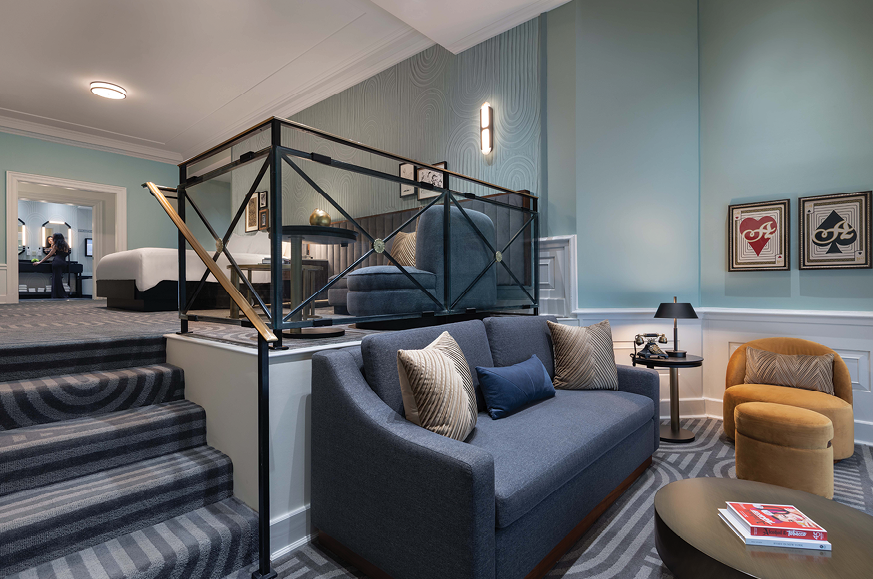
The Barrymore Suite
Will you provide an overview of The Algonquin Hotel, and how the property is positioned in the market?
The Algonquin Hotel has always been a bastion of creativity and luxury bathtub gin mill of trend setters, taste makers and a home to the irreverent high society. The Algonquin has a past, present and future history that must be nodded to, respected and fostered. The key is to create a vibrancy; to provide an atmosphere of unexpected warmth, quiet nooks and open spaces to get into good trouble, to fulfill unexpressed wishes and personal visions of New York City. We are a safe space in the center of the chaos and cacophony of the city. It is no mistake and is perhaps a magical point on the map, that we are located between Broadway, The Public Library, Bryant Park and The Town Hall which share in our support of the core creative community.
If I were to paint a picture of our positioning, it would be a step over from what is considered luxury experience; not up or down from, but it would be a portrait capture where a living legend of high society casually slips off her evening heels and effortlessly dangles her diamond bracelet over a bracingly cold martini. The music in the background would be ’90s hip hop followed by Parisian pop of the early ’70s, and then a Stax Records B-Side of Memphis Soul. I create the music playlists in the hotel to surprise our loyalists, and I think one of our regulars, a retired civil rights figure and ex-Mayor of Memphis and his wife would appreciate that mix.
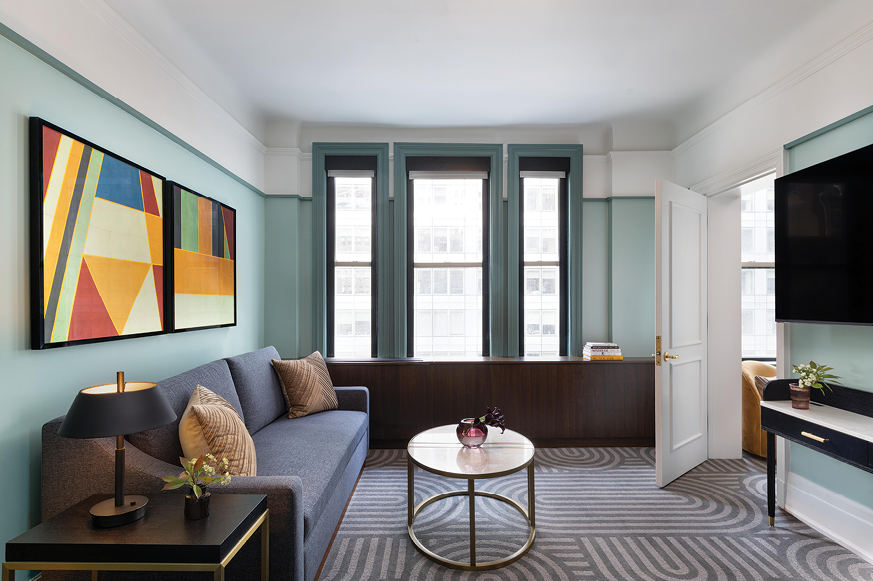
Suite living area
What can guests expect from the recent renovation at the property?
Completed through a carefully phased, multi-year process, we wrapped the project in August 2026. The renovation was quietly executed while the hotel remained fully operational, preserving the guest experience through construction. Guests can expect a renovation that leaned into the intimacy of the hotel, allowing the original framework and patina of 125 years to shape the guest experience. Our collaboration with CRÈME/Jun Aizaki Architecture & Design focused on fusing historic scale with residential sophistication. This renovation focused less on basic work, sleep, bath tasks and more on the personal experience of the hotel. Whenever and wherever possible, we removed bulk for path. We embraced the idiosyncrasies of both the hotel as well as our place in the building of New York City’s art scene over the past century. This renovation was far from cookie cutter and as evidenced by the custom quotes on every door, every room has its own charm. Also, we went to great lengths to make sure that the legendary ghosts and spirits remained comfortable in their new digs. The ghost stories have continued and they are a lively, rambunctious group.
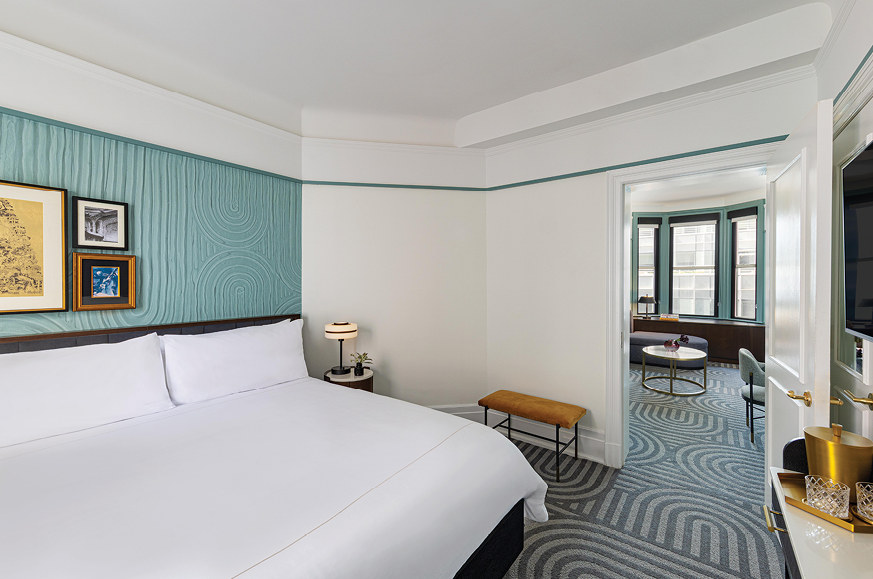
Suite bedroom
How important was it for the renovation to maintain the history and heritage of The Algonquin Hotel while adding modern and current touches?
It was written in 1937 that, “Entering the Algonquin is easy. Leaving it is not. It is hard to tear yourself away from the company of people you also pay to see.” The heritage of the Algonquin is tremendously important, but also a treacherous path if not carefully plotted. It was a critical point not to turn this space into a museum whose natural next step would be a mausoleum. I needed at every critical point to respect the past but not be beholden to it.
One of my closest friends in the city is the Director of The Al Hirschfeld Foundation, David Leopold, and we met over far too much morning coffee to look back over 80 years of Al Hirschfeld’s career to select the art for the renovation. Hunting and digging, we have pieces hanging that have not been displayed in decades or have not seen light since being featured in media decades ago. The Algonquin and The Hirschfeld Foundation share a unique New York City story rooted in creativity and character, characters and caricatures. We created an immersive experience where every hallway, room and detail invites the guest to engage in a deeply personal way. I labeled no pieces and provided no dates. Before you ask, yes, pieces have already been torn from the wall, and I have had to step up the security process.
You never know who will stop into The Algonquin after a show or a performance. The other night we had musicians from the killer SNL house band stop by and sit in with our fantastic piano player. On another occasion my buddy Thurston Moore picked up his acoustic and played a Lou Reed song. We had the new cast of Maybe Happy Ending, which is now the longest running show in the history of The Bellasco Theater, practicing their timing on their duets. The place is magic and it is my job to fan the spark, not put it behind glass.
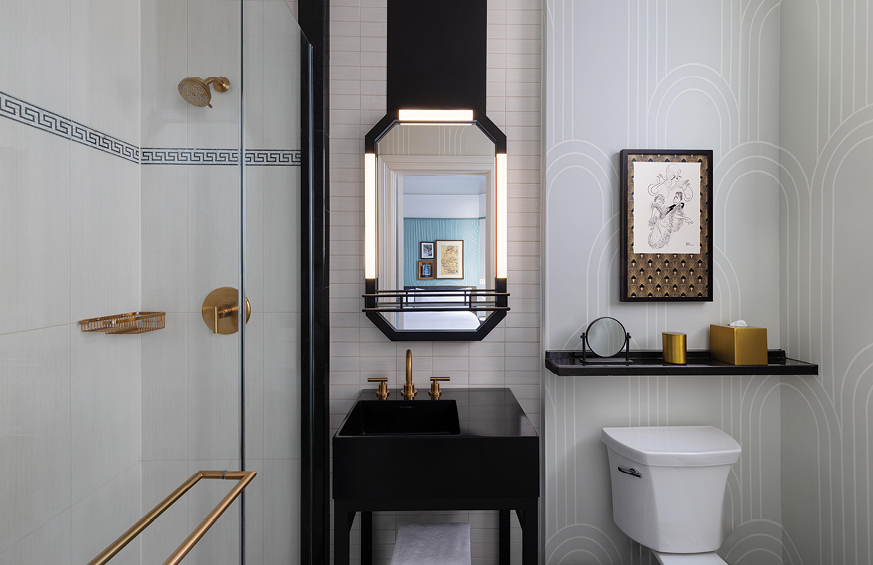
Suite bathroom
How has The Algonquin Hotel approached its restaurant/food and beverage offering, and what are the keys to being successful in this part of the business?
I had to muzzle the Michelin Star seeking devil on my shoulder. Traditionally, F&B is a show, referred to as theater, and the diners are the audience. I wanted, rather than monologue it and stand on stage asking, “have you dined with us before” or “are you familiar with our concept,” to integrate the guest into their own show, allow them to cultivate their own experience. So, I leaned into the lore of The Algonquin cocktail culture created over the last century at the hotel and created food that plays well into the scene; yummy, fresh, ingredient driven food, nothing fancier. If Marlon Brando were tending bar and Marvin Gaye picked up the mic, would you want your server to tell you how to dine?
As far as how to be successful, I recommend doing all of the thinking in advance and then letting the moments play out. Check how your knife lays across the plate or bowl when it gets put down, make sure that your cooks eat in their own spaces. It can divert a conversation or ruin a train of thought when you have to figure out where the saltshaker is or if the knife keeps falling into the sauce. In many ways, this is method acting; know the details enough not to let them get in the way of authentic emotion.
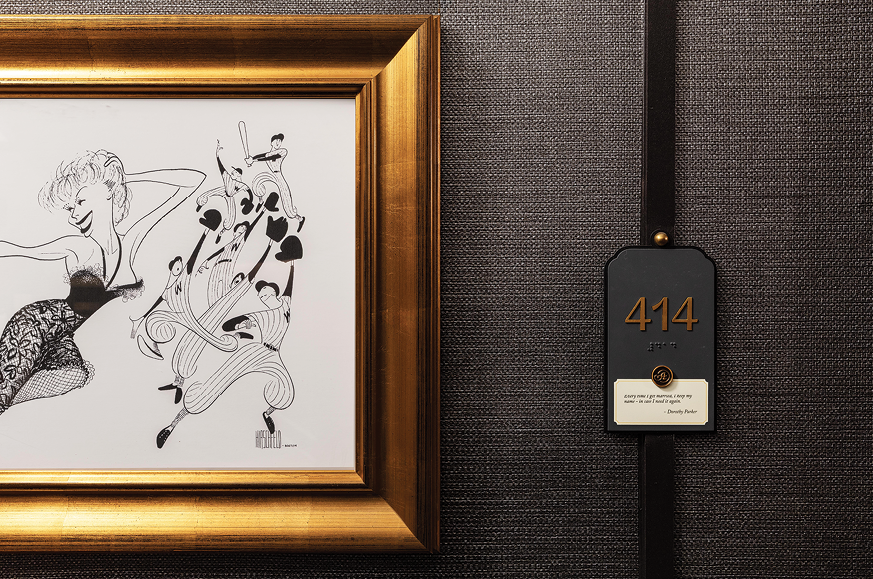
Original Hirshfeld artwork lines the corridors
Will you discuss The Algonquin Hotel’s focus on offering personalized service and a customized guest experience?
Hospitality has become homogenized, hidden behind additions, never-ending options, and heavy-handed luxury-minded experiences. To me the best contact is eye contact, and true luxury is the freedom to be pleasantly surprised by small, subtle moments. We have become well versed in the same customizations, and I am always training my managers to listen, take notes of quirks and never to hide from obvious signals. To this point, I find it critical to interview and hire based less on experience, hiring managers and line staff who are genuinely interested in people and atmosphere. I would rather hire a star from Foot Locker than depend on a perfectly built Hospitality resume.
We have 181 rooms at the hotel and 24 suites. Every room has a distinct, individually curated quote on the luggage-tag-inspired room signs from legends who created or influenced the hotel. The distinctive messages are from a diverse cast of characters and past residents such as Maya Angelou, James Baldwin, The Notorious B.I.G., Dorothy Parker and, of course, Kermit the Frog as well…The Muppets Take Manhattan. From there, every bathroom has a different Hirschfeld drawing. I made every attempt to highlight Algonquin’s individuality and irreverence; we support the same in our guests.
What advice do you offer to young people interested in building a career in the industry?
Be present, travel out of your expected area, learn your hotel. Learn what is in every cooler and dry storage, know your pantries and storage areas, know how the food comes in and the trash goes out. Greet everyone on your way into the operation and say goodbye on your way out. This career permits a great deal of pivots and paths – keep the blinders off and break your compass.