- Home
- Media Kit
- MediaJet
- Current Issue
- Past Issues
- Ad Specs-Submission
- Reprints (PDF)
- Photo Specifications (PDF)
- Contact Us
- PRIVACY POLICY
- TERMS OF USE
Loading

ONLINE

Artist Conceptual Rendering of Timbers Captiva Ocean Club Owners Lounge (Proposed)
A Strong Connection
To The Destination
Editors’ Note
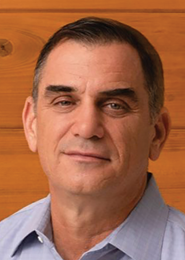
As Chief Executive Officer for Timbers Resorts (timberscompany.com), Greg Spencer actively drives the company’s overall strategy and growth while ensuring employee, guest and owner experience aptly represents the Timbers brand. Spencer’s passion for crafting unmatched lifestyle experiences stems from the pure joy he felt when spending time by the ocean in his childhood, a feeling that has propelled his vision for Timbers since joining the company in 2007. Throughout his tenure at Timbers, he held several prominent positions including Chief Operating Officer, Director of Corporate Finance, Director of New Development and Project Director for several Timbers Resorts properties. Prior to joining Timbers Resorts, Spencer developed high-end properties in the southeastern U.S. for his firm, Mont Ventoux Capital, and was a Senior Manager with Accenture where he specialized in financial services mergers and acquisitions with an emphasis on real estate related integration. Before joining the civilian workforce, he was a Captain in the United States Air Force and deployed in support of numerous operations around the world. Spencer has a bachelor’s degree from Florida State University, an MBA from Webster University, and a master of science in real estate development from Columbia University. He received his commission as an Air Force Officer from ROTC, where he was the Corps Commander at Florida State University, a Distinguished Graduate, and recipient of the President’s Award.
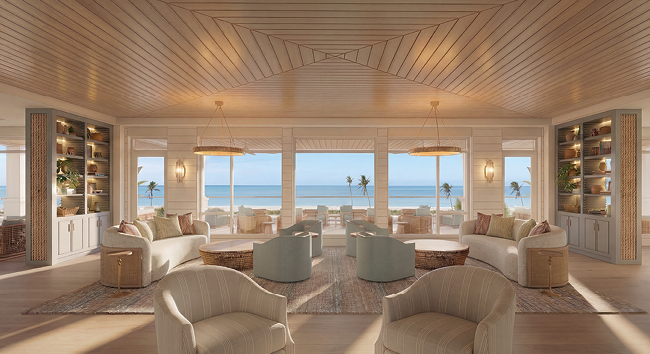
Artist Conceptual Rendering of Timbers Captiva Ocean Club
Owners Lounge (Proposed)
Will you discuss your career journey?
I knew fairly early that I wanted to eventually build a career in the luxury resort space. I was familiar with Timbers before attending graduate school at Columbia University; I came across an ad for the company in Worth Magazine. What appealed to me was the combination of real estate, hospitality and incredible destinations. It felt much more interesting than traditional real estate.
After graduating, I had opportunities with more conventional real estate firms, but I was determined to find my way into the resort business. I “cold-called” Timbers Resorts, which led to a meeting with its founder, David Burden. By the time I got home, I had an offer to join the company as a development project manager.
I’ve been fortunate to grow alongside the company and work across many different parts of the business. That experience has given me a perspective I really value today because I’ve seen projects evolve from the earliest stages through years of ownership and operation. You learn that what you’re creating goes well beyond real estate. These are places that become an important part of people’s lives, where they create memories with loved ones.
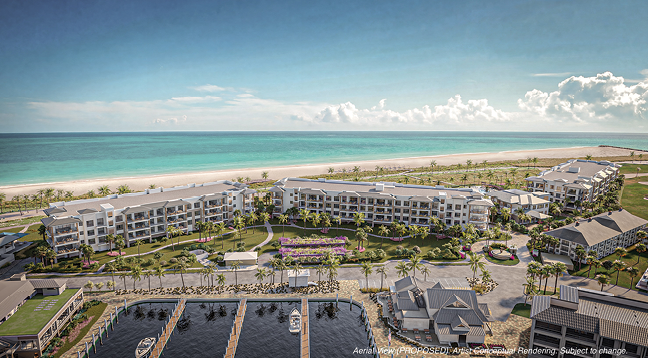
Artist Conceptual Rendering of Timbers Captiva Club
& Residences on Captiva Island (Proposed)
Will you provide an overview of Timbers Company?
Timbers Company grew out of more than 25 years of experience with Timbers Resorts, creating and operating luxury resort and residential properties in extraordinary destinations, from the mountains of Colorado to Kaua‘i, Tuscany and Florida. As the business evolved, Timbers Company was established to build on that foundation and expand our expertise across luxury hospitality, real estate and development.
At the heart of everything we do is a strong connection to the destination. Rather than applying the same formula from one location to the next, we start by understanding what makes a place distinctive and then attempt to create something that feels like it belongs there.
That philosophy continues to guide how Timbers Company grows. We are selective about where and how we expand, looking for opportunities where our experience in real estate and hospitality can enhance a destination and create long-term value.
One project we are especially excited about is Timbers Captiva Club & Residences on Captiva Island. It is particularly meaningful for us because it is here in Florida, not far from our corporate office in Winter Park. Captiva embodies so much of what we value in a destination: natural beauty, character and an enduring appeal that has drawn families back to the island for generations. We have an opportunity to build on that legacy while introducing something entirely new.
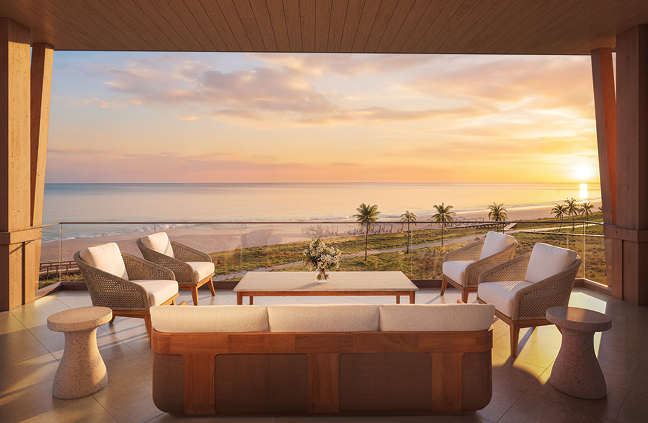
Artist Conceptual Rendering of Timbers Captiva
Osprey Penthouse Building 2 Lanai Gulf View (Proposed)
What can guests expect from the opening of Timbers Captiva?
Timbers Captiva is the first new luxury residential offering on Captiva Island in more than three decades, so we recognize how rare an opportunity this is. We are creating 84 three- and four-bedroom beachfront residences across 12 acres with more than 1,000 feet of shoreline within the iconic South Seas resort.
Captiva doesn’t need us to reinvent it. Part of its appeal is that it has retained the relaxed, authentic character people have always loved about the island. Our goal is to complement that with an exceptional residential experience that gives owners a new way to enjoy Captiva.
Owners will have membership access to the Ocean Club, including a private clubhouse and lounge, beachfront infinity-edge pool and hot tubs, fitness center, children’s programming, water sports and concierge services. They will also be able to enjoy the broader South Seas experience, from the marinas and golf course to dining, the waterpark and other resort amenities.
But the real luxury is how effortless we want ownership to feel. You arrive, your residence is ready and you can immediately begin enjoying the island. That simplicity is a big part of the Timbers Captiva experience.
What do you feel separates resort residential real estate from traditional luxury real estate in today’s market?
For me, one of the biggest differences is what happens after you buy. In traditional real estate, the transaction can be the end of the relationship. In resort residential real estate, it is really the beginning. Owners are certainly buying an exceptional residence, but they are also choosing a lifestyle and a destination. There is a team caring for the home when they are away and helping make the experience seamless when they return. The service, amenities and community surrounding the residence become an important part of the value of ownership.
People are increasingly protective of their time, particularly when it comes to a second home. They want to spend that time enjoying it, not managing it. Resort residential real estate is designed around that idea.
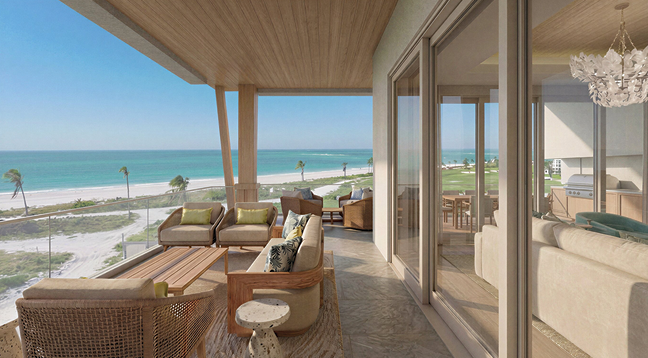
Artist Conceptual Rendering of Timbers Captiva
Osprey Penthouse Lanai Gulf View (Proposed)
Why has the club/residence model resonated so strongly with today’s luxury consumer?
I think buyers have become much more thoughtful about how they use vacation homes. They are asking themselves how often they will actually be there, what they want from the experience, and what type of ownership best fits their lifestyle. That is why we see an important role for both whole ownership and private residence club ownership. For someone who wants the flexibility to use a residence throughout the year, whole ownership may be the right fit. For someone who knows they will spend a certain amount of time in a destination each year, the private residence club model can make tremendous sense.
In either case, you have a place that feels like your own without many of the responsibilities traditionally associated with a second home. It allows owners to focus their time on the reason they bought in the first place: enjoying the residence, the destination and the people they are there to spend time with.
What are the keys for developers to be successful in balancing long-term real estate value with hospitality experience?
The two really have to work together. You can build a beautiful residence in a great location, but if the ownership experience falls short, that eventually matters. The opposite is true as well. Great service cannot compensate for real estate that was not thoughtfully conceived in the first place.
It starts with making good decisions about the fundamentals, including location, architecture, quality, scale and how people will actually live in the residences. Hospitality should then enhance that foundation rather than overwhelm it.
The best service is often the service you barely notice. Your home is ready when you arrive. Someone understands how you like to spend your time. The details have already been handled. That is very different from simply having a long list of amenities.
When you get both sides right, you create lasting value and a place people genuinely look forward to returning to.
What guides your approach to leading Timbers and its continued growth?
I try to stay focused on the principles that have always defined Timbers: creating memorable experiences, respecting the character of each destination and delivering a genuinely hassle-free lifestyle.
When we evaluate growth opportunities, we are not focused on how many keys we can add. We think about whether it is somewhere our customers want to be, whether the market and opportunity are right and, most importantly, whether Timbers can bring something meaningful to it.
At the property level, that means staying close to our teams and understanding what owners and guests are actually looking for. Luxury is increasingly personal, so our job is to listen carefully and respond to what matters most to the people who choose to spend their time with us.
Timbers Captiva is a great example of that approach. There is tremendous affection for the island and everything that makes it unique. As we introduce Timbers Captiva, we are approaching the opportunity thoughtfully, creating a new residential experience that feels at home within the destination.
You’ve built your career with Timbers and have spent the past 12 years leading the company. What has made the journey so rewarding for you?
One of the most fulfilling parts of being with Timbers for so long is having the opportunity to see the full life cycle of what we create. I remember projects when they were drawings on a table, and now I see owners returning years later with their children and grandchildren. That gives you a very different perspective on development. You realize that a successful project can have a life well beyond its initial development. Traditions take shape, friendships form and these destinations become places people look forward to returning to year after year.
Captiva brings that full circle for me because I came to the island with my own family as a child. I know firsthand the connection people can develop with a place over time. Having the opportunity to now contribute to Captiva’s future makes this chapter particularly special to me.