- Home
- Media Kit
- MediaJet
- Current Issue
- Past Issues
- Ad Specs-Submission
- Reprints (PDF)
- Photo Specifications (PDF)
- Contact Us
- PRIVACY POLICY
- TERMS OF USE
Loading

ONLINE

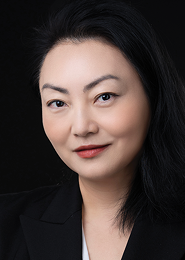
Maggie Gu
AI For All
Editors’ Note
Maggie Gu is an international affairs expert with over two decades of experience across diplomacy, human development, and international cooperation. She began her career working with the United Nations and in international mediation, and has since developed a cross-sector profile spanning public institutions, nonprofit leadership, and technology-driven initiatives. She has always been concerned with human development, public welfares, and cross-cultural communication She holds a professional medical degree, a Master’s degree in Communication and Public Relations from Peking University, an MBA in Global Management from Thunderbird School in the United States, and a Master’s degree in International Relations and Economics in Switzerland. She is also proficient in ancient Chinese language.
Foundation Brief
Tomorrow Foundation (tomorrow-foundation.com) is a Swiss charity foundation dedicated to advancing education, digital inclusion, entrepreneurship, and international cooperation. It is motivated by the belief that transformation begins with people and that education, when paired with digital skills, innovation, and leadership development, becomes the most powerful lever for lasting societal change.
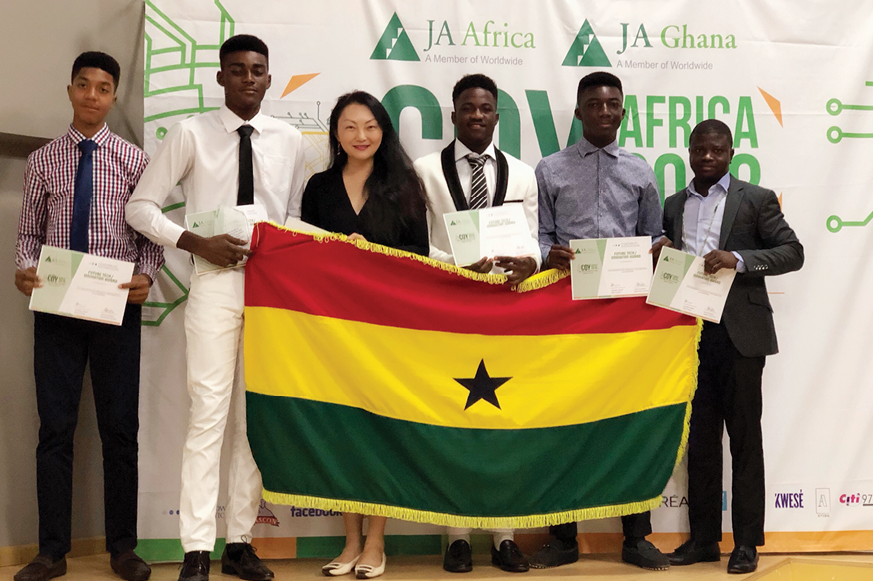
Maggie Gu with the winners of the Tomorrow Foundation
Future Tech/Innovation award at JA COY Africa in Ghana
(2018)
Will you discuss your career journey?
My journey has always been shaped by linking diplomacy, technology, and human development. Early in my career, I worked with the United Nations and in international mediation. The real turning point came in 2003, the first time I set foot in Africa. I was amazed by the huge potential of this continent. I became convinced that diversifying its economic and political partnerships would be very positive for its development. At that moment, I knew I needed to play a bigger role – putting my network and my energy at the service of initiatives that were truly relevant to local development. That realization changed everything. It led me to move into technology and impact investment. In 2017, I founded Tomorrow Foundation in Geneva to turn these ideas into real, scalable action.
At the core of my work is a simple belief: that the youth, the innovation, and the growing technological capacity in Africa and the Middle East will not only shape their own future, but the future of our world.
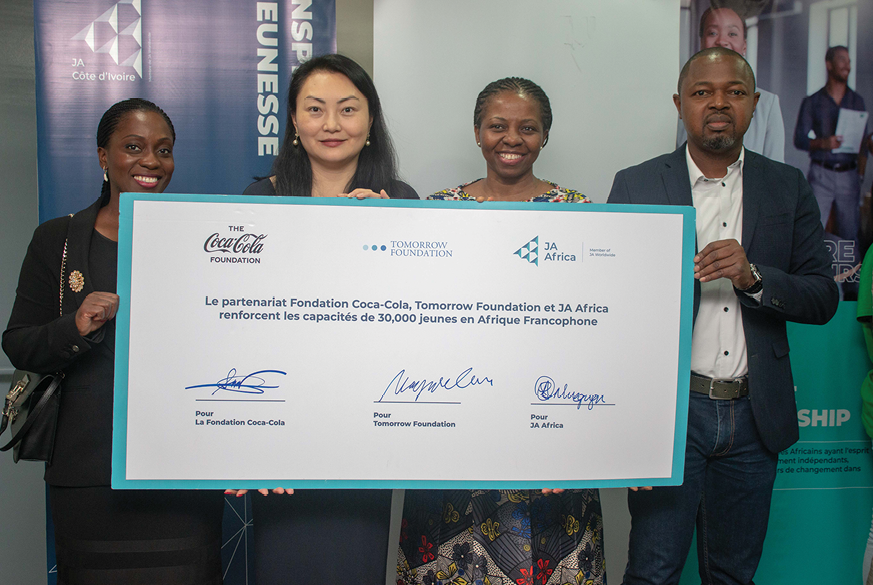
Maggie Gu JA Deep official launch Francophone Africa
in partnership with Coca-Cola Foundation (2022)
How do you define Tomorrow Foundation’s mission?
Tomorrow Foundation’s mission is to help build future-ready societies by expanding access to education, innovation, and opportunity. We are focused on ensuring that people are not left behind by technological, economic, and cultural transformation, but are equipped to participate in it and lead within it.
The Foundation’s mission is rooted in empowerment rather than assistance. It seeks not to deliver turnkey solutions, but to enable young people to shape their own path – to think critically, create fearlessly, innovate with purpose, and lead with integrity. We want to empower today’s young people in Africa and the Middle East to become tomorrow’s economic leaders, innovators, and changemakers.
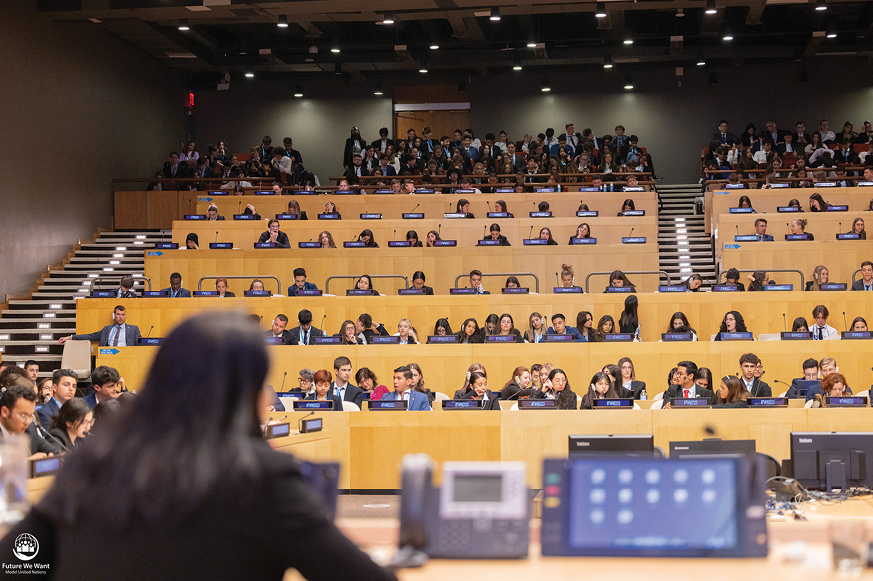
Conference on the “Future we want: global initiative for young
leaders” at the United Nations Headquarters in New York
(2023)
Will you provide an overview of Tomorrow Foundation’s main programs?
Tomorrow Foundation’s work is structured around programs that respond to the major forces reshaping societies: the transformation of education, the rise of digital and AI-driven economies, the need for entrepreneurial pathways, and the importance of cultural and creative industries as engines of both identity and growth.
A major umbrella framework for us today is AI for All, which is designed to make the AI era more inclusive, more human-centered, and more development-oriented. It is built on three pillars: AI Infrastructure, AI Education for All, and the Creative Industries Development Initiative. Together, these pillars address not only access to technology, but also the capability to build, govern, and apply it meaningfully.
Alongside this, the Foundation has also developed initiatives centered on education access, women’s leadership, entrepreneurship, and digital transformation:
•Her Startup: A four-month intensive entrepreneurship accelerator for women founders, delivered with the Founder Institute of San Francisco, offering world-class training, seed financing, mentorship, and pathways to further funding. It directly addresses the structural underfunding of women-led ventures in Africa.
•100 Million Learners: A free, multilingual online platform (in 40 languages) partnering with Thunderbird School of Global Management and Arizona State University. It delivers over 300 hours of accredited entrepreneurship, innovation, and leadership training, with a target of 70 percent women learners. Participants receive official certificates and credits.
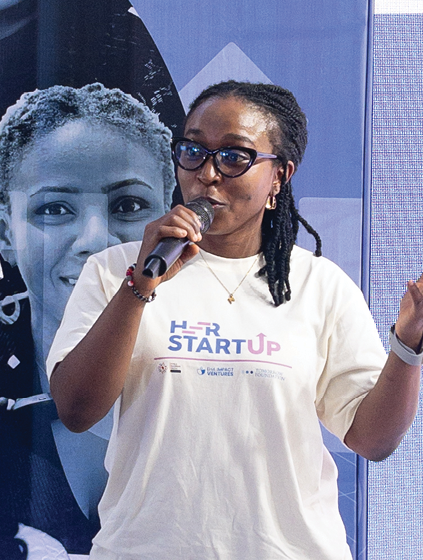
Her Startup program pitch competition in Lagos (2025)
What was the vision for launching AI for All, and what is the goal for this initiative?
The vision statement frames the central question of our era: “When AI becomes the dominant capability, how does humanity remain human?” AI for All is not another digital-literacy or access program. It is a systemic effort to ensure that as AI reshapes labor, cognition, values, and social structures, humanity retains its wholeness – dignity, meaning, agency, and continuity. Our goal with AI for All is to help ensure that the AI era becomes a period of broader human empowerment rather than greater exclusion. We wanted to create a framework that goes beyond commentary and moves into institution-building. That is why AI for All is not a single project; it is a structured platform built around three strategic pillars.
The first pillar, AI Infrastructure, is about supporting the foundations of AI sovereignty, including compute capacity, data infrastructure, and the ability of regions to participate in AI development on their own terms. The second, AI Education for All, is about building a scalable, multilingual, human-supervised learning infrastructure that can expand access to quality education at scale while strengthening, not replacing, educators. The third, the Creative Industries Development Initiative, recognizes that in the AI era, culture, storytelling, and intellectual creation are strategic assets. To support it, Tomorrow Foundation is bringing together a dedicated global leadership team spanning North America, Asia, the Middle East, and Africa. This marks the first public introduction of our creative founding team, with award-winning film producer and global media executive Aaron L. Gilbert and international cultural and media executive Xinglan Zhang joining the initiative. Together, we are building a platform that connects technology, capital, and storytelling across regions – while enabling emerging markets to actively participate in the global creative economy – and ensuring that human creativity remains at the center of the AI transformation.
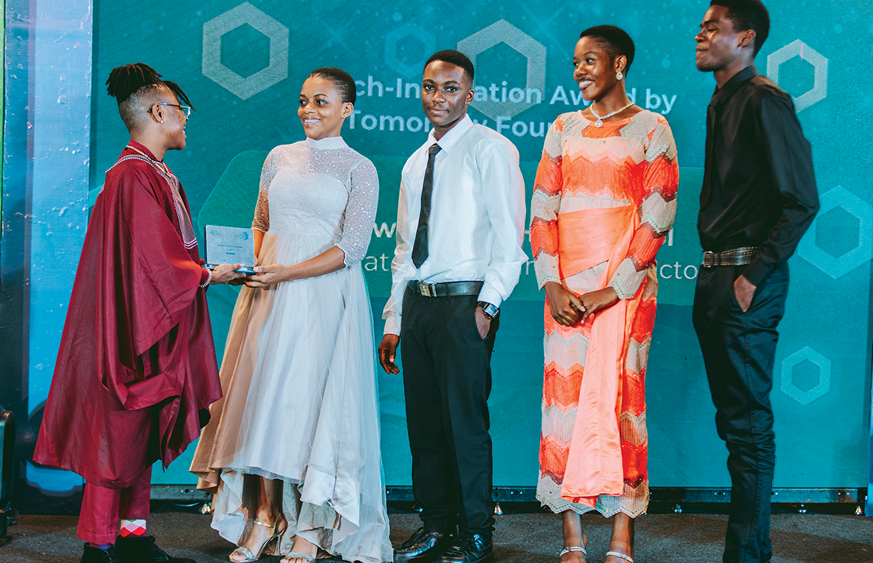
Winners of Tomorrow Foundation Future Tech/Innovation
award at National Business Pitch Competition in Ghana
(2023)
How is Tomorrow Foundation upgrading its in-house education programs to better align with the realities of the AI era, with a focus on preserving human capability, creativity, and agency?
We are evolving every program – Her Startup, 100 Million Learners, JA, and our technical support initiatives – around the AI for All framework. The upgrade is deliberate and dual-track: we integrate AI literacy and tools to prepare youth for AI-driven economies, while embedding safeguards that preserve uniquely human capacities.
Education remains the catalyst of transformation, but it must now go beyond access to capability. We shift from memorization to problem-solving, from consumption to co-creation. AI-generated content, personalized pathways, and simulations enhance learning, but human teachers, cultural experts, and mentors validate context, ethics, and meaning. We use AI to preserve and transmit heritage – languages, rituals, philosophies, scientific discoveries – so it becomes living knowledge rather than archived data. In practice, this means:
•Adding modules on ethical AI governance, human-AI collaboration, and creative resilience (especially through AMIA and the creative industries pillar).
•Strengthening “learning by doing” with real-world projects that require judgment, empathy, and originality – capacities AI cannot replicate.
•Measuring success not only by technical proficiency, but by preserved agency: the ability to think critically, create fearlessly, and lead with purpose.
The philosophy is explicit: civilization must be intentionally preserved, not repaired after collapse. Human warmth, dignity, and the capacity to act must be actively embedded. Our upgraded programs therefore equip young people to collaborate with AI without becoming passive, ensuring they remain the authors of their future rather than spectators.
How valuable has it been for Tomorrow Foundation to have such an engaged and committed board?
Invaluable. As a Swiss-regulated foundation, we operate under the highest standards of transparency and accountability. An engaged board brings precisely the strategic depth, diverse expertise, and long-term perspective required for work that spans diplomacy, technology investment, education ecosystems, and cross-continental partnerships. Their commitment ensures we stay grounded in our mission while navigating complex geopolitical and technological shifts. They provide wise counsel on governance, risk, and scaling impact – turning vision into durable systems. In an era of rapid change, such a board is not merely supportive; it is a strategic asset that multiplies our ability to deliver authentic, sustainable transformation.
What do you feel are the keys to effective leadership?
Leadership today is no longer about authority or control – it is about responsibility, judgment, and guiding others through complexity without taking away their agency. A true leader is someone who can see clearly in moments of uncertainty, take responsibility for decisions, and enable others to act with confidence. From my experience at the United Nations and in international mediation, I learned that winning arguments is not the objective – building agreements that endure is. And that requires listening, adaptability, and co-creation.
Today, the context of leadership is changing. In a world shaped by rapid technological advancement, geopolitical shifts, and increasingly interconnected societies, leadership is no longer just about driving outcomes. It is about helping people navigate reality, coexist, and make informed, independent choices.
At its core, leadership is about creating the conditions for others to see clearly, think independently, and act responsibly. That means three things:
•Expanding access to knowledge and truth, so people are not limited by information asymmetry.
•Building pathways for participation, so individuals and communities can meaningfully shape their own future.
•Preserving agency, so even when guided, people retain the freedom to choose.
Three principles continue to guide my approach:
•Integrity builds lasting trust.
•Collaboration is essential to solving complex challenges.
•Empowerment enables real and sustainable growth.
In today’s world, a leader must also be a lifelong learner and a connector – someone who expands access to tools, networks, and opportunities, rather than concentrating power. This is especially critical in the age of artificial intelligence. As technology becomes more powerful, leadership must ensure that humanity does not become passive, but remains conscious, capable, and responsible.
Ultimately, leadership is not about being the strongest person in the room – it is about making others stronger, and taking responsibility for what follows. The role of leadership today is not to decide for people, but to ensure they have the clarity, capability, and freedom to decide responsibly.
With all that you have accomplished during your career, are you able to enjoy the process and take moments to reflect on the impact of your work?
Yes, although perhaps not as often as one should. When you are deeply committed to building, improving, and moving things forward, there is always another challenge to address and another responsibility to carry. But I do believe it is important to pause and reflect, not from a place of self-congratulation, but from a place of perspective and gratitude.
What gives me the greatest sense of meaning is not the idea of accomplishment in a personal sense. It is seeing that certain ideas begin to take root, that institutions begin to strengthen, and that opportunities begin to open for people who may not have had access to them before. Those are the moments that remind you the work matters.
I also think reflection is part of responsible leadership. It helps you remain grounded. It reminds you that impact is always collective, and that progress is built over time through the contribution of many people. So yes, I try to appreciate the process, and I try to remain conscious of the privilege and responsibility of being able to contribute.
What advice do you offer to young people beginning their careers?
My advice to young people starting their careers is simple but powerful. First, build long-term learning capacity. Invest not only in skills, but in discipline, character, and the strength of your body. Second, be clear about what you want to do and what you are good at doing – not just what society expects. Third, don’t define yourself too narrowly. Be open-minded, curious, and adapt to change. And above all, let your ambition remain deeply human – grounded in integrity, guided by patience and passion, and defined by ethics, compassion, and empathy.