- Home
- Media Kit
- MediaJet
- Current Issue
- Past Issues
- Ad Specs-Submission
- Reprints (PDF)
- Photo Specifications (PDF)
- Contact Us
- PRIVACY POLICY
- TERMS OF USE
Loading

ONLINE

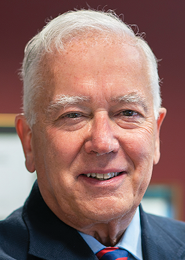
John E. Jones III
Preparing Students For What Comes Next
Editors’ Note
John E. Jones III was officially named Dickinson College’s 30th president on February 28, 2022, after serving as interim president since the summer of 2021. After taking the helm, Jones immediately launched the Dickinson Forward: Our Revolutionary Future initiative that included a strategic planning process and the college’s most ambitious scholarship fundraising campaign in its history. The college has advanced rapidly under Jones’ leadership, building an alumni and family center, improving athletics facilities, witnessing record philanthropic investments in the academic program and renovating the student center on campus. Jones took the helm after retiring as chief judge of the U.S. Middle District Court of Pennsylvania. He was appointed to the federal bench by President George W. Bush and unanimously confirmed by the United States Senate on July 30, 2002. As president of Dickinson, Jones has become a go-to legal expert for national media, and his commentary has appeared in The Wall Street Journal, The Guardian and Reuters. He has appeared on CBS Mornings, the BBC, CNN, NewsNation and MSNBC. Before becoming a federal judge, Jones was a lawyer in private practice in his hometown of Pottsville, Pennsylvania. In November 1994, then Pennsylvania Governor-elect Tom Ridge named Jones as a co-chair of his transition team. In May 1995, Ridge nominated Jones to serve as chairman of the Pennsylvania Liquor Control Board. Jones has received numerous accolades during his career. He received the Outstanding Alumni Award from the Dickinson School of Law, as well as an honorary doctorate in law and public policy from Dickinson College, where he was recognized as one of the 25 most influential graduates in the college’s history. In 2009, the college’s faculty voted to induct Jones into its Phi Beta Kappa chapter. In 2006, Jones was named by Time magazine as one of its Time 100 most influential people in the world. He also received a Rave Award for Policy from Wired magazine and was the recipient of the first John Marshall Judicial Independence Award, given by the Pennsylvania Bar Association. In 2009, he was the recipient of the Geological Society of America’s President’s Medal, and in the same year he was inducted into the George Washington Spirit Society. In 2013, Chief Justice John Roberts appointed Jones to the Committee on Judicial Security, a standing committee of the Judicial Conference of the United States, and in 2018 Roberts appointed Jones to the Committee on Space and Facilities. Jones joined Dickinson College’s board of trustees in 2008 and served as chair of the board from 2017 until 2021. He is a former member of the Board of Regents of Mercersburg Academy. He has served as an adjunct professor of law at The Penn State Dickinson School of Law. Born and raised in Schuylkill County, Pennsylvania, he is a graduate of Mercersburg Academy, Dickinson College and Penn State Dickinson Law.
Institution Brief
Dickinson (dickinson.edu) is a nationally recognized liberal arts college in Carlisle, Pennsylvania. The college emphasizes small classes with extensive opportunities for research, fieldwork, career immersion and internships, and challenging and innovative academic programs ranging from data analytics to neuroscience to international business. Since 1783, Dickinson has offered a future-proof education built for what comes next.
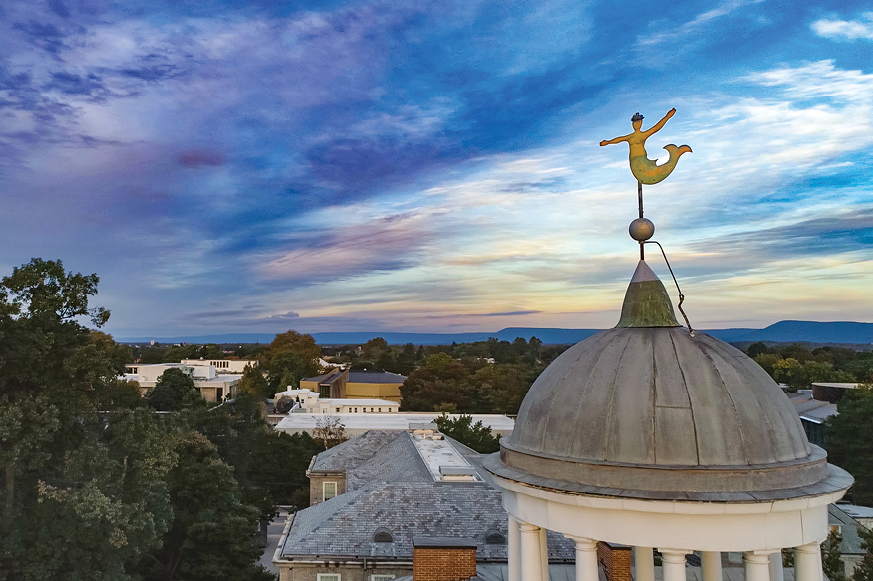
The Dickinson Mermaid above Old West, the oldest
building on campus, which was designed by U.S. Capitol
architect Benjamin Latrobe
Will you discuss your career journey?
I commenced my career as a kind of “country lawyer” back in my home county in northeastern Pennsylvania. As such, I represented folks from all walks of life, appeared in court frequently, and engaged in many civic activities. I became politically active early in my career as a member of the Republican Party, which exposed me to many elected officials. One of them was former Pennsylvania Governor Tom Ridge, who became a mentor and invited me to join his administration as part of his senior team. This exposure ultimately led to my nomination by former President George W. Bush to a judgeship on the U.S. District Court for the Middle District of Pennsylvania in 2002. I served in that position for nearly 20 years, and when I resigned my commission to lead Dickinson College, I was Chief Judge of the District.
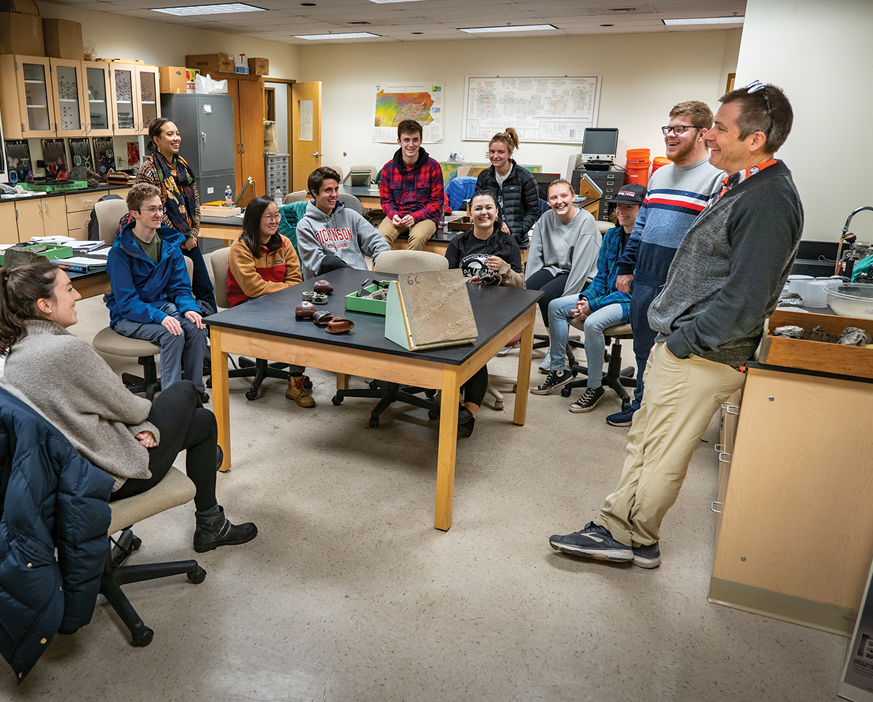
Dickinson students in a Geosciences class
What excited you about the opportunity to lead Dickinson College?
Interestingly, when first offered the position by the board of trustees, I turned them down. However, upon reflection and at the urging of my wife, Beth, I realized that this was a rare opportunity to make a difference in a way that was totally distinct from anything I’d ever done before. I recognized as well that I would never have the chance to achieve such a position again. With no small amount of trepidation, I accepted the offer and returned to my alma mater.
How do you approach the role?
While I worked very hard as a lawyer, putting in time during evenings and weekends as well, I seriously doubt that I’ve ever worked harder than I am now. This is a consuming job, and I’ve learned that it is important to try to pace yourself and as much as I hate to, decline some of the many invitations I receive to appear at functions both on campus and off. But in the end, my greatest joy is interacting with our students. This is tremendously rewarding, makes me optimistic about our future, and reminds me every day why accepting this post was precisely the right thing for me to do.
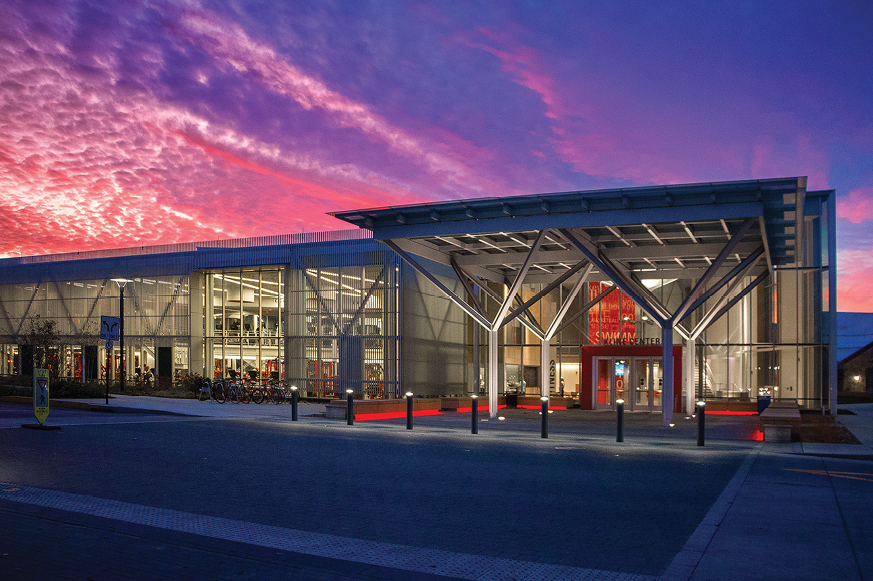
Kline Center, home of Dickinson athletics
What do you feel are the strengths of a liberal arts education?
At Dickinson, our mantra is that we prepare you for what comes next. I believe that the kind of liberal arts education we provide is the very best way to “AI proof” your career. While we lean in to teaching artificial intelligence’s many advantages, the world will always need the kind of critical thinkers who are emotionally intelligent and possess the ability to be good storytellers that the liberal arts produce. Job skills learned today may well become obsolete, but the utility of your liberal arts education will never expire.
What do you see as the responsibility that Dickinson College has to be engaged in its community?
Dickinson College is integral to the greater Carlisle and central Pennsylvania ecosystem. We foster excellent town-gown relations, offer our public spaces for community use, and welcome members of the community to the many public lectures we present during the academic year. Our faculty and staff engage in many civic and charitable ventures, and devote their time and talents to the betterment of the beautiful region in which we’re located. And our students do research in our community, intern here and volunteer.
What do you feel are the keys to effective leadership?
Effective leaders must be genuine, and not try to present themselves as something they’re not. They must also be visible, transparent, empathetic, and clearly delineate their priorities and goals. Generally, people like to be led by those who inspire them, respect what they do, and engage with them candidly. If you desire loyalty from those with whom you work, you must demonstrate that same loyalty to them.
When you look to the future of education, who excites you the most, and what concerns you the most?
It is not hyperbolic to say that higher education is at an inflection point. Arguably there are too many colleges and universities for the number of students who desire to enroll, and we are seeing institutions fail. More will disappear in the years to come before this levels out. While Dickinson is not at any similar risk, as with other colleges, we are concerned about the ever-rising costs of operation and our ability to conduct a sound business model that allows us to properly compensate our faculty and staff. But at bottom, I believe there will be myriad opportunities for strategic partnerships and creative ways to enhance the world-class liberal arts education we afford students. We must continue to innovate around our curriculum to make sure we are meeting the needs of our students. I am confident that we will remain the premier institution we’ve been for nearly 250 years, producing engaged citizens and leaders who will change the world. Dickinson’s best days lie ahead.