- Home
- Media Kit
- MediaJet
- Current Issue
- Past Issues
- Ad Specs-Submission
- Reprints (PDF)
- Photo Specifications (PDF)
- Contact Us
- PRIVACY POLICY
- TERMS OF USE
Loading

ONLINE


John Fish
The Future Of Construction
Editors’ Note
John Fish is the Chairman and Chief Executive Officer of Suffolk, a national contractor and real estate enterprise that invests, innovates, and builds. Under his vision and leadership, Suffolk has grown into one of the leading privately held builders in the country. With over $10 billion in annual revenue, Suffolk is currently ranked on the Engineering News-Record national list of Top Contractors. Fish is a fixture on numerous Boards focused on economic stability and real estate industry growth. He is the Chair of the Real Estate Roundtable, a non-partisan organization that convenes government, business, and communities to establish more equitable policies for economic growth. He is the founding member and current Director of the Massachusetts Competitive Partnership (MACP) and former Chairman of the Board of the Federal Reserve Bank of Boston. In New York City, Fish is a Director of the Real Estate Board of New York and a member of the Partnership for New York City, and he sits on the National Business Roundtable. He serves as Chair of Brigham and Women’s Hospital and sits on the Executive Committee of Mass General Brigham. He also serves on the Board of the Feinstein Institutes for Medical Research at Northwell Health. He is the Chair of the Board at Boston College, his second time serving that role and first non-alum to fulfill that role. Fish is also on the Board of Overseers for Home Base. In 2009, Fish founded Scholar Athletes and led the program for more than ten years, improving the lives of thousands of inner-city high school students by leveraging the proven link between school athletics and academics. Fish is a graduate of Bowdoin College with a bachelor’s degree in political science. He received an honorary doctorate of engineering technology degree from Wentworth Institute of Technology, is the recipient of an honorary degree from Regis College, and received an honorary degree in business administration from Curry College.
Company Brief
Suffolk (suffolk.com) is a national enterprise that builds, innovates and invests. Suffolk is an end-to-end business that provides value throughout the project lifecycle by leveraging its core construction management services with vertical service lines including design, self-perform construction services, technology start-up investment (Suffolk Technologies), supply chain management (Freedom Source) and innovation research and development. Suffolk, known as America’s Contractor, is a national company with more than $10 billion in annual revenue, 3,500 employees, and offices in Boston (headquarters); New York City and Westchester County in New York; Miami, West Palm Beach, Tampa and Estero in Florida; Dallas; Los Angeles, San Francisco and San Diego in California; Las Vegas; Portland in Maine; New Haven in Connecticut; Herndon in Virginia; and Salt Lake City in Utah. Suffolk services clients in sectors including healthcare, life sciences, education, gaming, transportation/aviation, government, mission critical, advanced technology and commercial. Suffolk is ranked #8 on Engineering News-Record’s list of “Largest Domestic Builders” and #10 on its list of “Top CM-at-Risk Contractors.”
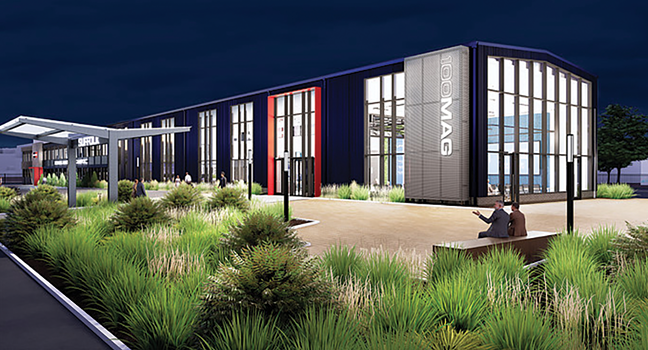
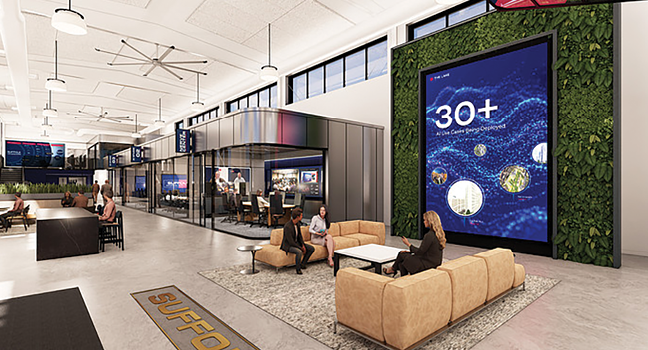
100 MAG exterior (above) and interior (below)
How do you define Suffolk’s mission?
Our mission is to redefine what it means to be a builder. I have been in this business for a long time, and I believe we are at an inflection point. The projects we are delivering across the country today are more complex than ever, and we are facing rising costs, tighter schedules and increasing expectations. Those pressures are real, but I see them as an opportunity to think differently and find innovative ways to add value for our clients. At Suffolk, we have fully embraced that challenge. We are bringing together technology, data, AI and the expertise of our people to create a smarter, more connected, and more predictable way to deliver the highest-quality projects with greater precision and speed. Construction is a people business and relationships matter. That has always been at the core of Suffolk and will never change.
What is changing is how we build and we intend to continue leading that evolution by reshaping how buildings are envisioned, planned, designed, built, and managed. That is how we will redefine this industry and it drives us every day.
Will you discuss Suffolk’s commitment to being at the forefront of innovation?
Innovation has always been essential to how we operate and how we create value for our clients and partners. We made the decision to invest ahead of where the industry was going and put real capital behind data, technology and new capabilities because we believed the future of construction would look very different. That early investment has been critical and differentiating for us as a company.
Through Suffolk Technologies, we are investing in startups and solutions that are transforming the built environment, while also giving those companies the opportunity to test and refine their technologies on our jobsites. That allows us to bring leading-edge innovation directly into how we deliver.
Through Suffolk Design, we are engaging much earlier in the lifecycle of a project and working alongside architects to identify gaps, improve coordination and ensure greater completeness before construction begins. That reduces rework, improves predictability, and drives better outcomes for our clients.
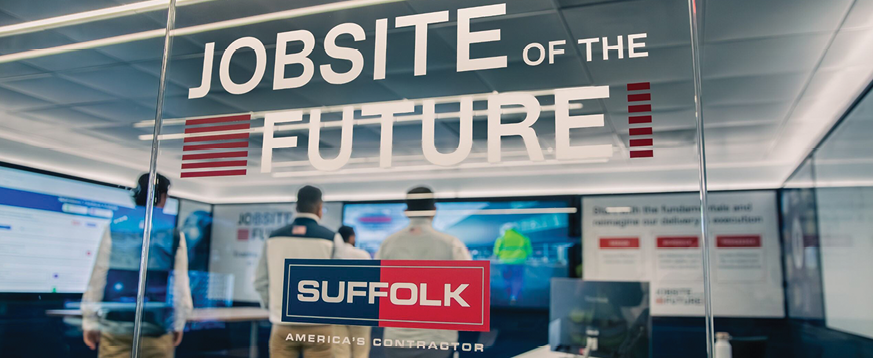
And through Jobsite of the Future and 100 MAG, we are building what is a fundamentally new operating model for construction. We are embedding AI engineers directly on our jobsites to solve real problems in real time and connecting that work to a centralized hub where those solutions can be developed and scaled across the company.
We’re not looking for incremental change. Our focus is on building a better way to do the work and helping move the entire construction industry forward.
What role do AI and data analytics play in Suffolk’s projects?
AI and data are at the center of everything we are doing. More than 15 years ago, we made a decision to invest heavily in clean, structured data because we believed it would become the foundation for better decision-making. Today, that investment has created a powerful data set built from hundreds of projects that allows us to see patterns, anticipate risk and make better decisions earlier. What sets Suffolk apart is how we are putting that data to work. At our headquarters in Boston, we are expanding our campus to create 100 MAG, which will serve as the nerve center of our innovation ecosystem, bringing together AI engineers, data scientists and operational leaders to study, develop, refine and scale solutions.
At the same time, innovation is happening directly on our jobsites through our Jobsite of the Future program. We are embedding AI engineers with our project teams, where they are working side by side to understand and solve real problems across design, schedule and process.
That is where the model becomes powerful. Ideas are generated in the field where the work is happening and then brought to 100 MAG to be tested, refined, and scaled. From there, those solutions are deployed back into our projects and integrated into how we operate across the company. The idea is a continuous loop between the field and our innovation center, allowing us to move quickly and create real impact.
AI is not about replacing people. It is about giving our people better tools, eliminating inefficiencies, improving decision-making, and allowing them to focus on what they do best: building, solving problems and leading teams.
How is Suffolk addressing workforce development to ensure it has the needed talent and expertise for the future?
One of the most rewarding aspects of this business is seeing people grow both personally and professionally and helping them realize their potential over time. I often say we don’t just build buildings; we build people. Today, that also means preparing our teams and the next generation of construction leaders for the future. As the industry evolves, we have to invest in people differently. The next generation of builders will need to be comfortable working with data, technology and new ways of delivering projects. They will need to think differently, take on responsibility early and adapt quickly.
A good example of our investment in the future is our Career Start program. Since 2004, we have brought in early-career professionals and given them the opportunity to rotate through preconstruction, project management and field operations, exposing them to every part of the business and how projects actually get delivered. That kind of experience accelerates learning and helps develop well-rounded leaders, many of whom have grown their careers at Suffolk.
At the end of the day, culture matters most. If you create an environment where people feel supported, challenged and part of something meaningful, they will grow and they will help move the industry forward.
How do you balance cost pressures with sustainability goals in large-scale projects?
Cost and sustainability are often viewed as competing priorities, but I don’t see them that way. The key is alignment early in the process. When you bring design, construction and operations together from the outset, as we do with Suffolk Design, you can evaluate tradeoffs in real time and make better, more informed decisions. We see this on our projects every day, from large-scale healthcare and higher education projects to complex commercial developments, where early coordination allows us to balance performance, cost, and long-term value.
Data also plays an essential role. It allows you to understand how decisions will perform over the life of the project rather than focusing only on upfront cost. In many cases, the most sustainable solution is also the one that delivers the greatest long-term value.
What is your outlook on the future of urban development in major U.S. cities?
I remain optimistic, but I think we are at a defining moment. Cities have always been centers of opportunity, innovation and economic growth. At the same time, they are facing real challenges from housing affordability to infrastructure and climate resilience. Addressing those challenges will require new thinking and stronger collaboration between the public and private sectors. The cities that succeed will be the ones that are willing to embrace change, whether that is new technologies, new approaches to development or new ways of working together. We see that as an opportunity to be part of the solution.
What advice do you give to young professionals entering the construction industry?
Be curious, work hard and care about other people. I also strongly believe that culture defines great organizations. My advice to young professionals is to find a place where the culture aligns with your values, because that is where you are going to grow, build meaningful relationships, and do your best work. At Suffolk, our culture is built around a core set of values that we discovered over time: passion, hard work, integrity, professionalism and caring. They are our North Star and guide how we hire, how we work together and how we serve our clients. For those who share those values, there is an opportunity to build a mission-driven career here.
I would also add that construction today is about solving complex problems using technology, data and new ways of thinking. This is not the same industry it was even ten years ago and the people who will succeed are the ones who are willing to learn, adapt and embrace that evolution. Young people have an enormous opportunity to be part of leading that change. These are exciting times in our industry.
When you look to the future of construction, what excites you the most, and what concerns you the most?
What excites me most is that we now have the tools to truly change this industry. For the first time, data, AI and new business models are coming together in a way that allows us to improve productivity, reduce risk and deliver better outcomes at scale. I have believed for a long time that this was possible, and we are now seeing it take shape. I am also encouraged by the next generation of leaders coming into the industry and see every day how their perspective, adaptability and energy are going to help drive this change forward.
What concerns me is that the industry has struggled with productivity and inefficiency for a long time, and those challenges are not going away. If we continue to rely on the way things have always been done, it will be difficult to keep up with the demands we are facing.
This is a defining moment that requires leadership and a willingness to think differently. And I’m optimistic because I believe the organizations that lean into that change, invest in innovation, and stay focused on their people will chart the future of construction.