- Home
- Media Kit
- MediaJet
- Current Issue
- Past Issues
- Ad Specs-Submission
- Reprints (PDF)
- Photo Specifications (PDF)
- Contact Us
- PRIVACY POLICY
- TERMS OF USE
Loading

ONLINE


Farooq Kathwari
Constant Reinvention
Editors’ Note
Farooq Kathwari has been the chairman and CEO of Ethan Allen Interiors Inc. since 1988. A recipient of the 2018 Ellis Island Medal of Honor, he has been inducted into the American Furniture Hall of Fame and recognized as an Outstanding American by Choice by the U.S. government. He has also received the Yale School of Management Chief Executive Leadership Institute Lifetime of Leadership Award and Ernst & Young’s Entrepreneur of the Year Award. Kathwari is an advisory member of the New York Stock Exchange and on the board of the Western Connecticut State University Foundation. He is associated with several nonprofit organizations, including the International Rescue Committee, the Center for Strategic and International Studies, the Institute for the Study of Diplomacy at Georgetown University, and the Council on Foreign Relations. He is chairman emeritus of Refugees International. The author of Trailblazer: from the Mountains of Kashmir to the Summit of Global Business and Beyond, Kathwari has been recognized as one of Worth magazine’s 50 Best CEOs in the United States.
Company Brief
Ethan Allen (ethanallen.com), named America’s #1 Premium Furniture Retailer by Newsweek for three consecutive years, is a leading interior design destination combining state-of-the-art technology with personal service. Ethan Allen design centers, which represent a mix of company-operated and independent licensee locations, offer complimentary interior design service and sell a full range of home furnishings, including custom furniture and artisan-crafted accents for every room in the home. Vertically integrated from product design through logistics, Ethan Allen manufactures about 75 percent of its custom-crafted products in its North American manufacturing facilities and has been recognized for product quality and craftsmanship since 1932.
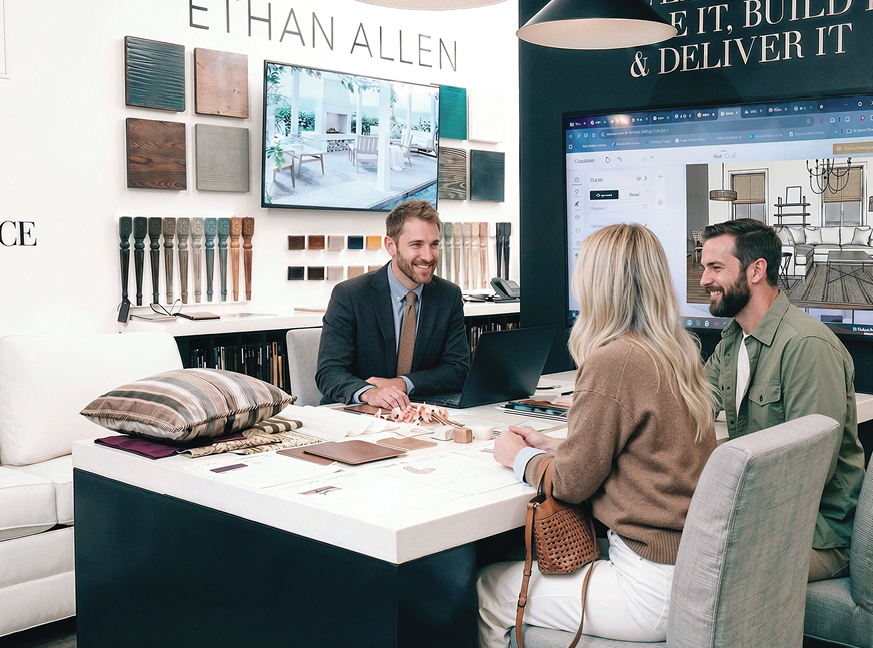
Interior design service is complimentary at Ethan Allen,
helping the company to build long-standing relationships
with clients
You have led Ethan Allen for decades. Has your leadership philosophy evolved over time, and what do you feel are the keys to effective leadership?
One of my most formative leadership experiences took place while I was completing my undergraduate studies in Kashmir. I was captain of the cricket team, and it taught me something very important: a captain needs to be out on the field with the players. The captain plays with the team, strategizes with the team, moderates the team, and is part of the team. A leader’s job is to help their people become better – not to get the most and give the least.
The culture of revolution and innovation was also part of my background, and treating people fairly has always been important to me. My association with Ethan Allen started as a partnership, with my company developing products from many parts of the world for Ethan Allen while I was a student at New York University. The two companies merged about 45 years ago, and I had the distinction of becoming President of Ethan Allen four years later, in 1985.
When I started at Ethan Allen, I created a list of 10 Leadership Principles. These principles continue to be a North Star for our company culture, and people who perform well at Ethan Allen tend to naturally align with these principles. They embrace change, recognize others’ contributions, and treat others with respect and dignity. They work hard, react with speed, and put our clients first in every decision they make.
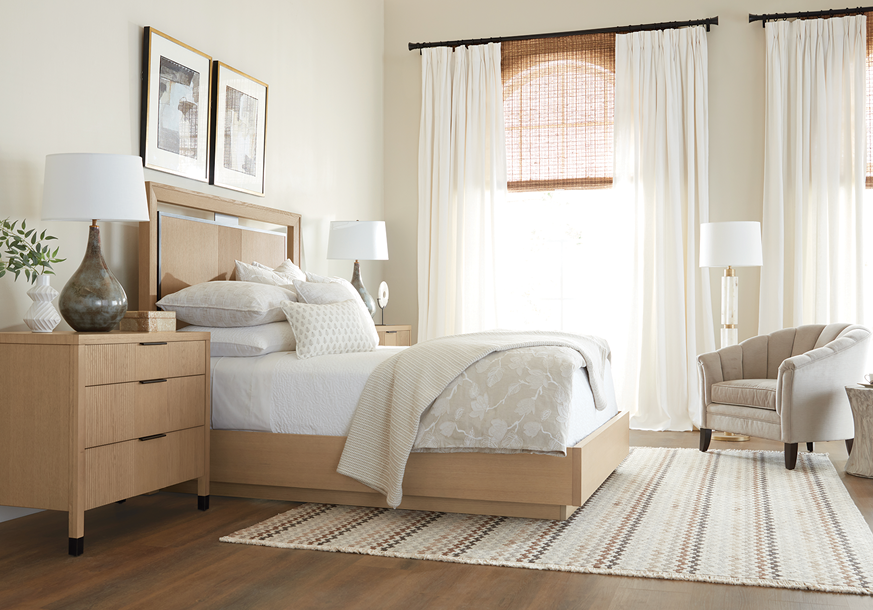
An ever-widening range of materials and artisan techniques
keep Ethan Allen’s products fresh and relevant
How do you balance tradition with innovation in a legacy brand?
At Ethan Allen, we have a design philosophy we call “classic design, modern perspective.” Our products are based on timeless forms, and they’re constructed using timeless techniques. At the same time, most of what we manufacture has custom options, so a single product can be made in different ways. Our clients can create a modern home, suited to their taste, designed around relevant products that will last and evolve with them over time.
Like the principles of good design, the principles of good business stay the same: financial responsibility, discipline, and a commitment to quality are just as important today as they were when Ethan Allen got its start 94 years ago. The environment has changed, customers’ tastes have changed, and the tools we have for running our business have changed, but through constant reinvention, we can reimagine how to achieve those core business goals.
What are the advantages of Ethan Allen’s vertically integrated model?
Staying vertically integrated has kept Ethan Allen in control of its own destiny. About thirty years ago, when most companies began sending manufacturing overseas, we doubled down on our commitment to staying in North America. That decision has paid dividends in many situations, especially during economic challenges, by helping us maintain strong standards of quality and service, and keeping our prices more stable compared to our competitors.
We manufacture most of our products in our North American plants, and providing high-quality products with customized options is a great advantage. Another main advantage of being vertically integrated is that we deliver our products, with excellent service, at one cost to our clients throughout North America. This gives us control over the quality of our products, the level of service we provide, and as I mentioned, control over our destiny.
In addition, we have a network of 175 Design Centers in North America, staffed by some of the longest-serving interior design professionals in the U.S.; we also have a number of Design Centers internationally. We’re able to recruit such strong designers because they know they can stand behind the quality of products that are made by us, and because they know they have so many custom options to offer their clients – all thanks to our decision to remain vertically integrated.
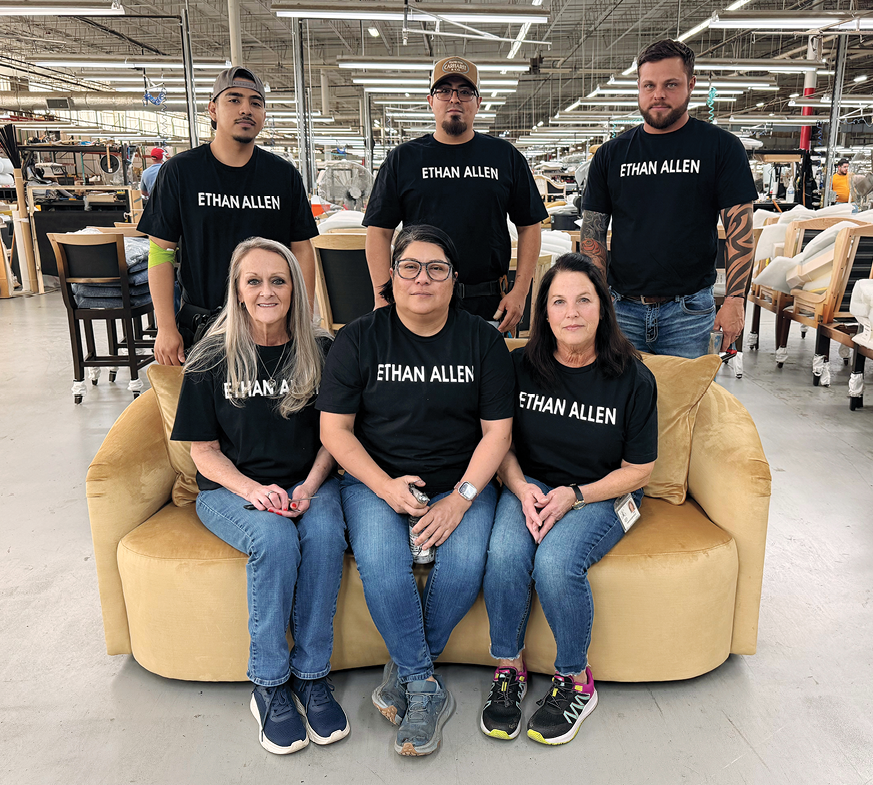
Ethan Allen makes most of its furniture in
North America,
hand-tailoring upholstery and
handcrafting wood furniture
What qualities do you look for in future leaders within the organization?
I expect leaders to point out new opportunities and find new ways of doing things while remaining focused on core goals and managing resources responsibly. I have a great, motivated, and diverse team, and when the right people are in the right positions, good things happen.
Over time, I’ve learned the value of keeping on a set of core objectives and maintaining constant communication about those objectives. I receive 40 weekly reports focusing on shared priority areas – talent, service, marketing, technology, and social responsibility – along with “WOW” stories that mark exceptional service from all areas of our business. We are focused on the future, entrepreneurial yet disciplined, and well positioned for whatever comes our way.
“The foundation of our business is trust – the trust clients have in the quality of our products, and the trust they have in the interior designers they work with – and that’s a foundation that can withstand almost anything.”
How is technology changing the furniture retail experience?
Technology, as I noted before, is very important in all areas of our enterprise. Looking for ways to combine personal service and technology continues to be key in our product design, marketing, retail network, manufacturing, and service. At our Design Centers, 3D technology has not only given clients a greater ability to visualize their projects as they work with our designers, but also changed the look and feel of many of our locations. Clients can enjoy a complete experience within a smaller footprint, which gives us greater flexibility as we consider the best places to locate our Design Centers. It places us closer to our target customer and ensures they have even better interactions with Ethan Allen while helping us optimize our costs – a win-win for everyone.
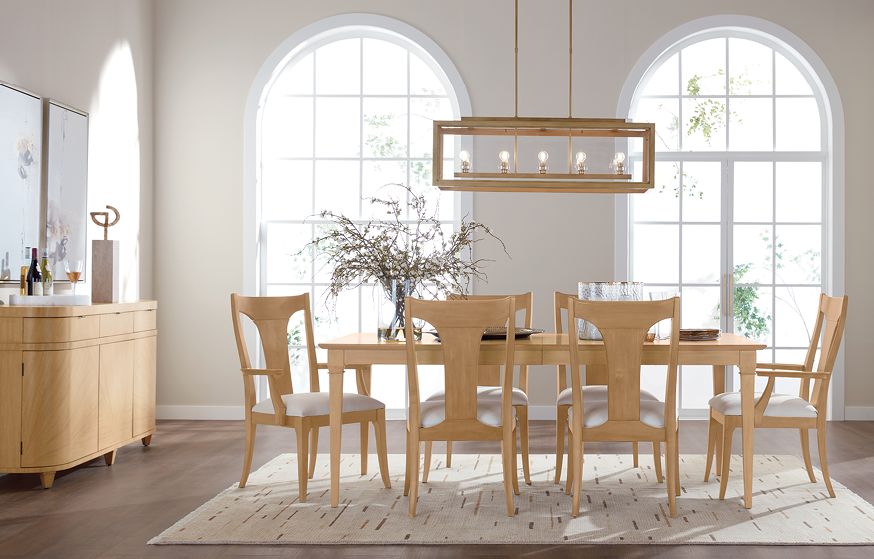
Ethan Allen’s specialty: taking classic furniture forms and
reimagining them for the way people live today
How do you maintain a high-touch customer experience in a digital world?
Rather than making it harder to build relationships, digital tools give us more ways to reach clients. We find that most clients initiate projects via online contact, even before they meet their designer in person. We’ve recently implemented an in-house platform for our designers that gives them a personal online storefront along with tools for sending emails and texts about our offers, new products, and other marketing to clients and prospects – giving our designers even more touchpoints around which to build repeat business.
The future of design is about clients being able to work with a designer from anywhere, in the way that works for them. A designer in Connecticut may help a client design a summer home in North Carolina; another designer in Texas may help a client design a home in the Middle East, working via video calls, emails, and text messages in which they review images, photos of fabrics, and 3D renderings together. An entrepreneurial designer can greatly expand their reach while maintaining the highest standards of personal service.
What do you see as the responsibility that leading companies like Ethan Allen have to the communities they serve?
As part of our commitment to North American manufacturing, we make a point to support the communities where our associates live and work. In Vermont, where our company began, we still have the sawmill our founders purchased in 1936, and we have a large manufacturing plant where we make wood furniture. We’re one of the area’s largest employers – it’s not uncommon for multiple generations from the same family to work with us, and we take our contribution to the local economy seriously. In 2023, when the area experienced major flooding that severely impacted our plant, we didn’t leave; we rebuilt.
We’ve expanded our footprint in North Carolina in recent years and maintained operations in Silao, Mexico, and in Honduras, and we also take our responsibility in those developing countries very seriously. In both locations, we offer on-site medical care and health fairs, as well as meals; in Silao, we provide transportation to work.
Our commitment to community also shows in our commitment to environmental stewardship; for example, our Silao plant, for seven years in a row, has been recognized as Environmentally and Socially Responsible by the Mexican Center for Corporate Philanthropy and the Alliance for Corporate Social Responsibility. We’ve also been recognized for our support of responsible forestry by the Sustainable Furnishings Council and the National Wildlife Federation.
When you look to the future of the industry, what excites you the most, and what concerns you the most?
The challenge most affecting our industry right now is the uncertainty in our economy. Overseas conflicts, changing relationships with other countries, and trade inhibitors like tariffs could have significant consequences for the passage of goods around the world and pose a risk of diversification away from the U.S. dollar. Consumers are also facing many inflationary pressures, which affects their discretionary income, their access to credit, and their access to affordable housing. Of course, inflation also affects the cost of the resources we purchase to make our products.
Despite these challenges, I remain cautiously optimistic. Because Ethan Allen is a vertically integrated enterprise, and we manufacture most of our products in North America, we’ve been less affected by some of the volatility, and we’re in a stronger position than many of our competitors. I’m also optimistic when I see the great talent across our company, the benefits of our unique combination of personal service and technology, and the attitude of constant reinvention that permeates our culture. The foundation of our business is trust – the trust clients have in the quality of our products, and the trust they have in the interior designers they work with – and that’s a foundation that can withstand almost anything.
What advice do you give to young people beginning their careers?
Young people today face many challenges as they begin their careers, whether in our industry or in any industry. It’s difficult to know how the advancement of technology will affect the kinds of jobs that will be available ten years from now.
At the same time, although some jobs may no longer be available, others will be created because of new technologies. It’s important to spot those emerging trends, to seize new opportunities, and to commit to being a lifelong learner – again, entrepreneurial yet disciplined.
I always say that crisis creates opportunity, and if young people will remain open to change, and most of all, if they’re willing to work hard, they will find their way – even though the way may look very different than it did even just a few years ago.