- Home
- Media Kit
- MediaJet
- Current Issue
- Past Issues
- Ad Specs-Submission
- Reprints (PDF)
- Photo Specifications (PDF)
- Contact Us
- PRIVACY POLICY
- TERMS OF USE
Loading

ONLINE

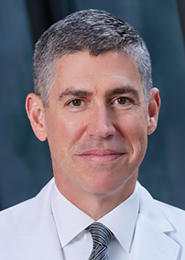
Dr. Brendan G. Carr
The Future Of
Healthcare Delivery
Editors’ Note
Brendan Carr, is a nationally recognized leader in academic medicine and health policy. He leads as a physician-scientist. He completed his residency in emergency medicine, as well as fellowships in trauma and surgical critical care and in health policy research. In addition to clinical practice, he maintained a decades-long funded research portfolio and served in multiple policy roles within the U.S. Department of Health and Human Services. His career has focused on transforming the health care delivery system in order to improve patient outcomes. Carr is an elected member of the National Academy of Medicine, and an advisor to domestic and international health care organizations.
Institution Brief
Mount Sinai (mountsinai.org) is consistently recognized among the world’s leading academic health systems. It includes a premier academic enterprise consisting of leading schools of medicine, graduate biomedical education, and nursing, along with 600 research and clinical labs. The Icahn School of Medicine at Mount Sinai ranks #11 nationally among medical schools for National Institutes of Health (NIH) funding, underscoring the strength of its academic enterprise and its leadership in scientific discovery, biomedical research, and innovation.
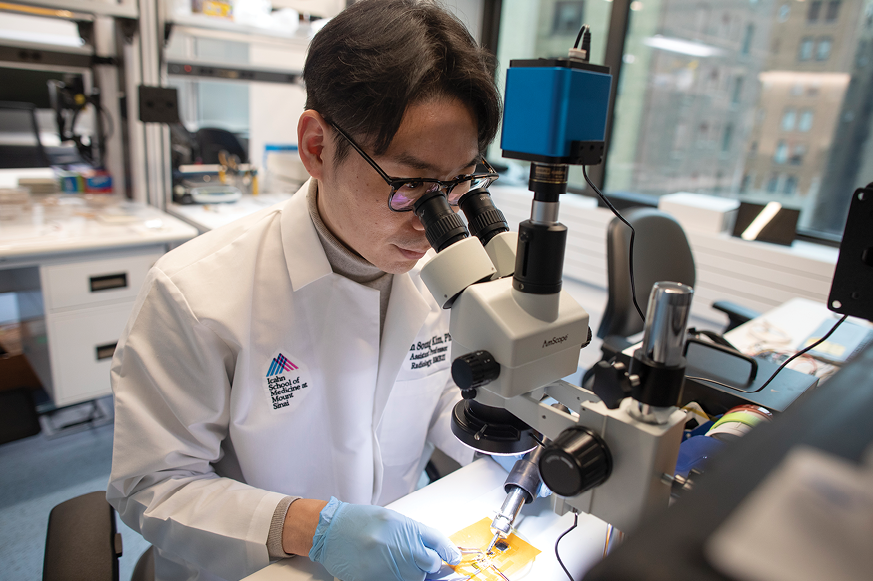
Dr. Yun Soung Kim is an Assistant Professor of Radiology
at the BioMedical Engineering and Imaging Institute
of the Icahn School of Medicine at Mount Sinai
Mount Sinai’s academic excellence sits side-by-side with one of the largest integrated health care systems in the nation. Serving the greater New York metro region and the world, Mount Sinai’s 48,000 caregivers include more than 9,000 physicians and 8,500 nurses, and delivers care to millions of people every year. Mount Sinai serves its communities across more than 400 outpatient practices, seven hospitals, and strategic partnerships with public and private entities. Its academic hub, The Mount Sinai Hospital, is ranked the #1 hospital in New York by Newsweek.
Mount Sinai’s unique structure creates a culture of creativity, learning, and innovation. Mount Sinai is addressing the full range of medical needs from essential primary and preventive care to health optimization and longevity, as well as the most complex tertiary medical needs of the population. Mount Sinai pushes the boundaries of health care delivery through innovative thinking about how to use data and technology to improve the way care is delivered both at the bedside and in patient-focused administrative roles.
Mount Sinai’s structure, mission, and drive position it to deliver innovative, comprehensive health care for communities while at the same time relentlessly working to discover tomorrow’s breakthroughs, cures, and leaders.
Will you discuss your career journey to medicine?
I had a nontraditional path to medicine. I was in graduate school for psychology, working on a mobile crisis intervention team, and staffing a 24/7 suicide and crisis hotline. Nobody in my family had ever been in medicine, but this opportunity exposed me to health care as a career in two ways: one is that we were supervised by psychiatrists, and two, because everybody needed medical clearance before they went into our residential psychiatric facilities. I was in Baltimore at the time and got to know the team in the Johns Hopkins emergency department very well from having to go in for medical clearance, and this opened my eyes to the importance of the work. I ended up going on to a 12-month post baccalaureate premedical program to complete all of the science requirements. I didn’t know when I went to medical school what specialty I would pursue – I liked everything!
I came to understand over time that what I am most drawn to is understanding how health care is delivered and how we can evolve it to be more patient-centered. Given the importance of regulatory and financial levers in incentivizing or limiting delivery system evolution, I completed a fellowship in health care policy after my clinical training, spent decades researching health care delivery, and worked inside the federal government to implement change.
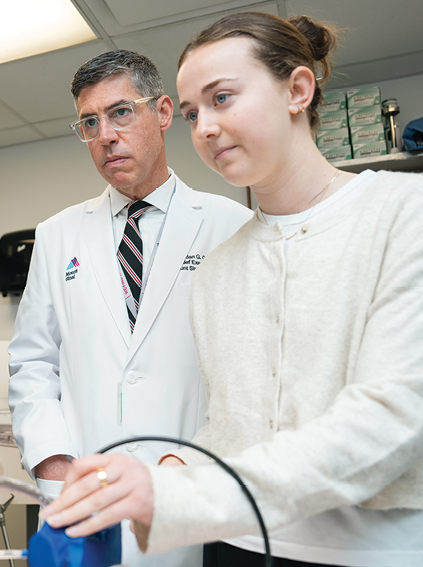
Mount Sinai BioDesign Lab is the premier incubator for r
apid medical device innovation within the
Mount Sinai Health System
Will you highlight Mount Sinai Health System’s commitment to innovation?
The word innovation is so broad that it means different things to different people. If you ask a scientist who is studying a drug pathway, or a potential drug target, they will say that innovation for them means creating a drug to treat people and cure disease. If you talk with people that run our health care delivery system, an example of innovation to them would be the move to telemedicine when COVID-19 happened and the use of virtual specialists across the Mount Sinai Health System for consultations in the Emergency Department or intensive care units. Innovation just means finding creative new ways to improve human health, and that is what we do. Our tagline is “We Find a Way.” And that really captures our organizational DNA. We know that it’s our job to invent the future of health care delivery and we pursue that daily in our clinical work, our research and, frankly, our back-office functions as well. The book written about Mount Sinai during the COVID-19 pandemic was called “Relentless.” It perfectly captures who we are.
How do you see AI and new technology impacting the future of health care?
In every way. A common and appropriate question as we democratize health information with agentic general intelligence is how it will impact the workforce. On the one hand, we want to empower patients to better understand, but then we immediately juxtapose that idea with the dread of mass unemployment. It’s an unreal and unhelpful juxtaposition in my mind. There is clearly a tremendous challenge with access to health care today – we should want to extend our health care workforce to serve as many people as we can. We are not going to instantly replace everyone in health care – but our jobs are going to change. The goal over the next five to ten years is to recalibrate over time what we can and should hand off to automated systems in a way that supports our teams and keeps them doing the work they love.
This tension that people feel about whether or not AI should be let into health care, whether or not AI is going to destroy the health care workforce – we can’t let it be seen as a binary issue. It’s not. This anxiety has been felt about every innovation that occurs in the health care delivery space. Change and uncertainty are scary. I would prefer that we focus our conversation around how we’re going to change health care for the better and what tools we need to do that.
We take brilliant people who are not at all knowledgeable about how to be a doctor, even if they are knowledgeable about facts and science, and we teach them how to be a doctor through medical school and residency. That’s what we do. What is the difference between generative artificial intelligence and a really, really smart college graduate – the question is how do we train them? It is about how we take these models that have enormous potential and find a way to allow them to coexist in the health care delivery system with these smart, innovative, and passionate people entering the industry. At Mount Sinai we are building an ecosystem and harnessing technology to automate and democratize health care where possible, while freeing our people to do what only humans can do: innovate, create, and transform the future of care. This should not be framed as a doomsday scenario; this is an exciting opportunity.
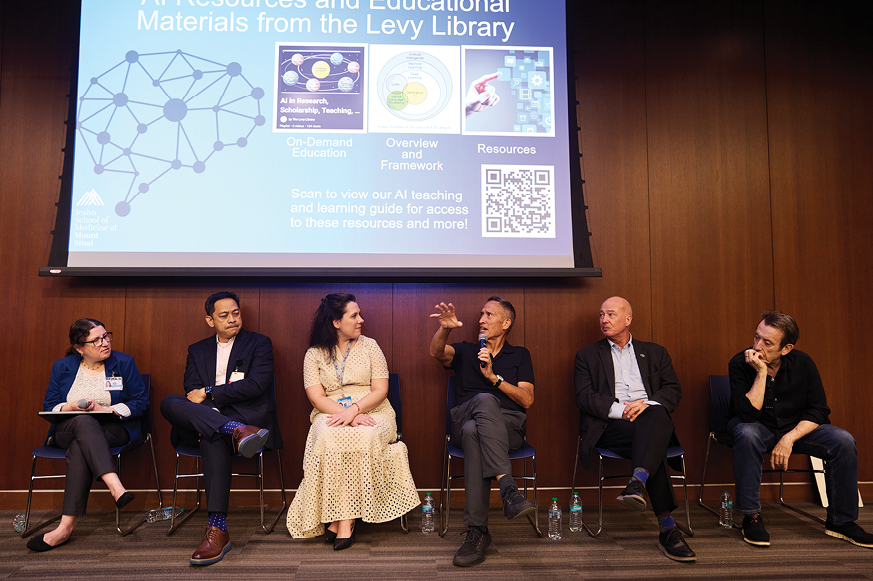
Scholar, author, and innovator José Antonio Bowen, PhD,
speaks during a panel at the inaugural AI in (Bio)Medical Education:
Innovation in Teaching and Learning symposium, held in
July 2025 on the Icahn School of Medicine campus
How critical is it for medical schools to continue to innovate their curriculum to prepare students for the future of health care?
We have brilliant students, a generation of young people who have only lived as digital natives, who are now artificial intelligence leaders. We cannot cling to the way we have educated students in the past – they wouldn’t stand for it. We must evolve what we’re teaching. We used to teach them a lot of facts and have them memorize the facts, synthesize them, and communicate them effectively to patients. Now, the facts are table stakes. Even the memorization and synthesis of the data are becoming table stakes because of the internet. With the evolution of artificial intelligence, the data and the synthesis of the data will be commoditized. What is left is the piece that we’ve been talking about for a century, and that is the human part. There will always be a critical role for people – you cannot replace the human touch and the human connection with patients.
We are fortunate to have schools of medicine, biomedical sciences and nursing that were created by visionaries who had a broad definition of health and developed an innovative curriculum to prepare future leaders in the industry. Our students do not solely learn from a book but get to see firsthand what it means to deliver care and serve patients. It is exciting to see the level of talent coming into our schools. We remain committed to developing students and future leaders who will be on the front lines of tackling the future challenges in health care.
Are you still surprised to see the amazing things that take place at Mount Sinai Health System on a daily basis?
There is not a day that goes by that I do not see or experience something that is astounding to me. It is the best part of being CEO. I get a bird’s-eye view of our amazing people helping people in every way possible. It is a privilege and an honor. The continuous innovation that is part of Mount Sinai Health System’s DNA is so exciting to be a part of. Our people are working every day to invent the future of health care delivery. I’m full of optimism and excitement.