- Home
- Media Kit
- MediaJet
- Current Issue
- Past Issues
- Ad Specs-Submission
- Reprints (PDF)
- Photo Specifications (PDF)
- Contact Us
- PRIVACY POLICY
- TERMS OF USE
Loading

ONLINE

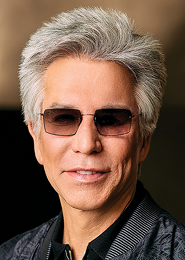
Bill McDermott
The Blueprint For
Agentic Business
Editors’ Note
Bill McDermott was named Chairman in 2022 and has served as a member of the Board of ServiceNow since 2019. Previously, he was Chief Executive Officer and a member of the Executive Board of SAP. Before joining SAP, he served in senior executive roles with Siebel Systems and Gartner, Inc. He launched his business career at Xerox Corporation, where he rose to become the company’s youngest corporate officer and division president. McDermott got his start as a young entrepreneur running a small delicatessen business on Long Island, New York, at age 17. He received his bachelor’s degree from Dowling College and his MBA from the Kellogg School of Management at Northwestern University.
Company Brief
ServiceNow (servicenow.com) is putting AI to work for people. The company moves with the pace of innovation to help customers transform organizations across every industry while upholding a trustworthy, human-centered approach to deploying its products and services at scale. As the AI platform for business transformation, ServiceNow connects people, processes, data, and devices to increase productivity and maximize business outcomes.
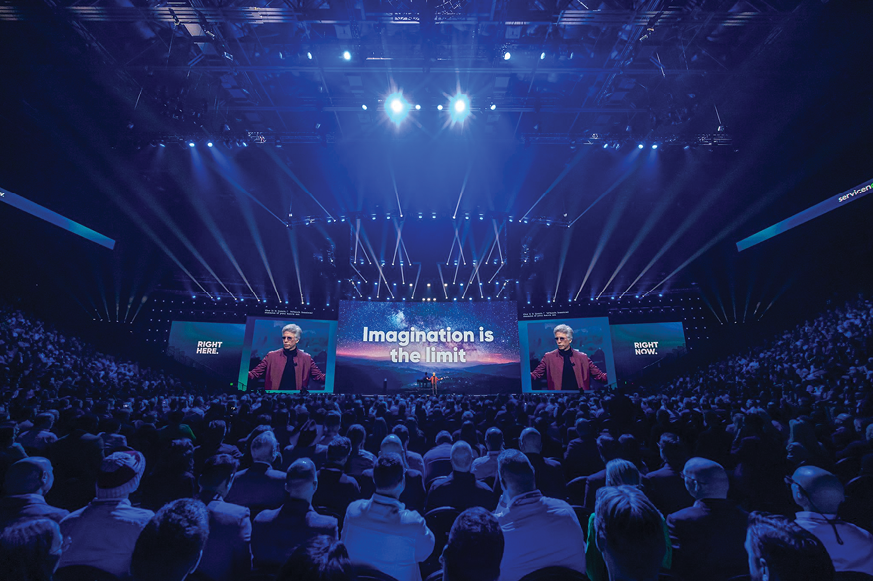
Bill McDermott speaking at ServiceNow’s 2026 Sales Kickoff
How do you define ServiceNow’s mission?
We make the world work better for everyone – every enterprise we transform, every workflow we modernize, every employee we free from work that buries their potential: that is the mission in action. When businesses run well, people’s lives get better. In the end, it’s all about people. The need for what we do has never been greater. By 2030, major economies – the U.S., U.K., Germany, Japan – could face a combined labor shortage of 50 million workers. That tells us one thing: it’s time to put AI to work for people.
At the very inception of this intelligence revolution, I predicted AI would grow exponentially. I was short…by far. Exponential is just a simple doubling: take 30 linear steps and you cover 30 meters. Take 30 exponential steps – one, two, four, eight – and at step 30, you are at one billion meters. The equivalent of circling the planet Earth 25 times. I used that analogy to shift mindsets. It worked. Then reality lapped it. IDC projects the number of active AI agents will grow 77 times over the next five years – from 28.6 million to 2.2 billion by 2030. Staggering on its own. Yet the work those agents perform, the tasks they execute, grows nearly 10,000 times over in that same window.
This is no longer exponential. This is a different order of magnitude entirely, arriving at precisely the moment humanity needs it most. Through every breakthrough, every new capability, every new frontier this revolution opens, our strategy stays anchored to the same principles. The customer is the only boss. Above all, people remain at the center of everything we do. Because technology has the potential to change businesses. Only people change the world!
“Trust is the ultimate human currency. It’s built in the moments that matter, when your people show up informed, focused, and ready. AI creates those moments.”
What have been the keys to ServiceNow’s industry leadership, and how do you describe the ServiceNow difference?
Since the day this company was founded, we have been laser-focused on one thing: the jobs our customers need done. When I joined ServiceNow, digital transformation was the top priority for every CEO on the planet. Billions had been invested, and in many cases, the returns weren’t materializing. The reason was clear: enterprises couldn’t connect their systems, their data, or their people. So, we became the Platform of Platforms. One architecture, one data model, with every system, every workflow, every employee and customer experience unified on a single platform. That’s our structural moat.
In the era of AI, customers don’t want lock-in. So we have become the AI Agent of Agents, connecting any model, any cloud, and any data source our customers choose, including OpenAI, Anthropic, Google Cloud, NVIDIA and many more. We’re proud to have built the strongest ecosystem in the industry.
Our real difference is 30,000 people who wake up every day focused on one thing: transforming our customers’ biggest challenges into even bigger opportunities. That hungry and humble culture is our enduring edge. I speak with hundreds of CEOs each year, and three challenges dominate every boardroom. ServiceNow is turning all three into opportunities.
The first is the transition from AI pilots to Agentic Enterprises. The era of AI experimentation is over. Every CEO is asking the same question: where’s the ROI? The answer is consistent. ROI comes when AI thinks and workflows act, closing the ticket, remediating the risk, fulfilling the request. That’s exactly what ServiceNow delivers.
The second is escalating AI risk. Regulatory scrutiny is intensifying and agent sprawl is accelerating. Every autonomous system operating without governance is a liability waiting to surface. The ServiceNow AI Control Tower onboards, monitors, and manages every agent, native and third-party, delivering full control and full accountability. We’re the rules and rails of business.
The third is building resilience. This is the era of structural volatility, defined by geopolitical uncertainty, supply chain fragility, and cyber threats arriving at machine speed. Reactive crisis management is no longer sufficient. ServiceNow doesn’t help enterprises recover from disruption. We help them never stop running. FedEx runs five million workflows every month on the ServiceNow AI Platform. When a security anomaly hits a sorting hub at 2:00 AM, it’s identified, contained, and resolved before the next plane boards. Chipotle operates more than 4,000 locations. When the menu changes, every restaurant reflects it immediately: one submission, one platform, zero delays.
A relentless focus on customer success. That’s the ServiceNow difference.
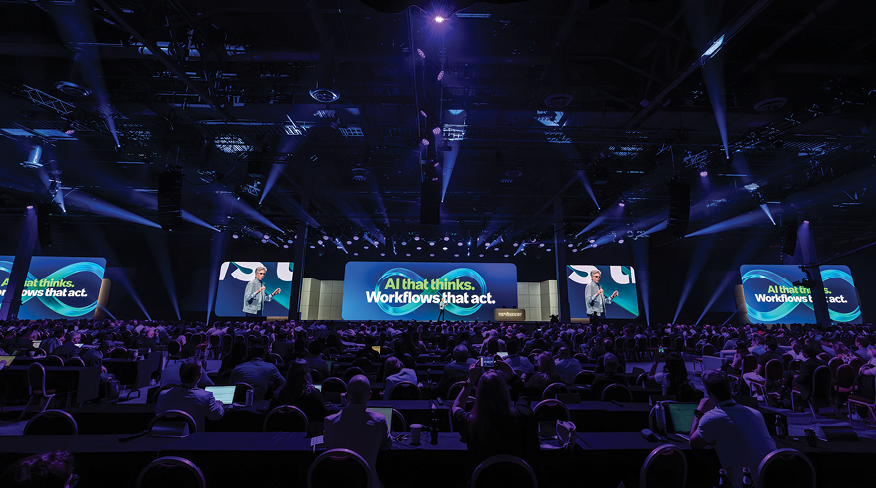
Bill McDermott speaking at ServiceNow’s 2026 Knowledge event
Will you highlight ServiceNow’s Blueprint for Agentic Business?
The Blueprint for Agentic Business is ServiceNow’s answer to the most consequential question in enterprise technology today: how do you turn AI potential into business outcomes? ServiceNow is the platform for autonomous work, built to sense across any data source or device, decide with full enterprise context, act across any workflow or application, and secure every agent, identity, and device.
Intelligence is rapidly becoming a commodity. Anyone can access a frontier model. The differentiator is who can apply that intelligence at the precise moment it matters, grounded in enterprise context, embedded in the flow of work, turning insight into action.
Intelligence will keep getting cheaper. Trusted execution will keep getting more valuable. ServiceNow applies AI inside the execution layer where work actually happens. That makes all the difference. Take a real example. A hospital nurse can’t access the patient records system at the start of her shift. A generic AI model without enterprise integration suggests troubleshooting steps: check your credentials, contact your administrator, reinstall the software. But it cannot act. It doesn’t know who the nurse is, what clinical protocols govern her access, or what device she’s using. That’s a probabilistic guess at a moment when seconds matter. ServiceNow gets to work. The AI agent senses the full context: role, department, access profile, device. It decides: root cause is an expired authentication certificate triggered by a system update overnight. It acts: certificate refreshed, access restored, ticket closed. And it governs: every step logged, audited, and fully policy compliant. The nurse is in the system before the first patient arrives.
Sense. Decide. Act. Govern, at enterprise scale, on a single platform. That’s the Blueprint for Agentic Business.
“Enterprise AI will be the largest driver of return on the multi-trillion-dollar investment in AI infrastructure being built as part of the Intelligence Supercycle.”
How do you maintain a high-touch customer experience in a digital world?
AI creates the conditions for better human connection. When AI takes on the routine, our people get their time back, and they use it where it matters most: with the customer. At ServiceNow, 89 percent of customer self-service requests are handled by AI while maintaining a customer satisfaction score of nine out of ten. Automation, at its best, is a loyalty engine. The net present value of a loyal customer is the greatest asset a company has ever had.
The numbers tell the story. Contract reviews happen 20 percent faster, so momentum builds before it has a chance to stall. We detect downsell risk 31 percent earlier through AI-powered signals, so our team arrives at every conversation prepared. I always tell the team: championships are won in the preparation. AI does the legwork so your people can do the human work. Bell Canada is a perfect example. By embedding ServiceNow CRM AI agents across its business, Bell has deflected three million support calls, automated 90 percent of dispatch operations, and is now serving 22 million customers on a single AI platform. Human agents focus on the complex, judgment-based work, the conversations that require genuine human presence, empathy and trust.
Trust is the ultimate human currency. It’s built in the moments that matter, when your people show up informed, focused, and ready. AI creates those moments. The shift is from firefighting to relationship building, from answering the same question for the hundredth time to having the conversation that actually moves the business forward. That is what high-touch looks like in the agentic world.
When you look to the future of the industry, what excites you the most, and what concerns you the most?
There are a lot of things AI can do for your business. And there are a lot of things AI can do to your business. Discerning between the two will define who thrives in this era and who doesn’t. What excites me is the magnitude of what’s possible. The internet connected information. Mobile put it in your pocket. Cloud made it accessible anywhere. This wave produces intelligence, and that’s opening up the greatest economic opportunity of our lifetime.
Enterprise AI will be the largest driver of return on the multi-trillion-dollar investment in AI infrastructure being built as part of the Intelligence Supercycle. From this point forward, the best product and the best service will always be the most intelligent. AI is not a new product category. It is the foundation of a new way of doing business, in healthcare, retail, banking, manufacturing, insurance, and every industry in between. CVS Health built a unified employee experience on ServiceNow, cutting live agent chats in half in just one month, enabling over 2.5 million AI-powered conversations while freeing their people to focus on patient care. Siemens Healthineers saved one million hours by automating their business services on the ServiceNow AI platform, while maintaining 91 percent employee satisfaction. That is what this moment looks like when you get it right.
What concerns me is companies deploying AI without proper governance. AI needs rules and rails to operate safely in the enterprise. An AI agent deleted production databases in a matter of seconds. That is not hypothetical; it happened. Hackers recently weaponized LLMs to breach ten Mexican government agencies, exposing 150 gigabytes of sensitive data including taxpayer records, voter information, and civil registry files. That is also a true story. Cybercrime is already the third-largest economy in the world, behind only the United States and China, and forecast to cost the world one trillion dollars per month by 2031. Every ungoverned agent deployed expands the attack surface. The enterprises that chase the excitement and skip the foundation will pay a price they didn’t budget for.
That is precisely why we built the AI Control Tower. On ServiceNow, every agent, every model, and every workflow is visible, governed, and auditable. Proper governance doesn’t slow down AI. It’s what makes AI safe to scale.
What do you see as the responsibility that leading companies like ServiceNow have to the communities they serve?
Our mission is to make the world work better for everyone, including the communities where we live, work, and serve. Every great technological transition has demanded the same thing of leaders: bring your people with you. When Ford introduced the assembly line in 1913, craftsmen feared obsolescence. Ford responded by raising wages, building new skills, and creating roles that hadn’t existed the day before. He redefined what it meant to be an industrial employer.
That same courage is required today. The living standards of future generations will be proportional to how many people gain access to the AI economy. ServiceNow University is helping close that gap, with nearly two million learners growing at 80 percent year over year. We’re building the workforce this era demands.
As AI scales, so do its demands on energy, water, and infrastructure. Since I joined ServiceNow in 2019, we’ve reduced our carbon footprint by 60 percent per dollar earned. Product energy consumption has decreased significantly across our data center operations, even as customer usage has nearly tripled. We scale AI responsibly.
ServiceNow.org is our impact engine, expanding access to water, energy, and livelihoods for more than 800,000 people worldwide. In partnership with our great brand ambassador, Idris Elba, and his foundation, Elba Hope, we’re working on Sherbro Island off the coast of Sierra Leone, where limited electricity access and high maternal mortality rates define daily life. Our commitment starts with reliable energy and clean drinking water, laying the groundwork for a connected workforce and a more sustainable future.
The AI economy is coming for everyone. The only question worth asking is whether we have the courage to make sure everyone is ready for it.
What do you tell young people about the types of careers the industry offers?
I tell young people the same thing I tell every CEO I meet: this is the greatest moment in history to be building a career. Not despite AI. Because of it. A significant portion of AI’s impact on careers will be simple: giving people back their actual jobs. For every hour a financial advisor spends with a client, at least two more are lost to compliance, documentation, and back-office work. For every hour a clinician spends with a patient, nearly two hours vanish into administrative tasks. On a typical factory floor, workers spend up to two hours every shift on paperwork and manual reporting instead of producing. AI will take that burden away. The advisor gets back to advising. The clinician gets back to caring. The factory worker gets back to building. That is what this technology is for.
Of course, AI is also creating entirely new categories of work: AI strategy, AI engineering, model operations, AI data annotation, LLM governance & cybersecurity. LinkedIn identifies AI-related occupations as among the fastest-growing job categories on the planet. The opportunity is real and it is expanding.
What qualities do you look for in future leaders within the organization?
When intelligence becomes abundant, judgment becomes the ultimate differentiator. That is what I look for in future leaders. Every leader needs to answer two questions honestly. First: what does your team know that AI doesn’t? That is your human capital. Protect it. Point it at the hardest problems. Second: what is your team doing today that AI can do faster, cheaper, and without error? That is your automation surface, and that is precisely where our platform delivers.
We live this internally. ServiceNow’s own AI deployment has generated $500 million in annualized value. Ninety percent of employee IT issues are now resolved without human intervention. We saved 2.3 million hours through employee self-service in 2025 alone. Our developers are shipping 25 percent faster. Manual security risk work is down 67 percent. Those are not future projections. That is Now on Now – ServiceNow running on ServiceNow.
The metric I care about most is what I call the human capital deployment ratio: what percentage of your people’s time is spent on work only a human can do? The young people who will lead this era are the ones who ask that question relentlessly. They are curious, hungry, and humble enough to know that the tools will keep changing. What won’t change is the need for people who can see around corners, build trust, and make judgment calls when the stakes are highest. That is the career that AI cannot replace. That is the career worth building.