- Home
- Media Kit
- MediaJet
- Current Issue
- Past Issues
- Ad Specs-Submission
- Reprints (PDF)
- Photo Specifications (PDF)
- Contact Us
- PRIVACY POLICY
- TERMS OF USE
Loading

ONLINE

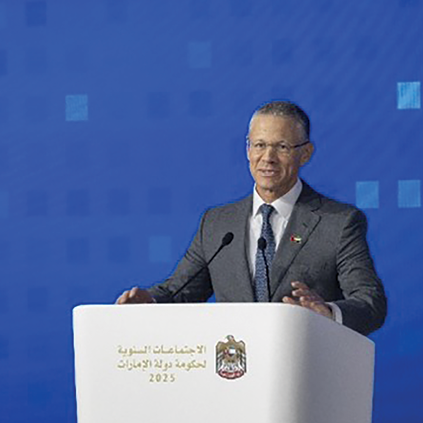
At the 2025 UAE Annual Government Meetings, Badr Jafar delivered key addresses emphasizing that the UAE’s economic success is driven by deep, ongoing partnerships between government policy and private enterprise
The Business Of Philanthropy
Editors’ Note
H.E. Badr Jafar occupies an unusual vantage point. As the UAE’s Special Envoy for Business and Philanthropy, he sits at the meeting point of statecraft, private capital, and social investment. As CEO of Crescent Enterprises, a diversified multinational company headquartered in the UAE, he runs businesses spanning ports and logistics, growth investing, frontier-technology venture capital, and venture building. He is also the author of The Business of Philanthropy and one of the region’s most persistent advocates for treating giving with the same rigor as investing. In this interview, he discusses why business and philanthropy can no longer operate in separate lanes, what the UAE’s “resilient openness” offers a fragmenting world, and where he is placing Crescent Enterprises’ bets for the decade ahead.
.png)
Badr Jafar delivering a keynote speech
at Investopia Global – Milan in May 2026
You serve as the UAE’s Special Envoy for Business and Philanthropy. How do you define this role, and why does the connection between business and philanthropy matter more now than ever?
For most of modern history, diplomacy meant governments talking to governments. Today, the connective tissue between nations is just as likely to be trade, investment, technology, talent, and social capital – flows that move through companies and foundations, not only foreign ministries. The UAE’s Foreign Minister had the foresight to create this role in recognition of that shift. My job, in essence, is to build bridges: to connect business and philanthropic leaders to public priorities, to mobilize capital and capability around shared challenges, and to make sure those relationships translate into tangible outcomes in areas like innovation, health, skills, infrastructure, and inclusive growth.
The reason the link between business and philanthropy matters more than ever is that we are living through an age of overlapping pressures – geopolitical fragmentation, technological disruption, fiscal strain, and climate risk – and no single sector can absorb them alone. Business brings scale, execution, and the capacity to build. Philanthropy brings flexibility, patience, and a willingness to take risks where others won’t. Government sets the rules and the direction. Align all three and you don’t just get more activity; you get multiplied impact that lasts.
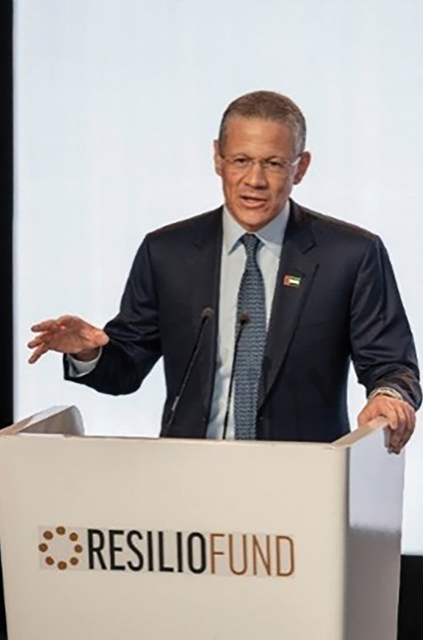
Badr Jafar delivered the opening keynote
address at the official launch of the
$500 million Resilio Fund in Dubai, focusing
on how strategic investment, private sector
innovation, and “hyper-local” philanthropy
build deep, long-term resilience for
affected communities
Your book, The Business of Philanthropy, makes the case for a more strategic approach to giving. What does “the business of philanthropy” mean in practice?
I have long argued that philanthropy is the forgotten child of the capital system. We obsess over how to deploy commercial and public capital efficiently, yet philanthropic capital – well over a trillion dollars a year globally, several times the size of official development assistance – is too often given on instinct and then left unexamined. The business of philanthropy simply means treating giving with the same seriousness, discipline, and intentionality we expect of any serious endeavor. Generosity is the easy part, and it matters enormously, but it is only the beginning.
In practice, that means moving from episodic donations to long-term strategies: setting clear objectives, backing trusted delivery partners, listening closely to the communities you intend to serve, using data to improve as you go, and measuring outcomes in a way that strengthens the work rather than just satisfies a report. I have always preferred the idea of building better rods over simply handing out fish – or even teaching people to fish – because the deepest, most durable impact comes from improving the systems and institutions around giving, not just the individual act.
Done well, philanthropy has an edge no other capital has: it can absorb early risk, convene unlikely partners, and back ideas that markets and governments are not yet ready to fund. That is when it becomes truly catalytic. Ultimately, capital of every kind should be judged not only by what it earns, but by what it builds, who it lifts, and what it leaves behind.
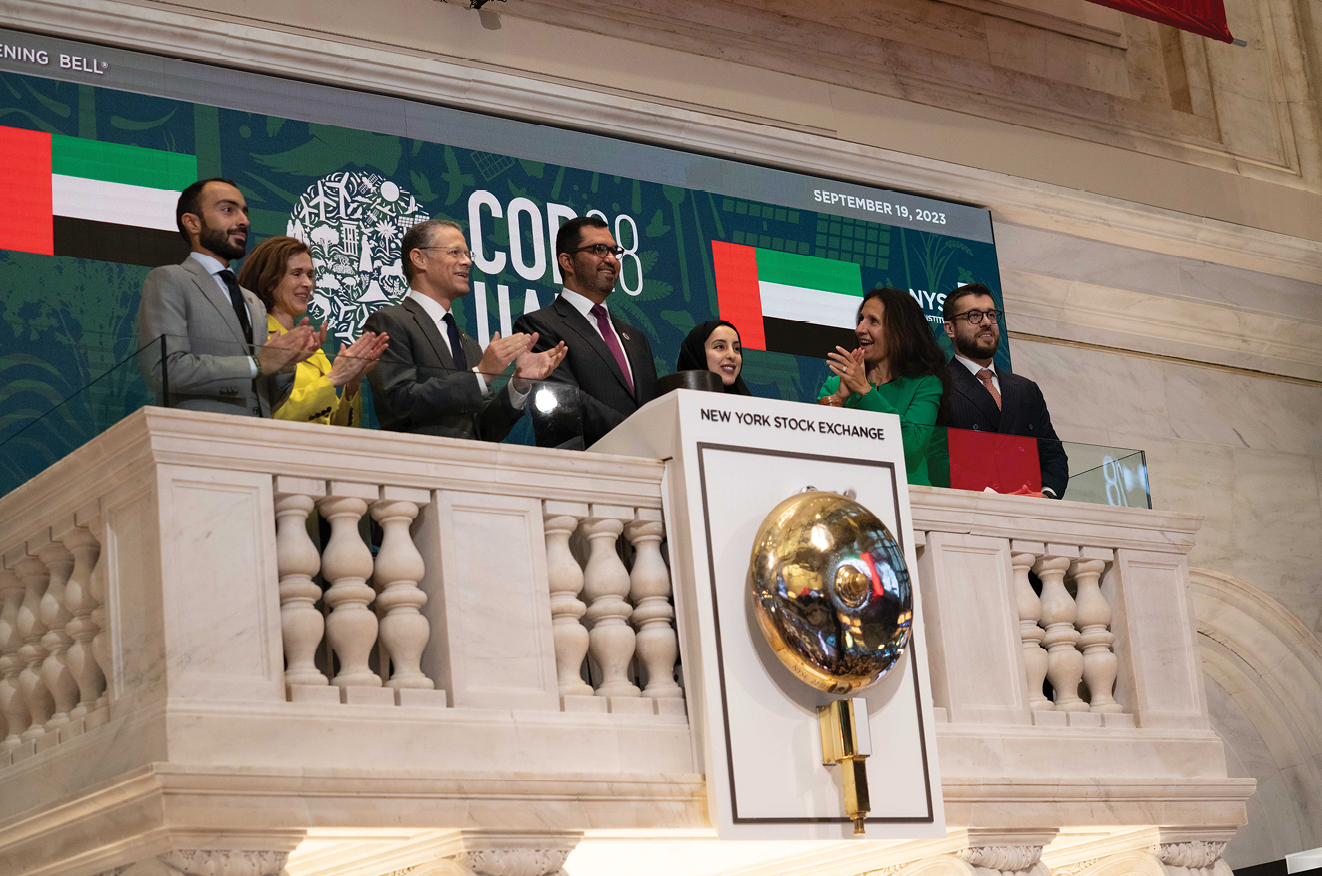
Badr Jafar with H.E. Dr Sultan Al Jaber
during the COP28 bell-ringing ceremony at
the New York Stock Exchange
You often talk about a “whole-of-society” approach. How does getting business, government, and philanthropy to work together help ensure that technological change – AI above all – drives inclusion as well as growth?
Left to market forces alone, technological transformation tends to be fast but not fair. We are seeing that play out in real time with AI. Only a small fraction of global AI investment is directed at social impact; a large share of humanity still lacks reliable internet access; and most AI systems are trained on a narrow slice of the world’s languages and geographies. These are not only equity concerns – they are strategic weaknesses. An intelligence built on narrow foundations will eventually run into the limits of those foundations.
That is precisely where a whole-of-society approach earns its keep. Government provides the enabling environment – policy, infrastructure, education, trust. Business builds useful products and scales them responsibly. And philanthropy does what it does best: it takes early risk, reaches underserved communities, and helps the ideas that work travel further and faster. The key is to design inclusion in at the front end, rather than bolt it on as an afterthought at the back.
Our partnership with MIT Solve is one concrete expression of this. The first Arabic-language Challenge Clinic and the inaugural MIT Solve–Crescent Enterprises AI for Social Innovation Prize were created to widen the pipeline of innovators tackling real problems in underserved contexts – because the best solutions usually sit closest to the people living the problem. Our job is to find them, resource them, and connect them.
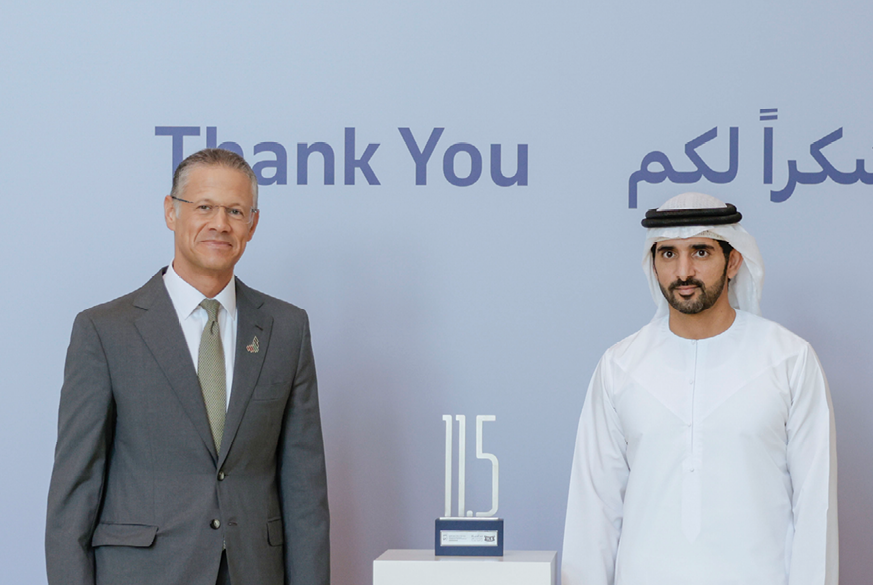
Badr Jafar being recognized by
H.H. Sheikh Hamdan bin Mohammed bin Rashid Al Maktoum
for his support of the Edge of Life campaign, which
aims to rescue five million children from extreme
hunger and malnutrition
In a period of geopolitical disruption and economic uncertainty, what can the UAE’s model of “resilient openness” teach other countries and business leaders?
The central insight from the UAE’s experience is that openness and resilience are not opposites – designed well, openness is itself a source of resilience. The real question for countries and companies today is not whether to stay connected to the world, but how to stay connected without becoming dangerously overexposed. The UAE’s answer has been deliberate diversification: world-class logistics and digital infrastructure, a widening web of trade partnerships, and an outward-looking mindset paired with deep, patient investment in institutions and long-term capability.
This year, that resilience faced an extreme stress test. Amid regional conflict and acute uncertainty, the UAE’s core systems – physical and digital, financial and social – adapted in real time, and business activity and daily life carried on with remarkable continuity. That capacity was not improvised in the moment; it was built over decades. Consider the trajectory: the UAE’s GDP has grown from around $40 billion in 1980 to more than $500 billion today, non-oil sectors now account for over 77 percent of GDP, and the country ranks among the world’s top ten for both goods exports and foreign direct investment.
So, the lesson for leaders elsewhere is straightforward: in a volatile world, don’t retreat into fragmentation – build optionality. Diversify supply chains intelligently, deepen trusted partnerships, and invest in the infrastructure and governance that can absorb stress. Resilience is not about closing doors; it is about building stronger systems behind them. And in a more dangerous world, resilience is being repriced. The ability to remain open, dependable, and effective under pressure is fast becoming one of the most valuable things a country or a company can bring to any partnership.
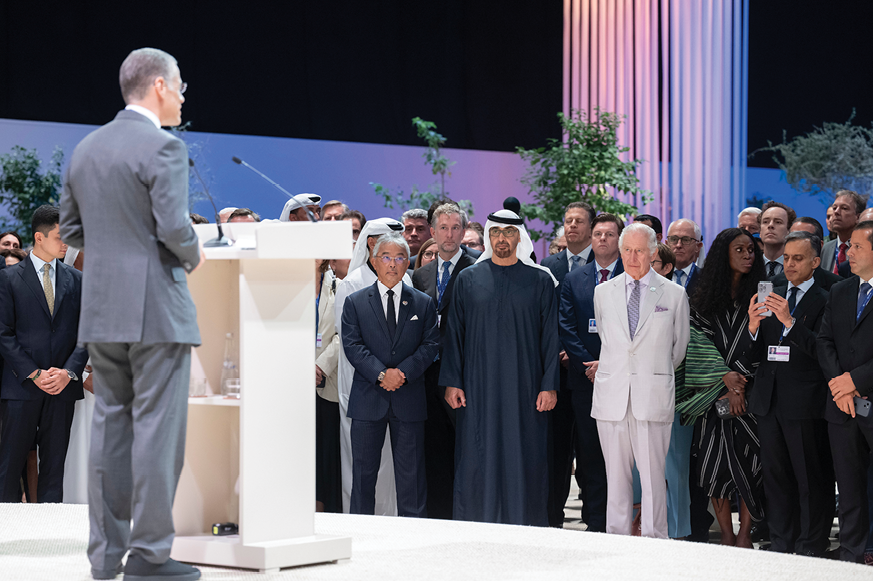
Badr Jafar delivering opening remarks
at the COP28 Business & Philanthropy
Climate Forum
Crescent Enterprises spans operating businesses, investments, venture capital, and venture creation. How are its four platforms positioned for long-term value creation in a world being reshaped by technology, resilience, and shifting capital flows?
We built Crescent Enterprises around four platforms because the next era will reward those who can operate across the full spectrum of value creation – from running hard infrastructure to backing a founder with little more than a conviction. Each platform plays a distinct role.
CE-Operates is our exposure to the physical economy: ports, logistics, and the systems that keep trade moving. This past year that meant strengthening connectivity across Gulftainer’s networks – linking maritime and terrestrial cargo flows – and adapting in real time to extraordinary supply-chain pressures. CE-Invests targets mid-market growth across the fast-growing Asia–GCC–US corridor, through a three-year, $300 million program focused on consumer, healthcare, manufacturing, and financial services. CE-Ventures backs frontier companies shaping the future of finance, energy, biotech, and deeptech, while staying disciplined on exits and returns – we’ve invested in over 100 companies and founders so far and plan to scale this significantly in the years ahead. And CE-Creates builds ventures from the ground up; our $100 million commitment into seed investments reflects a simple conviction – that the UAE can be a launchpad for home-grown companies with global reach.
Taken together, the four give us a deliberately balanced model: resilient cash flows from the physical economy, strategic growth capital, exposure to innovation, and the capability to create entirely new businesses ourselves. In a world being reshaped by technology, resilience, and shifting capital flows, that range is the point.
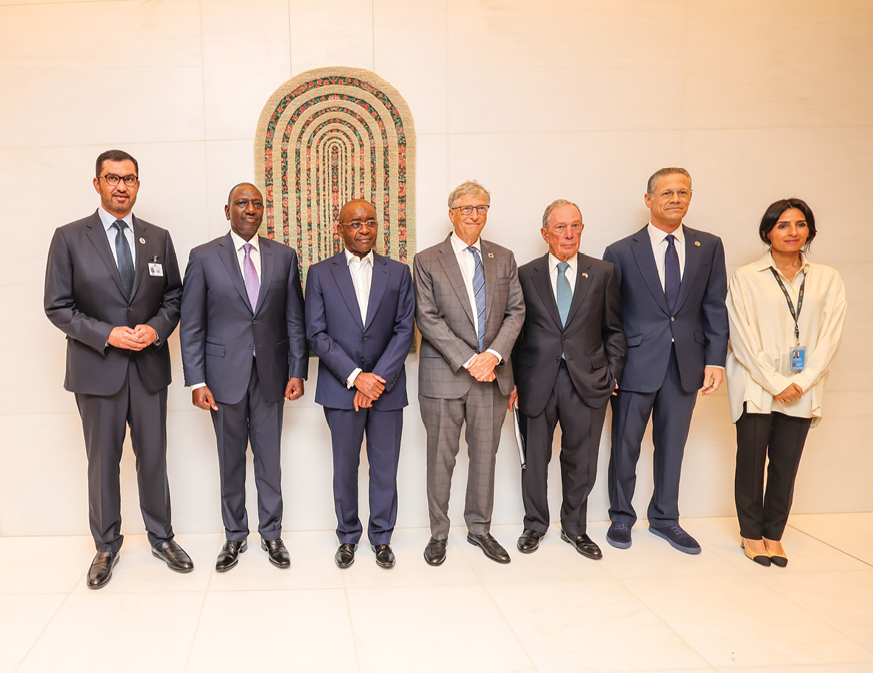
Badr Jafar with H.E. Dr Sultan Al Jaber, Bill Gates,
President Ruto, Mike Bloomberg & H.E. Razan Al Mubarak
during UNGA 2023
You’ve worked across business, philanthropy, governance, and diplomacy. What does effective leadership require in this new global environment?
Range. The defining feature of this environment is that the old silos no longer hold – you cannot lead effectively from inside business, or government, or philanthropy, or diplomacy alone, because the problems themselves refuse to stay in one lane. What matters now is the capacity to hold several truths at once: short-term instability and long-term transformation, commercial performance and social legitimacy, the drive to innovate and the discipline to govern. That calls for judgment, genuine humility, and a talent for getting people who would not naturally sit at the same table to do exactly that.
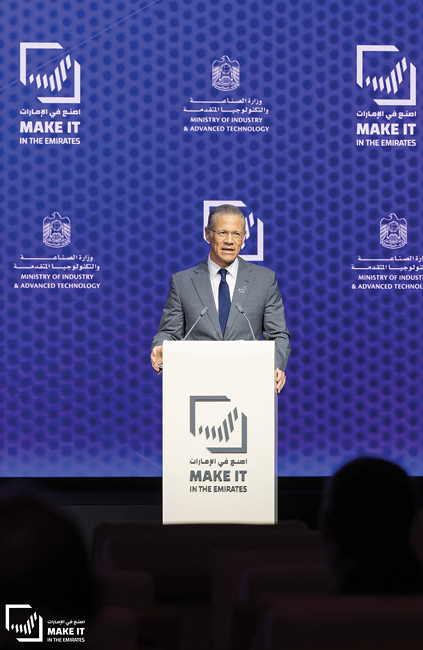
Badr Jafar delivering a keynote address titled
“The Time Is Now – Building Resilience and
Seizing Opportunity in a Changing World” at the
Make it in the Emirates (MIITE) 2026
But range without trust is just noise. Transparency, accountability, and integrity are not decorative values; they are operating principles, and when they erode, institutions lose legitimacy and performance soon follows. This is why I founded the Pearl Initiative over 15 years ago, a nonprofit that promotes the business case for transparency and accountability. I have always believed leadership sets the tone – culture starts at the top – but it only becomes real when it is embedded in decisions, incentives, and everyday behavior, not merely stated in a values statement. In a fragmenting world, the leaders who matter will be both builders and translators: building durable institutions while translating across sectors, geographies, and generations.
When you look to the future, what excites you most, and what concerns you most?
What excites me is that we may be entering a period where breakthroughs in technology, science, and capital formation can be pointed squarely at human progress – at scale. The convergence of AI, biotechnology, mobility, and new models of entrepreneurship is not an abstraction; it can move the needle on literacy, health, climate adaptation, and financial inclusion. I am drawn not to technology for its own sake, but to the chance to make innovation more purposeful, more regionally relevant, and more widely shared.
What concerns me is the mirror image: that we let the gains of this era pool too narrowly. If access to data, compute, capital, education, and trusted institutions stays uneven, progress will widen divides rather than close them. At a moment when hundreds of millions of people still lack access to education or basic humanitarian support, the challenge is not to invent faster – it is to align better. The future will be defined not just by how much we build, but by who we include in the building. That, to me, is the real test of this moment.