- Home
- Media Kit
- MediaJet
- Current Issue
- Past Issues
- Ad Specs-Submission
- Reprints (PDF)
- Photo Specifications (PDF)
- Contact Us
- PRIVACY POLICY
- TERMS OF USE
Loading

ONLINE

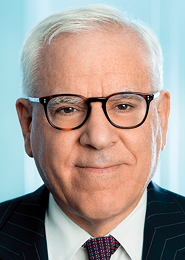
David M. Rubenstein
Leading With Impact
Editors’ Note
David Rubenstein is Co-Founder and Co-Chairman of the Board of Carlyle. Previously, he served as Co-Chief Executive Officer of Carlyle. Prior to forming Carlyle in 1987, Rubenstein practiced law in Washington, DC with Shaw, Pittman, Potts & Trowbridge LLP (now Pillsbury Winthrop Shaw Pittman LLP). From 1977 to 1981, he was Deputy Assistant to the President for Domestic Policy. From 1975 to 1976, he served as Chief Counsel to the U.S. Senate Judiciary Committee’s Subcommittee on Constitutional Amendments. From 1973 to 1975, Rubenstein practiced law in New York with Paul, Weiss, Rifkind, Wharton & Garrison LLP. Among other philanthropic endeavors, Rubenstein is Chairman of the Boards of the Council on Foreign Relations, the National Gallery of Art, the Economic Club of Washington, and the University of Chicago; a Trustee of Memorial Sloan-Kettering Cancer Center, the Institute for Advanced Study, the Brookings Institution, and the World Economic Forum; an Emeritus Trustee of Johns Hopkins Medicine; and a Director of Moderna, Inc. and the American Academy of Arts and Sciences. Rubenstein is a member of the American Philosophical Society, The Business Council, Harvard Global Advisory Council, Madison Council of the Library of Congress, Board of Dean’s Advisors of the Business School at Harvard, Advisory Board of the School of Economics and Management at Tsinghua University, and Board of the World Economic Forum Global Shapers Community. Rubenstein is a magna cum laude graduate of Duke University, where he was elected Phi Beta Kappa. Following Duke, he graduated from the University of Chicago Law School, where he was an editor of the Law Review.
Firm Brief
Carlyle (carlyle.com) is a global investment firm with deep industry expertise that deploys private capital across three business segments: Global Private Equity, Global Credit, and Global Investment Solutions. Carlyle’s purpose is to invest wisely and create value on behalf of its investors, portfolio companies, and the communities in which it lives and invests.
What do you feel are the keys to effective leadership?
A vision of where you want to take your followers; effective written or oral communications about this vision; an ability to lead by example – actually doing what you want others to do.
How important were mentors early in your career?
I found role models – people I wanted to emulate (and may not have known at all or very well) – to be more impactful than actual mentors. And some of these role models were peers who I greatly admired for certain of their skills.
What are the qualities you look for when building management teams?
People who have sublimated their egos, put the organization ahead of their personal ambitions, are willing to teach others, believe they are doing something of real value for their organization, colleagues, and society.
“I found role models – people I wanted to emulate (and may not have known at all or very well) – to be more impactful than actual mentors. And some of these role models were peers who I greatly admired for certain of their skills.”
How do you define success?
When a shared goal has been achieved without harming or embarrassing any team members and outside observers applaud the accomplishment for its merits and its useful impact on society.
What advice do you offer to young people beginning their careers?
Learn how to write and speak effectively; focus on the organization’s success rather than personal success; exude humility; share the credit for successes and accept some of the blame for failures; develop an expertise in one or two areas that makes your performance important to the organization; always focus on what can be done to improve society; read constantly, especially books; accept criticism politely; show respect and courtesies toward colleagues; always try to improve and learn.