- Home
- Media Kit
- MediaJet
- Current Issue
- Past Issues
- Ad Specs-Submission
- Reprints (PDF)
- Photo Specifications (PDF)
- Contact Us
- PRIVACY POLICY
- TERMS OF USE
Loading

ONLINE

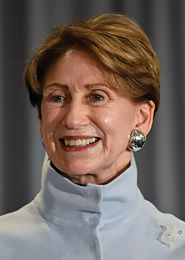
Barbara M. Barrett
Integrity And Character
Editors’ Note
Barbara Barrett was the 25th Secretary of the Air Force. She led the Department of the Air Force, comprised of the U.S. Air Force and U.S. Space Force. She was responsible for organizing, training and equipping Air and Space Forces, and for the welfare of 697,000 active duty, Guard, Reserve, and civilian Airmen and Guardians, and their families. As the Department’s senior leader, she oversaw an annual budget of more than $205 billion. Secretary Barrett has led business, government and academic enterprises. She was an executive of two global Fortune 500 companies, CEO of the American Management Association and CEO of a hotel. Her leadership roles included U.S. Ambassador to Finland, Deputy Administrator of the Federal Aviation Administration and Vice Chairman of the U.S. Civil Aeronautics Board. She taught leadership as a Fellow at Harvard’s Kennedy School and was President of Thunderbird School of Global Management. She was a strategic leader of companies and organizations focused on space, aeronautics, science, defense and diplomacy. Secretary Barrett served four terms as Chairman of the Board of The Aerospace Corporation and was on the boards of RAND and California Institute of Technology, which operates the Jet Propulsion Laboratory. She was Chairman of Valley Bank of Arizona and on boards including Exponent Corporation, Raytheon, Mayo Clinic, Embry-Riddle Aeronautical University, Space Foundation and the Smithsonian. She was a member of the Defense Advisory Committee on Women in the Services and the Defense Business Board. In diplomacy, she chaired the U.S. Advisory Commission on Public Diplomacy, U.S. Commerce Secretary’s biennial Export Conference and State Department’s Women’s Economic Empowerment Working Group. She was a Senior Advisor to the U.S. Mission to the United Nations, a member of the U.S.–Afghan Women’s Council and President of the International Women’s Forum. She is an instrument-rated pilot and was trained and certified for space flight. Additionally, she is a cattle and bison rancher. Secretary Barrett earned her bachelor’s, master’s and law degrees at Arizona State University.
.png)
Barbara Barrett aboard the Soyuz spacecraft (Reuters)
What do you feel are the keys to effective leadership?
In aviation and aerospace, effective leadership can be a matter of life and death. Failure is not an option. Safety consciousness must remain the highest priority in every aviation and aerospace mission. To ensure a safe environment, effective leadership principles include:
As in other settings, successful leadership in aviation and aerospace requires integrity in every action and decision. To symbolize my focus on integrity and character in leadership, I chose to take my oath of office as Secretary of the Air Force at the Center for Character and Leadership at the United States Air Force Academy.
How important were mentors early in your career?
Both mentors and role models bring value in guiding young careers. As an undergraduate intern in the Arizona State Senate, I witnessed up close the exceptionally capable leadership of Sandra Day O’Connor. As a role model, she exemplified integrity, discipline, and purpose through her work ethic. No shortcuts. No excuses. Do the work. Master the details. Get it done.
A simple imperative favored by eventual Justice O’Connor was: “Get involved.” She believed that democracy requires public engagement. Communities and democratic nations depend upon individuals stepping forward to serve. Correspondingly, she warned that democracy withers when treated as a spectator sport.
Her direction to get involved shaped my path to community engagement, locally, nationally, and globally. I benefited immeasurably from Justice O’Connor’s example as a role model of exceptional character and service.
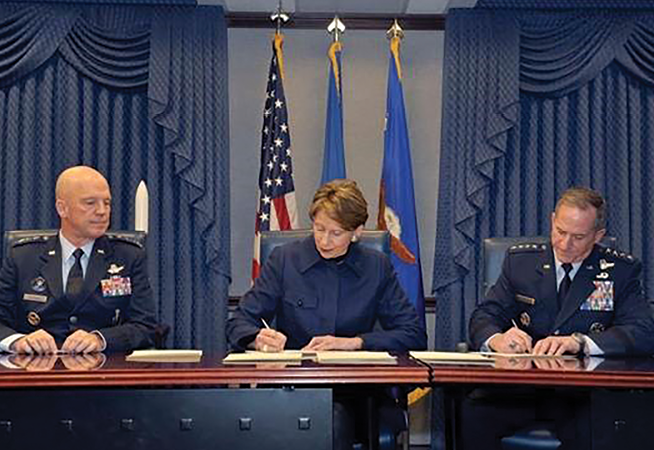
Barbara Barrett at the creation of the United States Space Force
What are the qualities you look for when building a team?
Integrity stands first among the qualities essential to any aviation or aerospace team. Beyond integrity, great teams combine high technical expertise with uncompromising commitment to safety, good communication, and collaboration to identify risks early and act decisively to prevent incidents.
Military, commercial, and general aviation all rely upon integrity, clear thinking, and decisive action even under stress to ensure safe completion of the mission. Aviation and aerospace teams may include pilots, aerospace engineers at aircraft or spacecraft manufacturers, controllers of air traffic in towers or centers, maintainers of aircraft or service equipment, operators of airports or airfields, or mission managers of space launches.
Safe and reliable operations require the courage to identify risks, communicate concerns, and resolve issues, often as a team. Each team member feels empowered to raise and address concerns candidly and quickly.
Today, digital tools and emerging aviation and aerospace technologies enable iterative design, flight, testing, and analysis, bringing new capabilities online faster than ever before. Improved tools and techniques continually elevate performance. Never has aviation been safer, nor aerospace more capable of improving lives and expanding human knowledge. The best aviation team members demonstrate a pioneering spirit. They feel the magic of our time as they chart new paths toward discovery.
“In life, success entails applying your talent, capabilities, resources, access, and opportunities to improve circumstances for a worthy interest.”
How do you define success?
In both aviation and life, success isn’t just about reaching a destination; it is about finding meaningful purpose and making a positive difference in the world through your existence. Like waypoints on a flight, milestones in life – graduations, weddings, births, and other defining moments – mark progress toward success.
Aviation and aerospace mirror life in the way that preparation, adaptability, and calculated risk management can predict success. Core techniques include fostering disciplined routines, maintaining situational awareness to adapt to change, and prioritizing continuous learning. Just as pilots use aids such as checklists for predictable processes, success in life can be aided by planning, organizing, and systematizing routine matters to reduce reliance on memory or chance and freeing up attention for the non-routine.
Situational awareness is key to pilots who must constantly monitor weather, fuel, and traffic, adapting to new information. Success in life and career depends upon awareness of business trends and personal circumstances to navigate toward meaningful goals.
Success in aviation and aerospace is a trifecta of uncompromising safety, flawless operational execution, and continuous innovation. In life, success entails applying your talent, capabilities, resources, access, and opportunities to improve circumstances for a worthy interest. Ultimately, success is accomplishing something that improves the human condition.
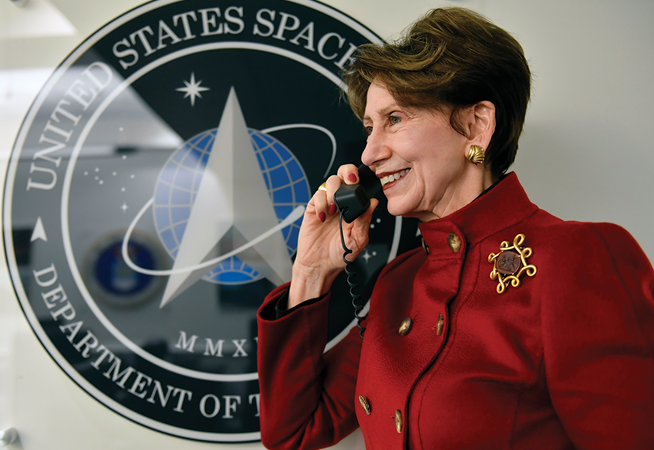
Barbara Barrett at Space Force headquarters
What advice do you offer to young people beginning their careers?
Aviation and aerospace offer valuable career lessons even for non-aviation careers. When offering advice to young people launching their careers, I encourage them to pursue and accept challenges working with the most capable experts they can find. Networks and advisors can supercharge a career. Seek programs, internships, and apprenticeships that provide real-world experience and engage with professionals who can provide firsthand insight and guidance in navigating a career flightpath. Be curious and passionate, even turning hobbies into potential careers. Maintain situational awareness – metaphorically scanning the instruments and anticipating course corrections before they become urgent.
As preparation for a career, technical skills are essential, but so are human skills like leadership, communication, and adaptability. I urge young people to master practical communication skills: writing, speaking, and listening. Learn how to run a meeting successfully by defining the purpose, respecting everyone’s time, and focusing on outcomes. Develop resilience and problem-solving skills, viewing failures and setbacks as opportunities for growth. Key principles include ensuring high standards, discipline, and integrity above all.
While young, invest in building life tools and capabilities even when their applicability may not yet be evident. Some of the most meaningful chapters of my career could never have been predicted. My experience in diverse areas of aviation, diplomacy, business, education, government organization, and space may seem disconnected, but each brought value to my highest career challenge: leading the creation of a new military service, the United States Space Force.