- Home
- Media Kit
- MediaJet
- Current Issue
- Past Issues
- Ad Specs-Submission
- Reprints (PDF)
- Photo Specifications (PDF)
- Contact Us
- PRIVACY POLICY
- TERMS OF USE
Loading

ONLINE

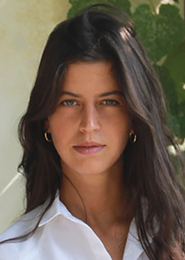
Marta Galli
A Truly Traditional
Style Of Amarone
Editors’ Note
Marta Galli is the third generation at Le Regose, handling the winery’s marketing and commercial operations. She holds a degree in management and a PhD in management and innovation in the wine business from the Catholic University of Milan where she also teaches wine marketing.
Her grandmother, also Marta Galli, is often referred to as “La Signora del Vino,” was voted “Wine Maker of the World” in 1990 by her peers, in part because of her influence in re-establishing Valpolicella as a classic in Italian wine and helping it achieve a DOC designation. She was also a founding member of the prestigious VIDE organization of small family-owned estates that promote excellence and typicity, as well as Le Donne del Vino, an international group for women in wine.
Winery Brief
North of Verona, in the town of Negrar, at the Valpolicella zone’s highest point (1,148 feet), the Le Ragose estate overlooks gentle, lush green hills. In 1969, enologists Arnaldo Galli and his wife Marta bought the 70-acre Le Ragose estate, which had been abandoned. Recognizing that many excellent vineyard sites had been abandoned in favor of more easily farmed sites on the plains, they replanted the Le Ragose (leragose.com) vineyards and began making Amarone and Valpolicella in as natural a way as possible. The 40 acres of terraced vines face southwest on steep slopes, well above the frequent, notorious winter nebbia (fog), which lingers below. The soil is clay laced with magnesium, calcium, and iron on well-draining tufaceous subsoil. The ideal “above-the-fog” location (low humidity and excellent sun exposure) is particularly suited for appassimento, the process of drying grapes essential to Amarone production; it also allows for successful ripening of minor indigenous varietals, which few producers can claim. The estate’s 40 acres are dry farmed (no irrigation) and the steep vineyard slopes require all vineyard work to be done by hand. For aging, large Slavonian botti (oak casks), with experimental use of new and used French Allier and Tronçais tonneaux, allow truer expression of subtle terroir characters that make a wine from “Le Ragose” unmistakably of its place and uniquely itself.
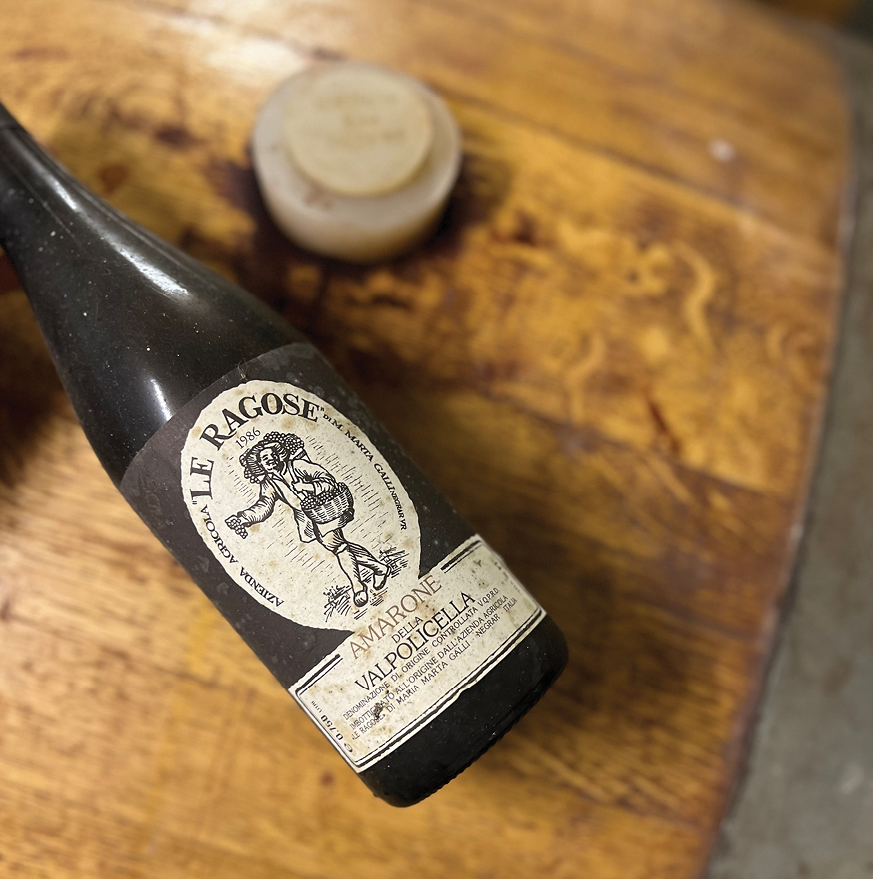
Will you discuss your career journey?
I have built my professional path at the intersection of academic training and hands-on business leadership. I hold a degree in Management and a PhD in Management and Innovation in the wine sector from Università Cattolica del Sacro Cuore in Milan. I entered the family business, Le Ragose, at the age of 21, initially taking responsibility for export markets – especially the United States – and for events.
Today, I lead the winery’s marketing and sales strategy, while also teaching marketing and sales at Università Cattolica del Sacro Cuore at both bachelor’s and master’s levels. This dual role allows me to constantly connect theory, strategy, and real-world practice.
Will you highlight the history of Le Ragose?
Le Ragose was founded in 1969 by my grandparents, Arnaldo and Marta Galli, who purchased 32 hectares in the highest area of Valpolicella Classica. From the very beginning, their vision was to produce elegant, high-quality wines, strongly linked to the territory and ideally suited for Amarone, thanks to the altitude and location of the vineyards.
In the 1990s, my father Paolo Galli, who oversees the administrative structure, and my uncle Marco, an oenologist and agronomist, guided the company through a phase of consolidation and growth. Today, we work as a unified team, combining generational knowledge with a forward-looking approach, ensuring continuity while constantly adapting to new market dynamics.
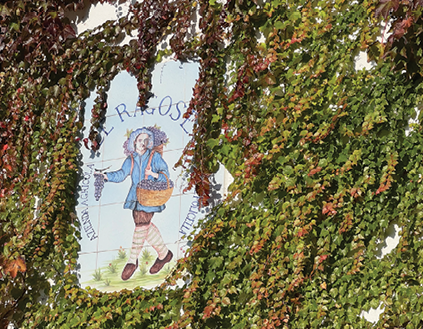
Will you provide an overview of Le Ragose’s offerings?
Our production focuses entirely on the classic Valpolicella range, using only local grape varieties such as Corvina, Corvinone, Rondinella, and other native grapes. We start with a fresh, fruit-driven Valpolicella Classico, aged exclusively in stainless steel, followed by a Ripasso (aged in big barrels of Slavoinian oak) that combines medium body with elegance and great versatility at the table. However, we are especially recognized for our Amarone wines.
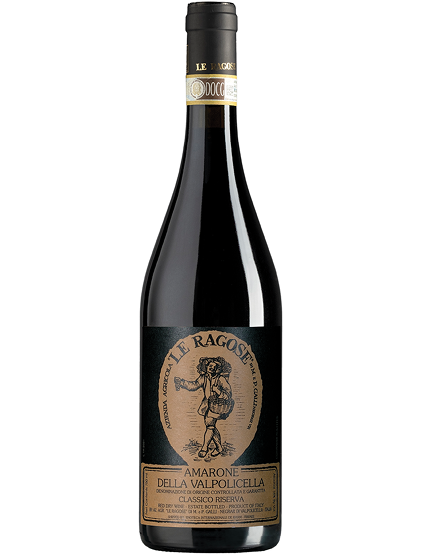
Our Amarone della Valpolicella Classico Riserva represents the heart of our production and is our flagship wine both in Italy and internationally. It is made from a careful selection of the best grapes and aged for eight to nine years in large Slavonian oak casks, resulting in a wine that expresses elegance, freshness, and drinkability, with low residual sugar – a truly traditional style of Amarone.
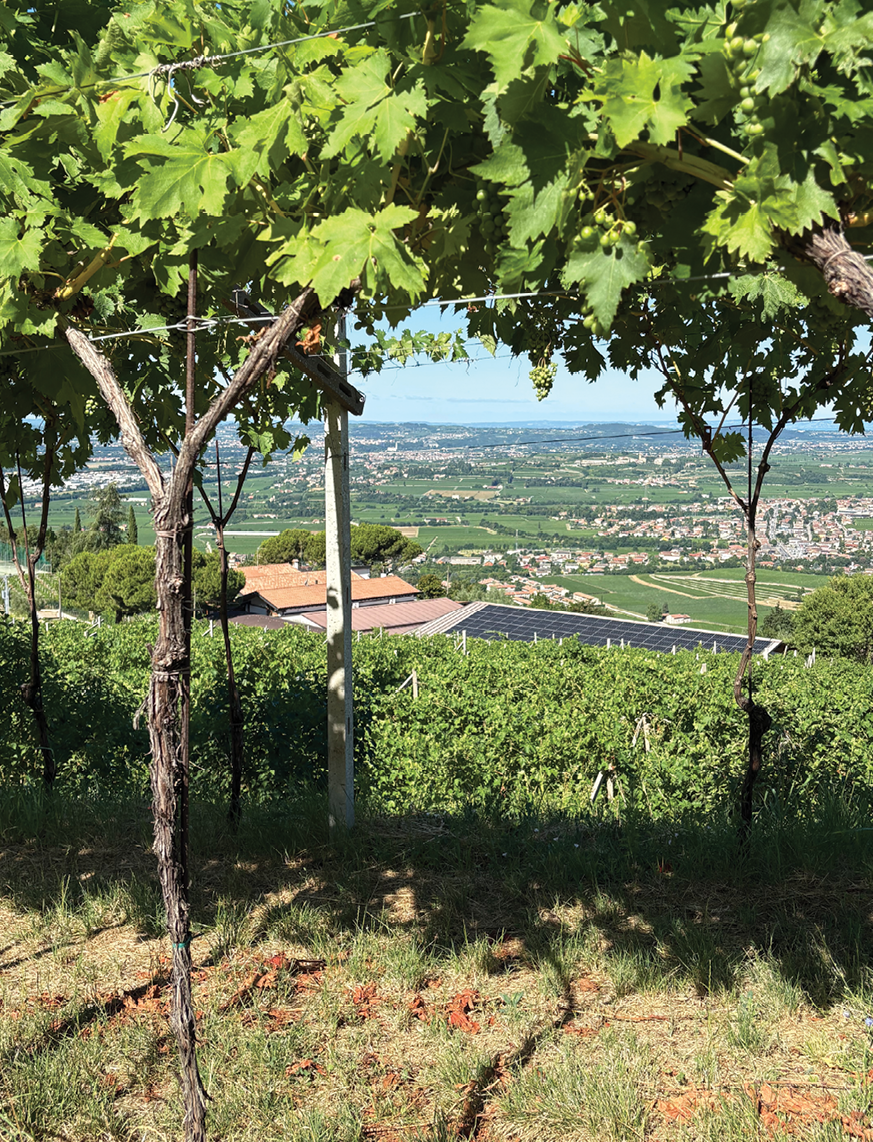
A view of Le Ragose winery from one of its vineyards
shows solar panels that supply 100 percent of the energy
the winery uses
How critical is sustainability to Le Ragose’s culture and values?
Sustainability has always been a core value for us, together with respect for the land and for the people who work alongside us. We have practiced sustainable agriculture since the very beginning, and in recent years we have formalized this commitment through SQNPI certification. In 2024, we also installed solar panels that now cover 100 percent of the winery’s energy needs. Our high-altitude hillside vineyards and the strong vocation of this territory allow us to intervene as little as possible both in the vineyard and in the cellar, letting nature play a central role in defining quality.
What has made the wine industry so special for you?
What I enjoy most about my work is building relationships with people and having the opportunity to explore the world through our wines. I entered the wine industry very young, but I immediately felt a strong connection to both the work and the product. Continuing my family’s story and sharing it with clients, importers, and wine lovers around the world is what motivates me the most and what gives meaning to my daily work.
Do you feel there are strong opportunities for women in the wine industry?
I believe that leadership in the wine industry today is driven by competence, strategic vision, and the ability to create long-term value. In my own experience, building credibility has meant combining a solid academic background with hands-on operational responsibility, from international market development to brand positioning and commercial strategy.
My grandmother, Marta Galli “Senior,” was a pioneer for women in Italian wine (one of the founders of the Women in Wine association) and a powerful example of what leadership can look like. My professional identity is rooted in my own skills, decision-making capacity, and results. I am convinced that opportunities in this sector are increasingly tied to merit and expertise, and that women who are prepared, consistent, and forward-looking can play a central role in shaping the future of the wine industry.