- Home
- Media Kit
- MediaJet
- Current Issue
- Past Issues
- Ad Specs-Submission
- Reprints (PDF)
- Photo Specifications (PDF)
- Contact Us
- PRIVACY POLICY
- TERMS OF USE
Loading

ONLINE

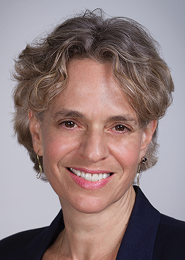
Sharen I. Duke
A Community Grounded In Kindness, Respect, And Hope
Editors’ Note
Sharen I. Duke has served as Executive Director and CEO of Alliance for Positive Change since its founding in 1990. Under her leadership, the organization has grown from a three-person HIV service organization into one of New York City’s leading multiservice community-based providers, serving thousands of low-income New Yorkers each year. A lifelong New Yorker, Duke earned her Master of Public Health from Columbia University where she is an adjunct professor in health, policy and management, and has been widely recognized for her leadership in HIV advocacy, workforce development, and community health.
Organization Brief
Alliance for Positive Change (alliance.nyc) provides low-income New Yorkers living with HIV and other chronic conditions with access to healthcare, behavioral health services, housing, peer training, and job placement programs that cultivate leadership and economic mobility. Alliance for Positive Change opened in 1991 at the height of the HIV crisis – a welcoming community of transformation and opportunity – with a founding mission to serve New Yorkers living with, at risk for, and affected by HIV. In 2014, Alliance for Positive Change expanded to serve low-income New Yorkers with other chronic conditions alongside people living with HIV. Alliance for Positive Change delivers on the promise of positive change with services and resources that equip people to navigate systemic inequities and achieve health and well-being. The organization annually serves 4,500+ New Yorkers and reaches 18,000+ through peer education, overdose prevention, and community outreach initiatives.
Will you discuss your career journey, and what led you to found Alliance for Positive Change?
I began my career working on a crime victims’ hotline in New York City, where many callers were survivors of domestic violence. I quickly saw how public policy decisions often compounded people’s hardships. That experience led me to pursue a Master of Public Health at Columbia University. In the early 1990s, while working in the New York City Health Department’s HIV/AIDS Bureau, I applied – somewhat ambitiously – for the Executive Director role at the Lower Manhattan AIDS Task Force, a small organization with limited funding and no direct services. To my surprise, I was hired. In those days, there was no effective HIV treatment and an abundance of discrimination and misinformation. I believed deeply that people deserved dignity, compassion, and meaningful support. We built a direct service model rooted in respect and community. That work evolved into what is now Alliance for Positive Change – a truly comprehensive, ever-evolving organization with six community service sites across Manhattan and the Bronx and an unswerving commitment to meeting the needs of low-income New Yorkers.
“At its core, our work is about possibility.
Yes, it’s about helping people manage their health conditions, but it’s also about building a stable foundation from which they can lead, contribute, and thrive.”
How do you define Alliance for Positive Change’s mission?
Alliance for Positive Change exists to ensure that low-income New Yorkers living with HIV and other chronic health conditions have a real opportunity to achieve health, stability, and long-term independence. Our mission is rooted in the belief that everyone deserves access to high-quality care, safe housing, and meaningful economic opportunities, regardless of their income, background, or circumstances. We embody this mission and belief system with an integrated model of service that addresses the full scope of each person’s needs at any given time. This includes enrolling people in health insurance, connecting them to healthcare through our medical partnerships, supporting people’s ongoing engagement in treatment, providing supportive housing and housing placement, delivering behavioral health and recovery services that meet people where they are, and workforce development pathways to sustainable employment. Health does not exist in isolation – it is deeply connected to housing security, food security, economic opportunity, and social connection. Our work reflects that awareness.
From our earliest days, Alliance for Positive Change was built around the idea of a community grounded in kindness, respect, and hope. We understand that progress looks different for everyone. Our role is not to impose a timeline, but to walk alongside people as they move forward at their own pace. We’ve worked hard to create an environment where individuals feel seen, heard, and supported without judgment. So many people have told us that Alliance for Positive Change feels like “family” and “home.”
At its core, our work is about possibility. Yes, it’s about helping people manage their health conditions, but it’s also about building a stable foundation from which they can lead, contribute, and thrive. Every Alliance for Positive Change program reflects that commitment to empowering New Yorkers to take control of their health, strengthen their stability, and shape their own future.
Will you elaborate on Alliance for Positive Change’s scope of services and how they have evolved?
Alliance for Positive Change was designed as a comprehensive, multiservice organization where people can find a huge range of supports under one roof. We provide care coordination; linkage to medical care; treatment adherence support; HIV, hepatitis C, and STI counseling and testing; harm reduction, overdose prevention, outpatient drug treatment, and recovery supports; mental health services; supportive housing; housing placement; benefits advocacy; food and nutrition services; and community-building programs.
One important way we’ve evolved is expanding our longtime partnerships with hospitals and health centers well beyond reciprocal referral relationships. We’ve shifted into deep collaborations in which Alliance for Positive Change co-locates our care coordinators within these medical settings to improve patients’ medical adherence, reduce missed appointments, and increase continuity of care. By leveraging Medicaid billing, we’ve created a sustainable model that greatly benefits both patients and providers, leading to better health outcomes and healthcare experiences.
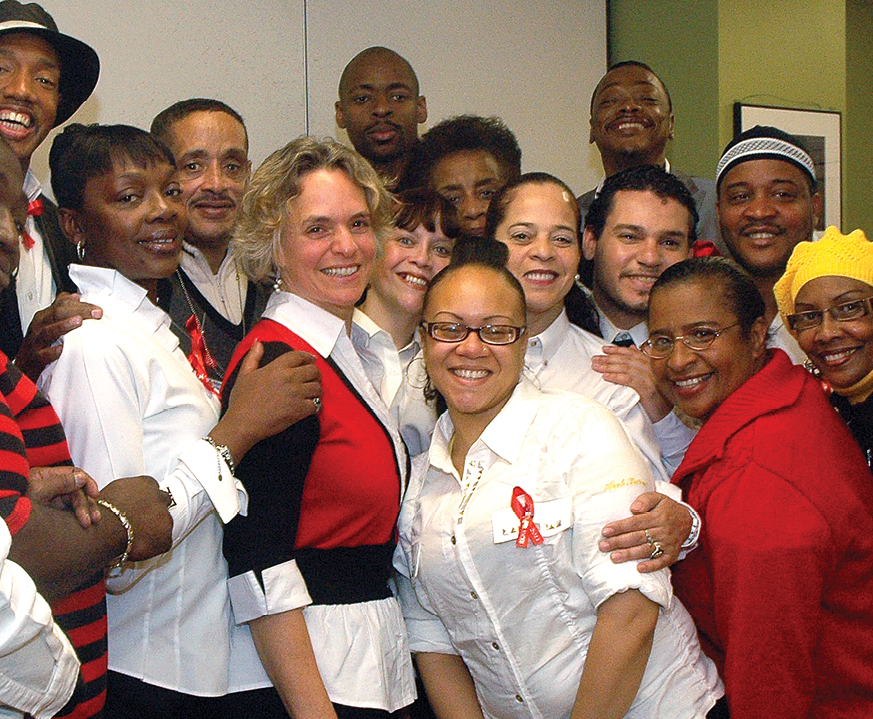
Sharen I. Duke and Alliance Peer Workers at
Alliance’s World AIDS Day event
How critical are metrics in measuring Alliance for Positive Change’s impact?
Metrics are essential, and challenging. Community-based organizations like Alliance for Positive Change are often funded to deliver services, not to build the infrastructure needed to measure long-term outcomes. We recently built and launched our own electronic health record system to better track our key performance indicators and health-related impacts. We serve 4,500+ New Yorkers annually. Of these, 45 percent are living with HIV, and over 90 percent of our program participants are virally suppressed – an outcome that reflects sustained engagement in care and treatment adherence that we work very hard to facilitate.
We are expanding our outcome tracking to more fully capture our impact on diabetes, hypertension, behavioral health, and other conditions. The goal is not just to count services delivered, but to demonstrate measurable improvements in each participants’ health and well-being. Continued investment in nonprofit infrastructure is critical to strengthening that aspect of our work.
Will you highlight the strength and expertise of the Alliance for Positive Change team?
Alliance for Positive Change’s extraordinary team is one of our greatest assets, without a doubt. We operate through integrated, cross-departmental collaboration, ensuring that care coordinators, substance use counselors, other staff, and our Peer Workers act as unified teams, so services are easily accessed and well-coordinated.
Alliance for Positive Change’s Peer workforce is distinctive. Many of our Peers are former program participants who completed our Peer training program and have chosen to “pay it forward.” They bring lived experience and wisdom that builds community trust and credibility in ways traditional service models often cannot. Over 30 percent of Alliance for Positive Change’s full-time staff are former Peer Workers who have transitioned into permanent positions at all levels of the organization, including leadership.
We are also well supported by an active Board of Directors and a seasoned leadership team with decades of experience in community-based care. That combination of engaged governance, professional expertise, and lived experience defines Alliance for Positive Change’s culture and drives our impact. I am very, very proud to be a part of the Alliance for Positive Change team.
As you look ahead, what are your priorities for the future?
Sustainability – financially and programmatically – despite the upheaval and uncertainty of these times. Alliance for Positive Change and other community-based organizations will remain essential pillars of community health across New York City – even as the policies change and the public health and funding landscapes shift. Alliance for Positive Change is quite capable of adapting to whatever comes our way because we’ve had plenty of practice to draw from over the past thirty-five years of addressing HIV, stigma, health inequities, the opioid overdose crisis, and so many other serious challenges.
Our focus is on maintaining the humanity at the heart of our work while strengthening our business models to ensure long-term stability. That means understanding our core competencies, cultivating new strategic partnerships, demonstrating our lifesaving impact with solid data, and remaining flexible enough to evolve as external conditions change.
Looking to the future is about staying the course so that Alliance for Positive Change can be here for the people who are counting on us, while pursuing opportunities to do even more and even better.