- Home
- Media Kit
- MediaJet
- Current Issue
- Past Issues
- Ad Specs-Submission
- Reprints (PDF)
- Photo Specifications (PDF)
- Contact Us
- PRIVACY POLICY
- TERMS OF USE
Loading

ONLINE


Sam Read
Inspiring A
Sustainable Future
Editors’ Note
Sam Read is the Executive Director of the Sustainable Entertainment Alliance (formerly the Sustainable Production Alliance). A graduate of Tufts University, Read has a deep background in coalitions and strategic partnerships, having worked on social impact and campaigns for organizations like the Peoples Climate Movement, No Kid Hungry, President Obama’s re-election campaign, and more.
Organization Brief
The Sustainable Entertainment Alliance (sustainableentertainmentalliance.org) is a consortium of the world’s leading studios, streamers, and industry leaders dedicated to advancing sustainability initiatives through advocacy, education, and innovation while reducing the entertainment industry’s overall environmental impact. The Sustainable Entertainment Alliance is a fund of the Entertainment Industry Foundation.
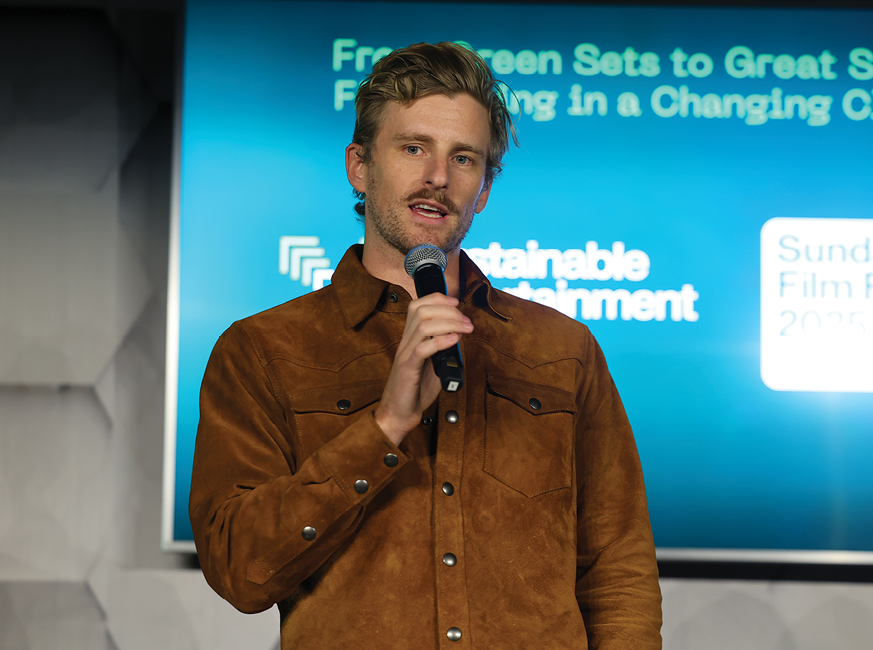
Sam Read at Sundance
Will you discuss your career journey?
I’ve spent my career at the intersection of social impact, coalition-building, and campaigns. While the sectors I’ve been working in have shifted, the through-line has always been the same: convincing people with different interests and priorities to move together toward a common goal.
I started in political organizing, working on the 2012 Obama campaign, where I learned the fundamentals of persuasion, constituency outreach, and community organizing. From there, I moved into digital and advocacy work with Share Our Strength’s No Kid Hungry campaign, where I managed social media fundraising campaigns, created an SMS tool that helped families find free summer meals, and developed online advocacy around the state and federal programs that are so crucial to keeping America’s kids fed. My time at No Kid Hungry taught me what a well-run organization can accomplish and how focusing efforts on structural changes can genuinely improve the lives of everyday people.
I transitioned to work at the People’s Climate Movement, supporting a coalition spanning environmental, labor, faith, and social justice organizations, and then at Murmuration, a civic tech organization where I led strategic partnerships focused on building long-term community power. I also spent time at RALLY, a communications firm, and with C40 Cities, advising on civil society engagement for mayoral climate action.
All that experience brought me to the Sustainable Entertainment Alliance, where I’ve been Executive Director since 2023. In many ways, this role is the convergence of my experience and expertise: coalitions, climate, social impact, and the power of a good story to shift what people believe is possible.
How do you define Sustainable Entertainment Alliance’s mission?
The Sustainable Entertainment Alliance exists to support the global entertainment industry’s embrace of sustainability, both behind the camera and on screen. The “behind the camera” side focuses on reducing the industry’s environmental footprint. Film and television production can be resource-intensive, but there’s significant room to reduce that through better practices, cleaner technology, and shared industry standards. One of the great joys of this job has been seeing the incredible progress that cutting-edge productions are making on reducing their environmental footprint and enabling more creative and operationally efficient productions.
While our work on production sustainability focuses on the industry’s environmental footprint, our work to support sustainability on screen addresses the industry’s cultural footprint. Film and television have a unique ability in our society to engage audiences by exploring our understanding of the natural world we all live in and the impacts of and solutions to our changing climate.
Combining these two elements – operational sustainability and narrative connections – is what makes the Alliance’s mission distinctive. We’re not only supporting the industry to green its productions. We’re asking the industry to think seriously about its role in engaging audiences by exploring how society responds to one of the defining challenges of our era.
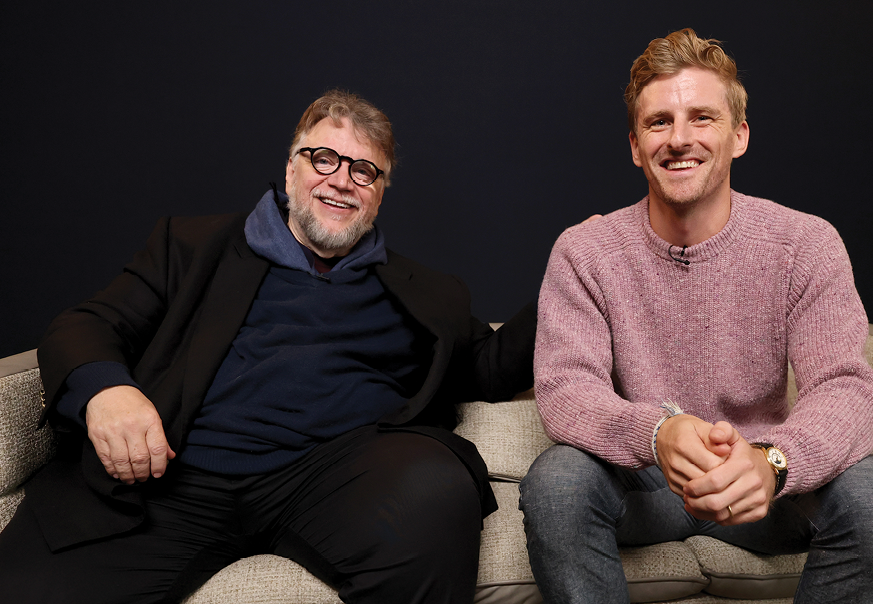
Sam Read with Guillermo del Toro
Will you provide an overview of Sustainable Entertainment Alliance’s areas of focus?
Our work falls into three main areas. The first is production sustainability: helping productions of all shapes and sizes reduce the environmental impact of film and television production. This includes developing shared tools and standards, such as the Green Production Guide, which includes a carbon calculator, a checklist tool, and other resources that inform how to implement sustainable practices on set. We also publish industry-wide carbon-emission benchmarking reports, helping us understand the carbon outputs of different types of production and identify the greatest opportunities for improvement. The second is the intersection of sustainability and storytelling – supporting the creatives who want to tell stories that engage authentically with climate and sustainability and understanding how those stories can best connect with a wide audience. This includes hosting a library of resources for writers and producers, researching the kinds of climate-relevant content that resonate with audiences, and connecting our members with the many incredible organizations that can provide expertise and guidance for creatives. We partnered with NRDC’s Rewrite the Future on a sizzle reel narrated by Meryl Streep (climateonscreen.org), making exactly this case: that stories can engage with climate even as they entertain. The third is about convening, education, and coalition-building – bringing together the entertainment industry to engage in broader climate conversations nationally and internationally. We bring global industry institutions together to align on shared positions, share best practices, and amplify the industry’s voice.
How critical are metrics to measure the impact of Sustainable Entertainment Alliance’s work?
For production sustainability, we work with actual data. Our benchmarking reports document average emissions across different types of productions (feature films, half-hour series, unscripted television, etc.), so that we can track progress over time as the industry adopts cleaner technology and better practices. When a production reduces diesel generator fuel usage by switching to mobile batteries and solar, that’s measurable. We can demonstrate it and use it to make the case to the next production that the same approach is viable.
The storytelling side takes a different approach. We know from research that audiences want climate-engaged content and that it resonates when done well. In the last year, we’ve seen stories that engage with climate, the environment, and sustainability achieve massive critical and commercial success – from massive blockbusters such as Avatar, to independent films such as Train Dreams, or popular television shows like Grey’s Anatomy. Our role is to lift up resources for creatives who want to tell these stories and to understand what helps those stories connect with the broadest possible audience.
Will you highlight the strength and expertise of the Sustainable Entertainment Alliance team?
One of the aspects I’m most proud of is how the Alliance operates. Our core staff is lean, but our team is effective and mighty. The real strength of the Alliance is our membership. Our internal team has the opportunity to work hand in hand with the sustainability teams from A24, Amazon MGM Studios, Apple TV, Disney, FOX, NBCUniversal, Netflix, Paramount, Sony Pictures, Warner Bros. Discovery, and the Television Academy. Those are some of the largest and most powerful entertainment and media institutions in the world, offering an extraordinary collection of expertise and people who understand production operations, supply chains, technology procurement, storytelling, and audience engagement at serious scale. Our team provides the structure, compliance, and shared agenda that allows best practices to flow across the industry in a pre-competitive space, which means we can move faster and go deeper than any of our members could working alone.
The model works because our members are genuinely invested. They show up and contribute time, money, and expertise to the work. They help us reach across the industry to engage passionate professionals in unions, guilds, academies, production companies, and more.
What are your priorities for Sustainable Entertainment Alliance?
On the production side, the near-term priority is accelerating the transition away from fossil fuels and towards clean mobile power and EVs. That’s where a massive amount of the emissions are, and there are now real alternatives: battery-powered mobile units, solar trailers, electric vehicles, cleaner fuel sources, and more effective processes that are proven and deployable. The best part is they also make for a better creative and on-set experience – beyond the emissions. Batteries have the benefit of reducing noise on set (as opposed to clanging generators that have to be stationed far away from where you’re shooting), and they don’t spend all day belching out noxious fumes on everyone standing around them. There’s also incredible work being done across the industry on circularity and material re-use, reducing the amount of waste we generate.
On the storytelling side, we’re seeing real momentum – more storytellers inspired by climate themes, growing demand from audiences, and a creative community genuinely interested in telling these stories well. I’m a believer that the best art is authentic to the human experience, and humans across the globe are experiencing both the impacts of climate change and the opportunities that come with a sustainable economy every day.
Finally, I’m excited about opportunities to deepen our international footprint. The entertainment industry is global. Our members are leading global companies, and the challenge of climate change is a global one. I serve on the steering committee for the UNFCCC’s Entertainment and Culture for Climate Action (ECCA) initiative, and we’re seeing interest from around the world in a more sustainable industry, especially in the Global South and in markets that have often been underrepresented in these conversations.
My underlying ambition is to get to a place where sustainability is genuinely embedded in how the industry operates and is a core part of how content is produced and great stories are told.