- Home
- Media Kit
- MediaJet
- Current Issue
- Past Issues
- Ad Specs-Submission
- Reprints (PDF)
- Photo Specifications (PDF)
- Contact Us
- PRIVACY POLICY
- TERMS OF USE
Loading

ONLINE


Ram Charan
A Wake-Up Call For The West
Editors’ Note
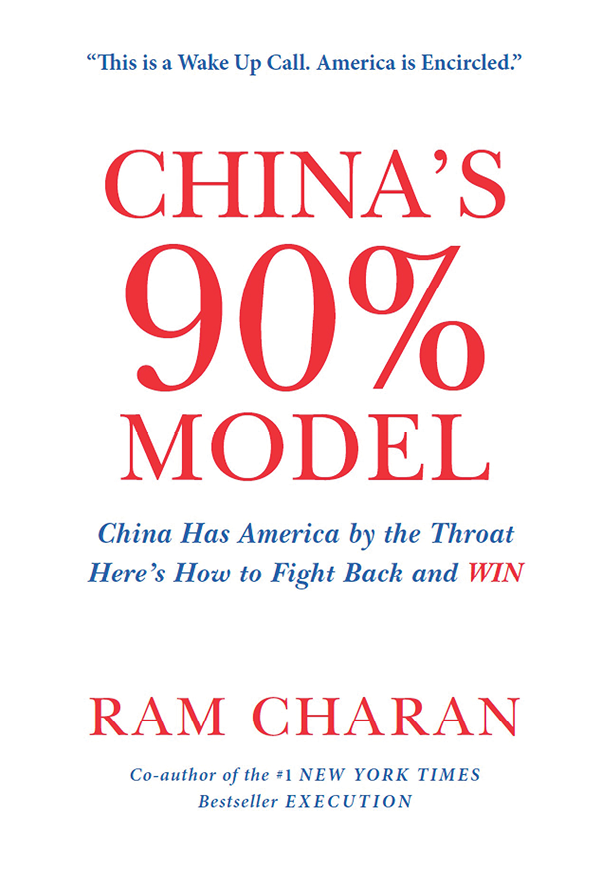
Ram Charan is a world-renowned business consultant, author and speaker who has spent 60 years advising the world’s largest corporations, advising some 100 boards, and advising more than 50 companies in China over 30 years. Fortune Magazine has called him “the most influential consultant alive.” Charan is the author of 36 books, including the best-seller, Execution: The Discipline of Getting Things Done, and his new book, China’s 90% Model – China has America by the Throat. Here’s How to Fight Back and WIN was published in March.
Given your widespread work and deep understanding of international businesses and strategy, what do you view as the important challenges for business leaders today?
Successful businesses must master execution, the systematic process of linking strategy, people, and operations, not just formulate a vision. Leaders continue to need to close the gap between plans and results by embedding execution into company culture, fostering robust dialogue, and ensuring accountability at all levels. Leadership requires deep engagement. A brilliant strategy fails without flawless execution. Leaders must be deeply involved in the mechanics of delivery, not just the ideas. I wrote the book Execution with AlliedSignal CEO Larry Bossidy in 2002. It still holds true today.
What are the challenges that exist today that didn’t exist then?
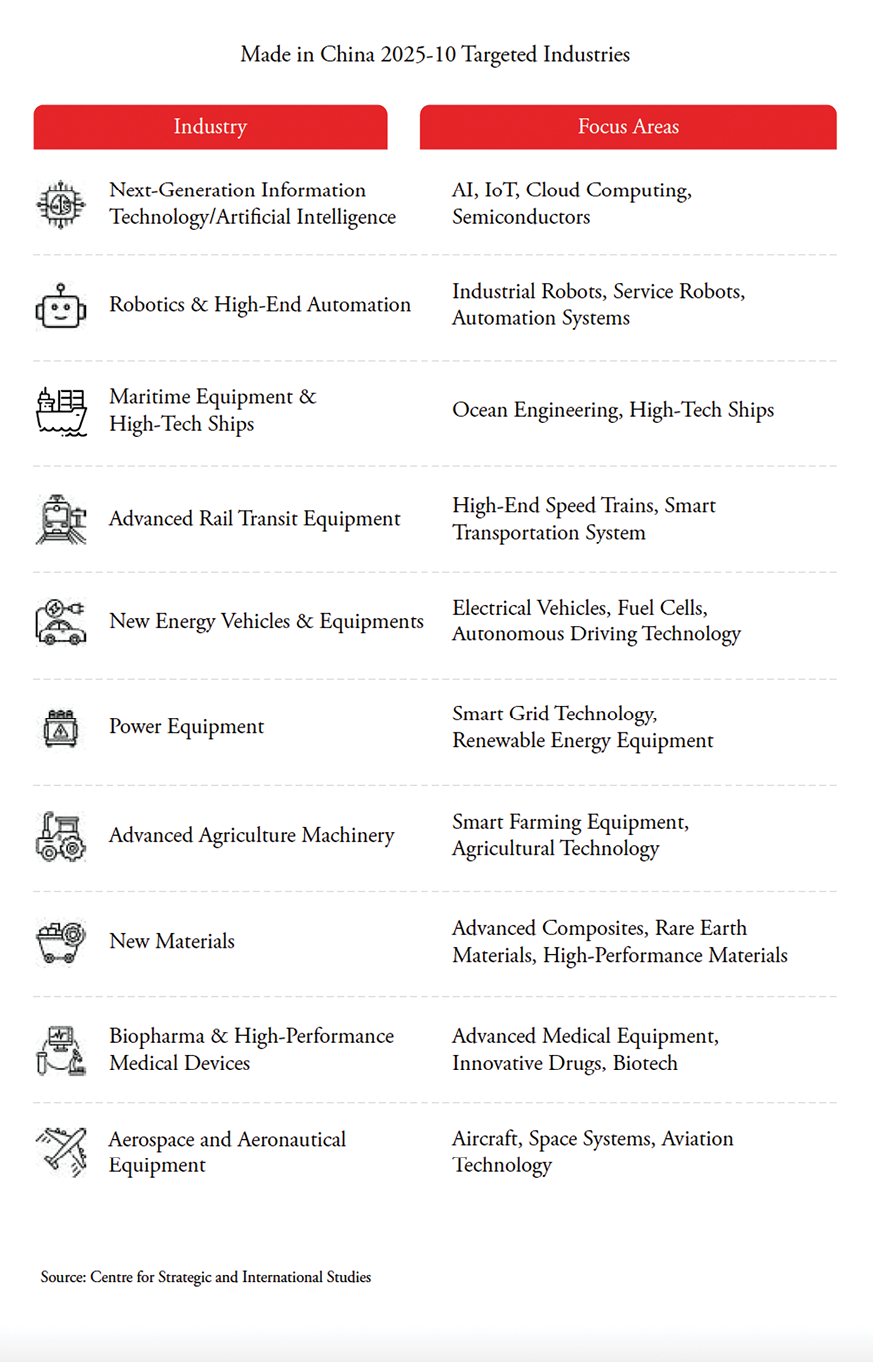
Obviously the international trade situation is far different today than it was back then. The biggest difference now is something business leaders and boards are keenly aware of but don’t discuss publicly – China. The United States and China are locked in an economic war that will define the rest of this decade – and possibly the rest of the century. The intensity is accelerating. The stakes are existential. And the outcome is far from certain. Yet few understand the totality of what is happening. The U.S. needs to wake up to reality and take steps before it is too late. China’s economic model is designed to destroy competitors, not just outcompete them. China has already done this with apparel, furniture, toys, and solar panels. Now it is targeting automobiles, semiconductors, pharmaceuticals, advanced manufacturing, chemicals, and defense systems. Action is urgently needed to be taken to break this business model and strategy.
You have just written a book about the challenge – China’s 90% Model. What does that mean?
It is what I call the 90 Percent Excess Capacity Model. It is not a theory or interpretation. It is a deliberate pattern of state-driven industrial dominance that has played out in industry after industry. China’s strategy is brutally simple. Build enough capacity to meet 90 percent of global demand in a targeted sector. Undervalue the currency by about 20 percent to make exports unbeatable on price. Flood the market with subsidized exports priced at or below marginal cost. Force competitors out of business. Dominate the sector. Put yourself in President Xi’s shoes and you will see the brilliance. Underestimating Xi is a delusion. One only has to look at the fact that China’s trade surplus with the rest of the world last year was well over $1 trillion, an all-time high. Since 2009, the United States has accumulated a $7.4 trillion trade deficit with China, Mexico, and Vietnam – capital that has funded China’s military expansion, technology acquisition, and global influence campaigns.
It is interesting to note that Xi and his advisors were raised playing Go, a game of encirclement, while most Western leaders grew up playing Chess. The two games embody fundamentally different strategic mindsets. Go is about wearing down your opponent by encircling piece by piece. Chess is about direct confrontation and capturing the king. China’s strategy of encirclement is increasingly in full view.
“Leadership requires deep engagement.
A brilliant strategy fails without flawless execution.
Leaders must be deeply involved in the mechanics
of delivery, not just the ideas.”
What allowed this to happen?
For decades, American leaders assumed that economic integration would make China a responsible stakeholder in the global system. That trade would soften authoritarianism. They were wrong. And they were naive. Give Xi credit where credit is due. Only those whose supply chains were destroyed, whose prices were undercut, or who were forced into joint ventures felt the pain early. Everyone else – consumers, retailers, CEOs, Wall Street – saw only benefits. Lower costs. Better margins. Higher returns. Who would complain? But here is what should shake every policymaker and CEO: almost all of the high-quality, high-tech manufacturing in China in the last 10 years was funded by trade surpluses accumulated through currency manipulation. And the know-how? It came from America and its allies. China took everything the West offered – technology, capital, market access – and used it to build a system designed to replace the American-led world order.
What led you to write the book?
I wrote the book with two purposes. First to highlight the underpinnings of China’s strategy that most people are not aware of. Once you understand how their business model works, how currency manipulation sustains it, and how the business model is executed, it is impossible to miss the threat. Secondly, to jumpstart actions governments and corporations need to take to change the course of the context over the next three to five years.
What needs to be done?
In the past, the U.S. had been fighting from a position of weakness – tariff for tariff, restriction for restriction. It needs to buy three to five years to knock down the 90 Percent Model, force currency realignment, rebuild industrial capacity with allies, and race ahead on next-generation technology. America cannot win this fight alone. Victory requires a coordinated bloc – the United States, European Union, Japan, South Korea, Israel and the United Kingdom – an alliance commanding nearly $60 trillion in GDP, more than twice China’s sphere or roughly $25 trillion (Russia, Iran, Venezuela, North Korea and their aligned states). Between them lie 180 unaligned countries with another $25 trillion. Most will choose the American sphere. Taiwan, Canada, Australia, India and others form a broader ecosystem. What matters is that the core set standards, coordinate the policies, and lead with clarity. Others will follow. Not through containment. Not through decoupling, but through convergence. And convergence must start now.
What does convergence involve?
Convergence is not a summit. It is not a declaration. It is an operating system for the free world. It means the bloc coordinates policies, aligns investments and rebuilds industrial capacity together. It means currency realignment happens simultaneously. It means supply chains are rewired, industries rebuilt, and technology protection is enforced with the same discipline as military alliances like NATO and AUKUS, the security pact between the U.S., Australia and the United Kingdom. Here is the strategic logic: in any contest between two powers, each side tests what the other cannot tolerate. China demonstrated this on October 10 when they threatened to cut off magnet supplies. Within days, industries from defense to EVs faced paralysis. That is China’s power. The ability to stop the U.S. economy at will. America and allies must create a counter-package: tariffs, currency pressure, export controls on critical inputs China cannot produce, and coordinated supply chain exits. No single tool wins. Only the package deployed together will lead China to negotiate in good faith and accept reciprocal arrangements. It means synchronized tariffs, joint investments, shared supply-chain intelligence and aligned currency policies. And here is why it will work. China cannot compete with $60 trillion in coordinated GDP.
How can the U.S. rebuild its manufacturing base?
It may sound ambitious, but I believe the U.S. must do it. Create a Department of Manufacturing and Advanced Technology. It has done this before. In World War II, the United States’ rapid production of Liberty ships averaged 1.5 built per day during the war. That level of industrial mobilization is what is needed again. Here is what gives me hope; the people who built China’s manufacturing capacity are still alive. And they are available. Most of them are in the West. I know Americans who, in the case of Apple, slept on factory floors in China training workers to manufacture precisions components. They did it once. They can do it again. The coordination requires a national war room. Not bureaucracy, but a command center operating at crisis speed – recruiting elite talent, modeling China’s moves in real time using AI, feeding decisions directly to the president and cabinet.
What is the timeline?
The October 2025 trade truce with China bought the U.S. one year. The question is what it will do with it. Does it build the Department of Manufacturing, coordinate with allies, and demonstrate progress? Or does it continue business as usual? This year is not breathing room. It is the starting gun. A lot can be done in three to five years. Year One: establish Department of Manufacturing and Advanced Technology. Years Two to Three: scale manufacturing buildout, diversify supply chains, train workforce. Years Four to Five: complete transition, achieve independence from Chinese chokepoints. After six months of starting, the psychology will shift. Energy will return. When people see factories reopening, jobs being created, supply chains rewiring, they will believe again.
What will it cost?
Let me be honest. Prices will go up in key industries such as defense, semiconductors, telecom, chemicals and automobiles. But fears of inflation are overblown. These sectors and their supply chains represent about 15 percent of GDP. In most cases, Chinese inputs are a small fraction of their unit cost. Cost-cutting has already begun. Companies will absorb what they can and pass through the rest. People have to understand that higher prices in some sectors are the cost of resilience. This is not a recession. This is an investment in survival. And those who complete the transition will have lower geopolitical risk, more control over their destiny, and long-term competitive advantage. President Trump’s tax cuts, pressure on interest rates and incoming investments are drivers of economic development that will offset any transitional pain.
What about private investment?
Equity needs to be made available. JPMorgan Chase has already pledged $10 billion for “America First” investments in U.S. companies critical to national security and economic resilience, as part of a broader $1.5 trillion commitment. The bank recently brought in one of Warren Buffet’s top investors to run the fund that will invest the money to help buttress American supply chains and promote technological innovation. CEO Jamie Dimon also has created a “Security and Resiliency Initiative” and advisory group that is a who’s who of high-power executives from Jeff Bezos to Condoleezza Rice. Elsewhere, nearly $9 trillion in new private investments have been announced as of late 2025. Nvidia, Softbank, OpenAI’s Stargate, Apple and sovereign funds from the UAE, Qatar and Japan are flooding capital into U.S. operations.
What more do CEO’s and corporate board members need to know?
Your decisions – where you invest, where your source, which markets you prioritize – affect not just your company’s future, but the outcome of this contest. The leadership of every major corporation must ask itself:
•Has your Chinese competitor built hyperscale excess capacity, taken over 50 percent market share, and driven your unit costs up?
•Do you have a war room tracking early warning signals?
•How is your competitor poaching your employees, particularly technology people?
•Have you built a concrete plan to exit China supply chains within 3-5 years?
And if you think this is just General Motors’ or Boeing’s problem, or Intel’s problem, think again.
Does China’s 90 percent model have weaknesses?
America and its allies have strengths China cannot match – capital discipline, technological creativity, trusted institutions, and the rule of law. China cannot build advanced semiconductors without Taiwan’s TSMC, the Netherlands ASML and U.S.-based Applied Materials. China’s rare-earth processing depends on ultra-pure chemicals and precision equipment from America and allies – small-dollar imports that control tens of billions of Chinese industrial output. When the six powers coordinate export controls, China has few alternatives. Their processing operations degrade. Their industrial machine stalls. This is the leverage that brings Beijing to the table.
Any final thoughts and recommendations?
I know I sound alarmist. I know some will dismiss it as hyperbole. But ask yourself: Did you know that China can shut down entire industries? They have done it and can do it again. The U.S.-China economic war is not temporary, not cyclical, but structural and existential. And there is no end in sight. This is a contest that will define not just this decade, but this century. The wInterview with Ram Charanake-up call has sounded. The only question is who is awake enough to answer it?