- Home
- Media Kit
- MediaJet
- Current Issue
- Past Issues
- Ad Specs-Submission
- Reprints (PDF)
- Photo Specifications (PDF)
- Contact Us
- PRIVACY POLICY
- TERMS OF USE
Loading

ONLINE

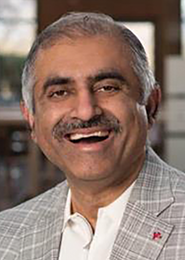
Nitin Seth
Scaling AI With Humans
At The Center
Editors’ Note
Nitin Seth is a global business leader, entrepreneur, and bestselling author. With nearly three decades of leadership experience, Seth has held pivotal roles at world-class organizations, including Director of McKinsey’s Global Knowledge Centre, Managing Director and India Country Head of Fidelity International, and Chief Operating Officer of Flipkart, India’s largest e-commerce company. Across these roles, he has led large-scale transformations in business, technology, data, and AI. Seth is the author of three acclaimed books. His debut, Winning in the Digital Age, became a national bestseller and won five prestigious business book awards, including the C.K. Prahalad Best Business Book Award. His second book, Mastering the Data Paradox, became a bestseller within a week of launch and has already won multiple awards. Seth’s third book, titled Human Edge in the AI Age – completing his trilogy on the transformation trifecta of Digital, Data and AI – was published in July 2025. An alumnus of the Indian Institute of Management Lucknow, where he received the Chairman’s Gold Medal for academic excellence, and Indian Institute of Technology Delhi, Seth is widely regarded as a thought leader. He is a sought-after speaker on digital transformation, AI, leadership, innovation, and building high-performance teams, passionately inspiring individuals and organizations to thrive in a fast-changing world.
Company Brief
Incedo (incedoinc.com) is a global AI and data transformation specialist empowering companies to realize sustainable business impact by delivering ROI from AI@Scale. As an innovation partner bridging strategy and execution, Incedo delivers integrated services and platforms built on AI, Data, and digital engineering, combining deep domain expertise with full-stack capabilities to drive transformation. With a global workforce of over 4,000 across North America, LATAM, and India, Incedo partners with Fortune 500 enterprises and fast-growing clients worldwide across wealth management, banking and payments, telecom, hi-tech, and life sciences.
Will you discuss your career journey?
I began my career as a consultant at McKinsey & Company in 1996, where I learned first-principles problem solving and helped build the McKinsey Global Knowledge Centre (McKC) in India. What started as a “back-office” research support unit evolved into a world-class global innovation hub and an industry benchmark for research, analytics, and knowledge services from India – demonstrating that breakthrough innovation can come from anywhere and that talent behind the scenes can deliver transformational value. I then moved to Fidelity, where I was the Country Head for India and led strategy and transformation for its international business during a shift from an investment-management-led model to a technology-driven one. This experience reinforced how inseparable business and technology strategy are, and how legacy systems and tech debt can slow transformation in large enterprises.
Seeking to shape a true digital native, I joined Flipkart as Chief Operating Officer. There, I learned that traditional management playbooks break down in high-velocity, VUCA environments, which demand technology-first thinking, rapid experimentation, data-driven decisions, and speed – while organizations simultaneously struggle to mature at the pce of growth. Together, these experiences shaped the strategy for my firm, Incedo, where I am the Co-Founder and CEO. Today, Incedo is a fast-growing digital, data, and AI services firm of over 4,000 people, helping Fortune 500 clients move beyond AI hype to deliver measurable business value.
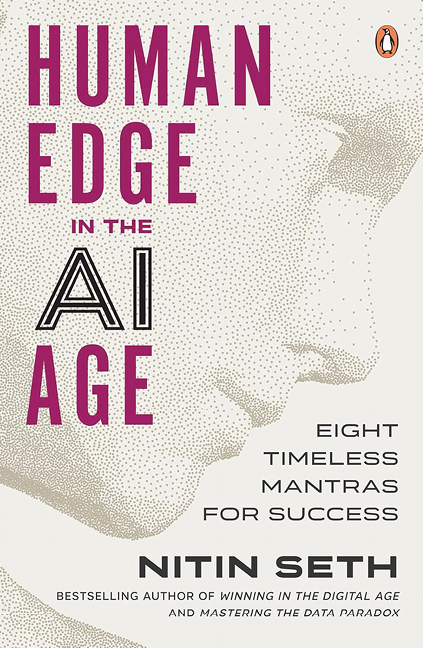
I have authored three bestselling books on what I call the trifecta of transformation – digital, data, and AI. My writing journey mirrors the evolution many organizations and individuals have gone through, and are still navigating, offering insights on how to bridge the gap between the promise of these technologies and the realization of real value. My first book, Winning in the Digital Age, explores why most digital transformations fail despite significant investments. My second book, Mastering the Data Paradox, serves as a practical guide for organizations seeking to generate real ROI from data. My latest, Human Edge in the AI Age, highlights the unique human capabilities that will remain timeless as technology continues to advance.
I am actively involved in developing the IT industry in India and deeply passionate about mentoring and nurturing talent, and that led me to co-found Plaksha University – a private science and technology University in India. Additionally, I am also a member of the Board of Trustees at the Hindu University of America (HUA). I also served as chairperson of NASSCOM’s (IT industry body in India) GCC Council and NASSCOM Regional Council (NRC) for North India.
How do you define Incedo’s mission?
I define Incedo’s mission through a dual commitment. First, from a client perspective, our mission is to be a true AI-led transformation partner. Today, we see a massive paradox in the industry – while AI is the most transformative force of our time, nearly 80 percent of enterprise AI initiatives fail to deliver meaningful ROI. Our mission is to close that gap. Combining deep domain expertise, strong product capabilities, and an outcomes-led, client-first approach, we deliver AI solutions at scale with measurable business impact. Our aim isn’t just to deploy AI, but to solve complex problems at scale through AI-led innovation.
Second, and equally important, is our commitment to people. A client-first culture must be built on an employee-first foundation. Our aim is to build an organization that becomes a nurturing ground for people to realize their full potential. This is why we focus on attracting, developing and retaining the best talent across all levels and empowering them to grow to their fullest potential. Our success is defined as much by the success of our people as by the ROI we deliver to our clients.
What have been the keys to Incedo’s industry leadership?
At the core, our industry leadership has been driven by a clear set of principles that consistently guide how we build capabilities, serve clients, and invest ahead of the curve. First, we recognize that there is a lot of waste in how technology is traditionally deployed – too much effort goes into activity without impact. From the start, Incedo has focused on eliminating this waste by anchoring technology investments to measurable business outcomes. Second, we operate at the intersection of business and technology. Technology is no longer a support function; it is the primary driver of business strategy, competitive advantage, and growth. Our strength lies in bringing deep business context and technology expertise together. Third, we believe that strategy without execution is hallucination. Industry leadership does not come from ideas alone, but from the ability to translate strategy into scalable, repeatable execution at speed.
We identified early that data would be the swing factor in digital transformation, and have specialized in helping our clients extract value from their data investments. Over time, our clients’ data stack has evolved into AI-infrastructure, uniquely positioning us to enable organizations to achieve ROI from their AI@scale initiatives.
And finally, thought leadership has been core to who we are, not a branding exercise. Leading clients ahead of the curve, rather than reacting to demand, has been central to our approach. Our thought leadership is codified in my books which articulate how enterprises must reimagine themselves in the digital and AI age.
What are your views on the impact of AI on business, and how critical is it for leaders to integrate AI while retaining the human touch?
I see AI as a civilization-scale shift, comparable to the discovery of fire, wheel and electricity. This is not another technology cycle – it is a reset of how businesses create value, and it will reshape every industry. AI is driving four structural shifts: hyper-personalization of connected experiences, end-to-end automation through agentic AI, dramatically faster innovation cycles, and entirely AI-native business models. However, most organizations are still using AI incrementally – layering it onto existing processes. The real winners will be those that unlock transformational growth – reimagine customer propositions and business models, and redesign workflows and data foundations with AI at the core.
This transition will inevitably lead to large-scale cognitive displacement – potentially impacting hundreds of millions of white-collar roles. That said, the human touch will become more – not less – critical, but roles will evolve. In the near term, humans will remain in the loop, orchestrating work, providing contextual intelligence, domain judgment, and accountability. But over time, as AI matures, humans must move above the loop – continuously imagining and creating entirely new sources of value.
The future belongs to leaders who shift from execution to orchestration, and from efficiency to impact. In my latest book, Human Edge in the AI Age, I anchor this thinking in the POSSIBLE Framework™ – eight timeless mantras that are core to the human edge. In the AI age, technology will scale the known – but the human edge lies in imagining the unknown.
What do you see as Incedo’s responsibility to be engaged in its communities and a force for good in society?
Our commitment and deep engagement with communities flows from our people-first mission – empowering individuals to realize their human potential to the fullest. I believe there is no greater force multiplier for societal change than education, which is why most of our contribution and engagement are focused there. The most fundamental aspect of digital and AI is the democratization of access to information, knowledge, and learning opportunities. It levels the playing field by giving the relatively disadvantaged populations access to education and low-cost technology, thus opening up unprecedented opportunities. In that sense, digital and AI are not just tools for productivity; they are powerful enablers of inclusion and upward mobility.
This belief led us to launch Digital Fundas in India – a social initiative in digital education rooted in the conviction that talent is universal, but opportunity is not. By providing free digital education in Hindi and other vernacular languages, we enable youth in Tier 2 and Tier 3 cities, not just metros, to participate meaningfully in the digital economy.
As digital, data, and AI reshape how we learn, work, and create value, they also demand that the education system itself evolve from static curricula to future-ready learning models. That conviction underpins my work across education, from my three books on digital, data, and AI to co-founding Plaksha University, and collaborating with schools and leading colleges across India to co-design industry-relevant curricula. By bringing a practical industry perspective to learners, we help future talent discover their human edge, ensuring the AI age remains an era of opportunity for all.
How do you approach your management style?
I lead with high energy and deep involvement, and I care about the details. Whether I’m reviewing a long-term plan or a single internal slide, I treat it as a chance to bring clarity – cutting through noise and helping teams focus on what truly matters. If people don’t understand why we are doing something, they can never do it well.
I believe in Mastering Duality – the art of balancing the paradoxes in business and in life. Big ideas mean little without strong execution, and execution without direction leads nowhere. I often say that strategy without execution is hallucination. The real work is in doing both – delivering results today while steadily building the capabilities we will need tomorrow.
Impact matters deeply to me. Leadership is a privilege, and time is limited, so I try to use it well, not just for clients and the organization, but for society. That is why I spend time writing, teaching, and engaging in forums where ideas can shape thinking and drive change beyond one company.
Above all, my leadership is human at its core. Technology will continue to accelerate, but unique human capabilities like judgment, creativity, context, and character will matter even more. My goal is not only to help people succeed in the next quarter, but to prepare them for the future they will shape and to help them realize more of their own potential along the way.
What advice do you offer to young people beginning their careers?
My first advice is to take more risks and adopt an entrepreneurial mindset, whatever your role. In the AI age, linear careers are fading, and security no longer comes from titles or tenure. It comes from your ability to create value and take calculated risks. Focus on gaining real, hands-on experience and go deep into a problem, a domain, or a craft to build true context and judgment. We are living in an era of constant change, where learning cannot be static – it must be continuous. As the pace of change accelerates, the life of any single skill is getting shorter, and staying relevant means learning, unlearning, and relearning constantly.
I distill what truly matters into five enduring capabilities – the 5 Cs: Context, Creativity, Courage, Connection, and Character. AI delivers speed and scale, often solving 70–80 percent of the problem. What completes the solution – the last 20–30 percent – comes from human insight and judgement. So, context gives it meaning. Creativity allows you to imagine what does not yet exist. Courage enables you to act in uncertainty, take risks, and stand by your values. Building real connections with care, empathy, and shared experiences is among the most enduring assets that no course or credential can provide you. And finally, character becomes your moral compass in a world full of shortcuts and instant gratification. These are the timeless human qualities that no machine can replicate.
When you look to the future of the industry, what excites you the most, and what concerns you the most?
It is an extraordinary time to be in the AI age. Rarely do we encounter a moment that combines such scale of disruption with such magnitude of opportunity. What excites me is the once-in-a-generation opportunity to leapfrog for everyone at every level – individual, corporate, society or nation. The year 2025 marked the end of the “experimentation phase.” AI has moved to the core, resetting the rules of competition. This shift allows us to move up the value chain, transitioning from “execution-only” roles to becoming strategic architects who solve the world’s most complex problems.
My deepest concern is that the magnitude of this disruption hasn’t fully sunk in. If we treat this as “business as usual,” we will not act with the intensity that is required and AI will eventually push us into a corner. Much of our industry still operates with an execution mindset, and those roles are the most vulnerable to AI-led disintermediation. We have a narrow window to act.
Success in the AI age requires coordinated efforts from industry leaders, educators, policymakers, and governments. From building a robust AI ecosystem to developing future-ready talent, the AI age calls for shared responsibility and long-term collaboration – without which we risk losing momentum at one of the most defining moments in history.