- Home
- Media Kit
- MediaJet
- Current Issue
- Past Issues
- Ad Specs-Submission
- Reprints (PDF)
- Photo Specifications (PDF)
- Contact Us
- PRIVACY POLICY
- TERMS OF USE
Loading

ONLINE

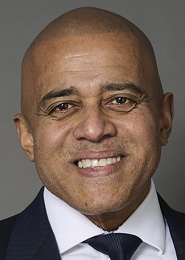
Jeremy C. Kohomban
The Power And Responsibility
Of Family
Editors’ Note
Jeremy Kohomban is the President and CEO of The Children’s Village and the President of Harlem Dowling, two organizations founded in the early 1800s that serve over 30,000 children and families. Kohomban is a leading national advocate for reforms that prioritize family support over the use of family separation interventions. He was a primary contributor to the federal Family First Prevention Services Act, which created the greatest advances to the field in over four decades. Under his leadership, The Children’s Village, the nation’s oldest children’s residential treatment center, has been transformed into a national model for community-embedded family support. Kohomban serves as a Trustee of Save the Children, a Trustee for the Save the Children Action Network (SCAN) and ArtsWestchester. He is also a member of the Bipartisan Policy Center’s child welfare initiative and serves as a reviewer for the American Institutes for Research (AIR). Kohomban was appointed by New York City Mayor Eric Adams to the Commission on Community Reinvestment and the Closure of Riker’s Island, and by New York City Council Speaker Adrienne Adams to the New Arrivals Strategy Team to evaluate and identify solutions to improve supportive services for immigrants who arrived in New York City. He is a graduate of Emporia State University, Kansas, holds a Masters from Long Island University, New York, a PhD from the School for Business and Leadership at Regent University, Virginia, and a LittD (Honorary Doctor of Letters) from Mercy College, New York.
Organization Brief
Founded in 1851, The Children’s Village (childrensvillage.org) is one of the nation’s oldest child- and family-serving charities. Over 175 years, what began as one of America’s earliest residential institutions has transformed into a national leader championing community investments that keep children safe and families strong. Each year, more than 21,000 youth and families turn to The Children’s Village for support across a coordinated continuum of prevention, treatment, housing development, and family-centered services. Serving children victimized by human trafficking, children removed through child welfare and youth involved in juvenile justice, The Children’s Village works to restore families whenever possible and to create new permanent families when necessary. At the heart of its mission is the conviction that every child deserves love, stability, and belonging.

Jeremy Kohomban poses with youth at the
2024 WAY 40th Anniversary dinner
Will you provide an overview of The Children’s Village’s mission?
Our mission is to help children return to their families. We define family broadly: it may be a single parent, a two parent household, an extended relative, or any willing and responsible adult able to provide a safe and loving home. Government and charity alone cannot give children what they most need – enduring relationships and a true sense of belonging. Children thrive when they are embraced by people who are committed to them. When they languish in systems or institutions, their life trajectory is far less positive than when they grow up in stable families. Today, 85 percent of the children we serve each year return home to family, a remarkable outcome given the challenges many face. About 15 percent cannot return home because a family is unwilling or unable to provide a safe environment. In those situations, we work to create new permanent families through amazing foster families, dedicated mentors, and adoption, ensuring every child has the opportunity for stability and belonging.
What inspired you to work in child welfare?
That story begins in Kansas. I had planned to pursue a military career when my captain made me volunteer at a local group home. I had no idea what a group home was. I formed a bond with the boys, teaching them something important to me, something I grew up doing: fishing and cooking. Over time, I got to know them well. One day, I asked about their families, and one boy told me they couldn’t see them. I was stunned. That realization stayed with me long after I left Kansas. Years later, that memory resurfaced when I found myself unfulfilled training to be a neuropsychologist in New York. I called my mother about this, and she told me to find something I enjoyed. At that moment, I remembered how meaningful it was to serve alongside those boys in Kansas. That memory guided my next step. I applied for a position at a local child serving organization. That decision marked the beginning of my career, and it ultimately shaped the path that brought me here.
What was your philosophy coming into leadership at The Children’s Village?
When I arrived, The Children’s Village reflected a dominant national mindset: that institutions were the solution for children deemed at risk. Residential care had become the default across the country. In the 1970s, we warned in an ad campaign that a child could end up “up the river” – a reference to Sing Sing prison – without residential placement. The message was blunt: remove children or prepare for incarceration. It was rooted in a backward narrative that wrote off entire families and communities as destined to fail. But the outcomes told a different story. Too many young people left residential care only to enter another form of government or charity care. I believed we could serve children with complex needs while prioritizing measurable, long-term outcomes centered on family. Residential treatment can be necessary, but it must be short-term – and it can never replace love and belonging. Our responsibility is to help children return home or find a permanent family. Becoming a parent deepened that conviction. As the father of four, I understand the power and responsibility of family.
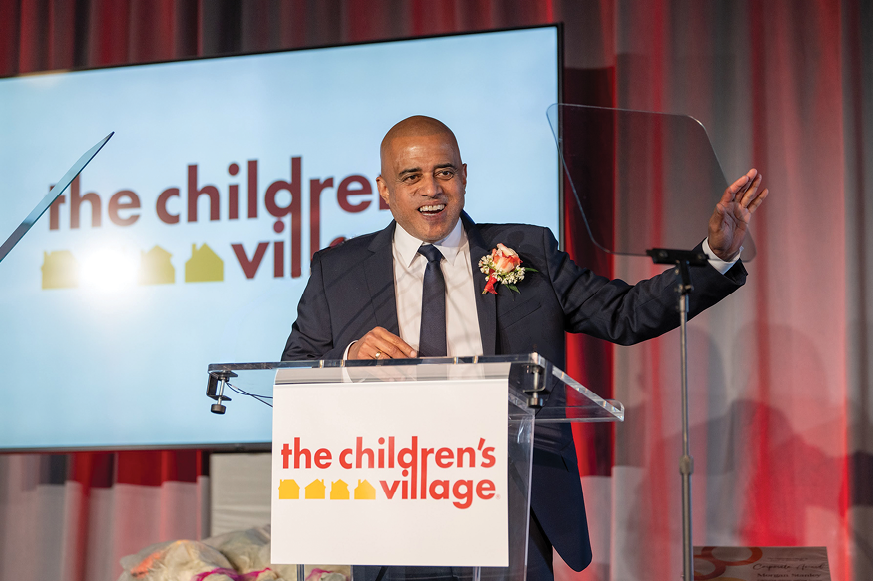
Jeremy Kohomban speaks at the 2025 annual
Children’s Village gala
How do you measure the impact of The Children’s Village’s work?
We focus on providing children and families with what we would want for our own children: love, safety, and education. We hold ourselves accountable by measuring our work against these three standards. First, are children returning home, or, when that isn’t possible, finding a permanent family? Second, are families set up for long-term stability after reunification? Going home is not the finish line; sustained success requires ongoing support, access to resources, and real opportunity. Third, where are we building homes? Do families live in communities that offer real pathways to upward mobility? In a nation shaped by both segregation and redlining, place matters: where a child grows up and attends school are among the strongest predictors of second-generation success.
Despite this evidence, more than 85 percent of affordable housing continues to be built in already overburdened communities, where schools are often struggling or failing outright. If we are serious about opportunity, we must create living environments that provide the same access to safety, quality education, and economic mobility that any family would seek for their own children. We would never accept diminished prospects for our own families. The question is why we tolerate them for the children we are privileged to serve.
You took this family-centered framework nationwide. What was your involvement in shaping national policy?
For several years, I worked with bipartisan leaders in Washington to reform how child welfare is financed. At the time, federal funding reimbursed providers by the day for residential placements. If we successfully returned a child home, we lost revenue – that’s a perverse incentive.
We maintained momentum across changing congressional leadership and presidential administrations. In 2015, I made the case for reform before the U.S. Senate Finance Committee. My message was that the system was unintentionally rewarding separation and longer stays instead of family reunification. For the next three years, we continued building a broad coalition to keep families together rather than separating children.
By 2018, we secured the passage and enactment of the Family First Prevention Services Act, which limits federal reimbursement for long-term congregate care and allows states to use federal funds for prevention and in-home services. It shifted the focus from paying for placement to supporting families and returning money to these communities that have suffered under-investment for decades.
Will you discuss your recently expanded housing portfolio both inside and outside New York City?
Our housing expansion reflects a simple truth supported by research: where a child grows up, and where they go to school, shapes long-term mobility. It is the best predictor of second-generation success. D’Assern Housing, A Home for Harlem Dowling in Manhattan, and most recently, The Eliza in Inwood, Manhattan, are our proofs of concept. The Eliza, built on the former Inwood Library site, includes 174 deeply affordable apartments integrated with a new New York Public Library branch, a Universal Pre-K classroom, and the ACTS Center, which offers educational and workforce training opportunities. The project demonstrates that integrating high-quality affordable housing with educational and workforce infrastructure in transit-rich neighborhoods promotes long-term stability, including for young people and families transitioning out of government and charitable systems of care.
We are extending that model in downtown Peekskill by redeveloping a historic property into 22 affordable homes, commercial space, and a new public library in partnership with the Field Library.
Our projects create affordable housing in desirable, transit-rich communities with strong schools and opportunities for upward mobility.
What is the role of corporate and foundation partners in sustaining and expanding your work?
Government contracts fund core services, but they are typically structured to sustain existing programs rather than fund innovation. Philanthropic and corporate support gives us the flexibility to test new approaches and prove what works. Early private investment allowed us to shift from long-term residential care toward in-patient treatment, family engagement, reunification, and demonstrate that teenagers could safely return home. That proof of concept helped shift the broader field’s opinion.
The same is true for our housing work. Building in high-opportunity, transit-rich neighborhoods requires capital beyond traditional public financing. Private partners make it possible to secure better-located properties, integrate libraries and educational space, and invest in design and amenities that people would choose for themselves.
What are your priorities for The Children’s Village as you look to the future?
Looking ahead, we aim to build on what works and scale it. We’ve shown that children can safely return to family, that short-term in-patient treatment works, and that housing location helps shape long-term success. Now we must deepen that impact.
First, we’ll continue investing in our people. Strong outcomes depend on strong staff, so my focus is on building and developing a confident, mission-driven team. Second, we will continue to invest in what is permanent: love, education, and safe homes in high-opportunity neighborhoods. Our integrated housing model has proven effective, but the need far exceeds our current capacity. Scaling that model thoughtfully is essential. Finally, we need to remain focused on measurable outcomes and proof of concept. We demonstrated that teenagers could return to their families and that we could shift national policy to financially incentivize treatment and family support. Going forward, we will continue proving that reunification, community investment, and place-based opportunity are effective – so the broader system evolves with us.