- Home
- Media Kit
- MediaJet
- Current Issue
- Past Issues
- Ad Specs-Submission
- Reprints (PDF)
- Photo Specifications (PDF)
- Contact Us
- PRIVACY POLICY
- TERMS OF USE
Loading

ONLINE

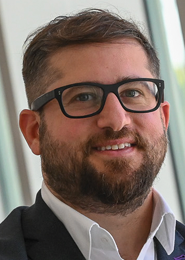
Hrag Hamalian
Putting Family And
Education First
Editors’ Note
Hrag Hamalian is a dynamic leader in education, with more than 20 years of experience in K-12 and higher education along with development and program expansion. Prior to joining TGR Foundation, Hamalian served as the Chief Executive Officer of Bright Star Schools. In this role, he strategically grew Bright Star Schools from four to nine schools and created a community-based schools model that provides a transitional kindergarten to 12th grade education, plus 6 years of higher education support, for over 3,500 students across Los Angeles. Prior to his time at Bright Star, Hamalian founded Valor Academy Middle School, a high performing 5th through 8th grade charter public school in Los Angeles. In 2013, he helped lead the strategic merger of Valor and Bright Star, the first merger between two successful charter organizations in Los Angeles. Hamalian is a Broad Academy Fellow, Aspen Institute Fellow, an Achievement First Accelerator Fellow, a Building Excellent Schools Fellow, and a Teach for America Corps Member. He currently serves on the Board of Directors for ExEd and Building Excellent Schools. In 2011, Hamalian was the recipient of Boston College’s prestigious Gold Award, honoring him as alumnus of the decade. He holds a double-major bachelor’s degree from Boston College in biology and honors English, a master’s degree in secondary education from Loyola Marymount University, and a master’s in business administration from UCLA.
Organization Brief
TGR Foundation (TGRFoundation.org) is a leading education nonprofit founded in 1996 by Tiger Woods. With a commitment to providing opportunities that unlock the unlimited potential in the lives of young people from under-resourced communities, its mission is to empower students to pursue their passions through education. In 2026, TGR Foundation is celebrating 30 years of driving dreams together. Through its TGR Learning Labs and signature education programs focused on science, technology, engineering, arts and math (STEAM) educational enrichment, career and college readiness and health and well-being, TGR Foundation has served more than 217,000 students.
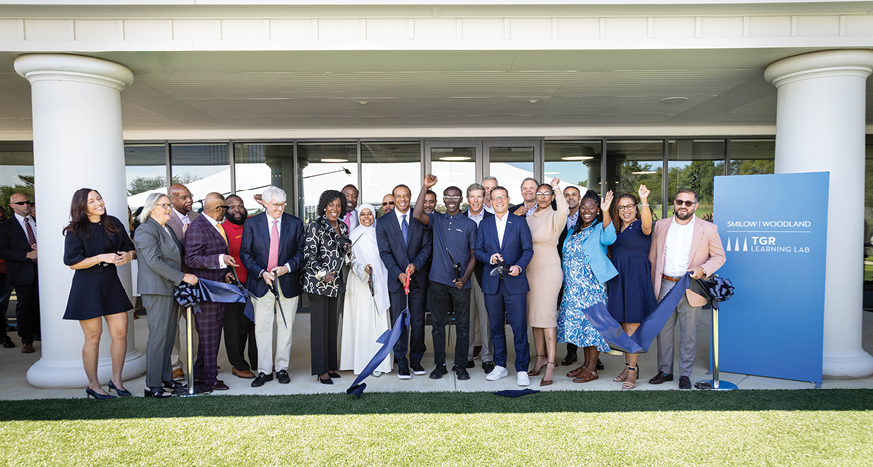
Smilow Woodland TGR Learning Lab in Philadelphia ribbon cutting
Will you discuss your career journey?
I am from an immigrant family, migrating to the United States when I was very young. My parents were college-educated and valued education deeply. They decided to come here because they believed public education in the U.S. was strong and that my sister and I would have the best chance at a quality life and to meet our potential. We mostly grew up in New Jersey and were exposed to excellent public schools. As an English language learner, I have deep appreciation and fond memories of teachers who created safe spaces that allowed me to flourish and grow. That stayed with me throughout high school and developed into a deep respect for the education system I experienced.
Like most immigrant kids, I was told I could be a doctor, lawyer, or businessperson. I chose medicine and was on track for medical school when I heard about Teach for America, which lets you take a short break from your track to teach in urban or low-income communities. I joined and was placed in South Los Angeles – then one of the lowest-performing high schools in the country. It was a historic school with amazing kids and families, but part of a broken system. As a biology teacher, I became frustrated by the stark contrast between the opportunities I had as a student and the limited ones my students faced – not because of their potential, but because of the conditions around them.
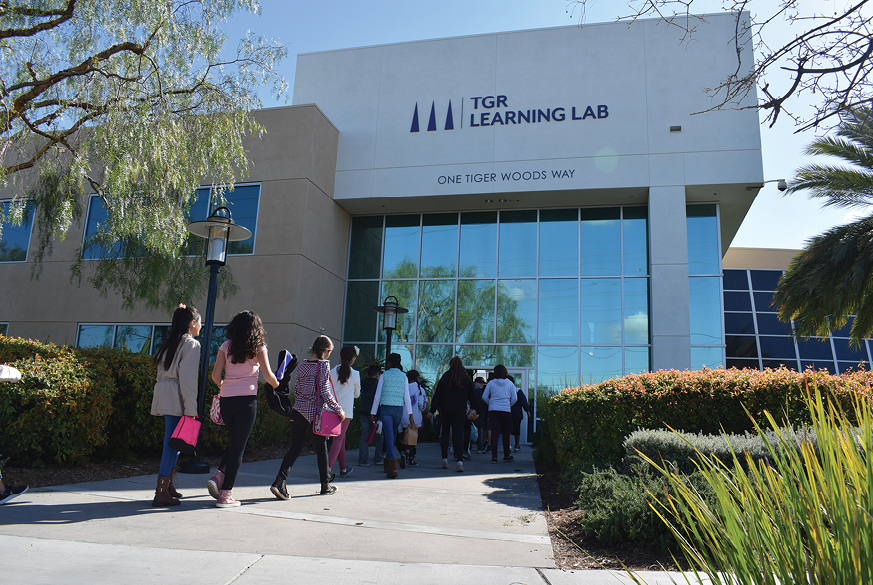
Students entering the flagship TGR Learning Lab
in Anaheim, California
When you’re young and brash, you make big decisions you might not make when you’re older. At 23, I decided I was going to open a school. With support, I studied strong school models nationwide, went door to door in Los Angeles neighborhoods, and found a community that embraced the vision. I opened a school called Valor Academy in North Los Angeles. The school became very successful quickly – one of the highest-performing middle schools in LA across demographics. The reason wasn’t that I was an amazing educator; it was because I built it alongside the parents and students I served. That partnership made all the difference.
Soon there was a desire to scale the impact. While attending business school part-time, I had a professor teaching about mergers which sparked an interest in how that concept might apply to education. Schools aren’t products – you can’t scale them quickly because they depend on community and grassroots involvement. But mergers made sense as a way to expand by joining with another network that shared our values. We executed one of the first charter school mergers in Los Angeles between two successful organizations and grew that network over the next 15 years, with me serving as CEO. We grew to nine schools serving 4,000 students annually, K–12, with six years of continued support after graduation to help students succeed in two-year or four-year colleges, technical programs, trades, and even into their careers.
I eventually decided to leave that work and join TGR Foundation because of the potential here. I have seen schools struggle because of a lack of auxiliary support. What TGR Foundation does is uniquely powerful: we add a layer of support for schools, families, and kids, breaking down barriers to access and opportunity for low income communities.
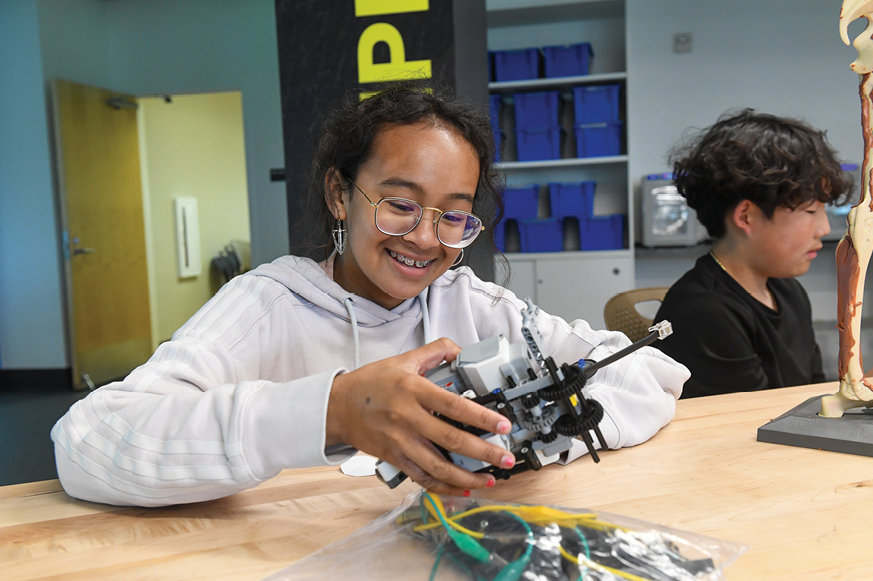
Students participating in STEAM-based programming
at a TGR Learning Lab
How do you define TGR Foundation’s mission?
Our mission is to empower students to pursue their passions through education. To break it down – we are helping students answer that age old question: What do you want to be when you grow up?
Our theory of change starts with building incredible, place-based learning labs – spaces with high ceilings, glass walls, maker spaces, multimedia studios, and cutting-edge technology, often located near athletic spaces, usually golf-related. These are inspiring, safe environments where kids feel a sense of belonging and curiosity, both figuratively and literally safe to experiment and try new things. Over time, as students attend through various touchpoints, field trips, afterschool programs, clubs, teams, studios, college and career-connected learning, and more, we provide three key pillars of support:
1. STEAM learning: Science, technology, engineering, arts, and math across a wide range of topics that let kids explore, discover what they love, and just as importantly, what they don’t.
2. College and career access: We help students connect their interests to concrete outcomes through scholarships, college guidance, and hands-on career learning with real companies and mentors.
3. Health and well-being: We aim to develop whole, healthy human beings – mind and body – through sports, golf, and mental wellness programs that support balanced growth.
Our programs help students explore a wide variety of subjects not typically taught in school, exposing them to careers aligned with their interests. From there we connect them to higher education and career pathways, provide real-world experiences and help them build a plan for their future. That ecosystem of support is something truly special that I don’t believe any other educational institution delivers on a national level.
All of it leads to one goal: helping kids unlock their potential, discover what brings them joy, and build purposeful futures.
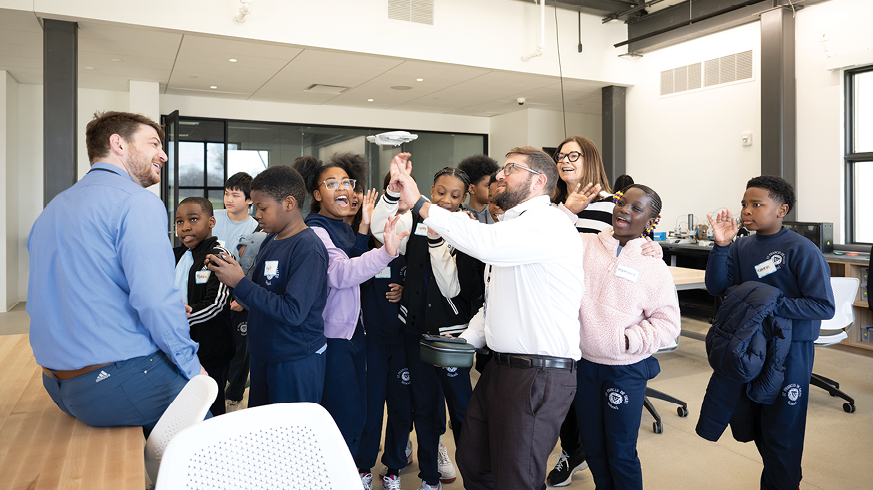
Hrag Hamalian at a TGR Learning Lab drone class
How has Tiger Woods’ vision evolved from a family-led mission to a nationally recognized education nonprofit?
Tiger is known as the GOAT in golf – and arguably one of the greatest athletes of all time – but less is known about his deep commitment to education and giving back to youth. From day one, his family values of sharing and caring were deeply ingrained in how he was raised. His parents emphasized education from the start – he wasn’t allowed to play golf until his homework was finished. After 9/11, Tiger and his father had conversations about purpose and impact, which led to the idea of giving back in a way that would truly change lives. What started as traditional philanthropy in 1996 – golf clinics and giving – evolved into the vision of putting family and education first, which became the basis for our first Learning Lab in Anaheim, adjacent to the public golf course where he grew up playing. That lab was created after detailed community assessments with local school districts and corporations, resulting in an intentional educational hub where kids could explore career paths. Over the last 20 years, programming has grown and evolved.
In recent years, Tiger has doubled down on his mission. In partnership with the Cobbs Creek Foundation, we opened our second Learning Lab in West Philadelphia in April 2025, adjacent to the historic Cobbs Creek Golf Course – where Charlie Sifford, the first Black PGA golfer and a personal mentor to Tiger, got his start. The lab sits in one of Philadelphia’s lowest-income communities and is already bustling with activity and learning. With that success, we’re now currently planning expansion into three additional cities.
Will you highlight the impact that TGR Foundation has made over the past 30 years?
Over three decades, the foundation has touched the lives of over 3 million young people through its various programming. Since opening our flagship TGR Learning Lab in Anaheim our STEAM, college access programs, and career-connected learning experiences have reached over 200,000 students. For 18 years, that work was localized near where Tiger grew up, giving back to his community. Now, with the expansion to Philadelphia and others ahead, that impact will scale exponentially. What makes TGR Foundation distinctive is our integrated model – working with families, local schools, education partners, and philanthropies – creating a coordinated system that uplifts everyone.
Our role is to help kids identify passions that excite them and then connect those passions to a sustainable lifelong pathway through education, career, and personal growth. As we expand, that impact will grow even deeper.
How does the TGR Learning Lab model adapt to local communities while maintaining a high standard of excellence?
We have a clear strategic roadmap for where and how we open new labs. It always starts with the students we want to serve – communities with a high density of low-income students who lack access to the same opportunities as more affluent peers. Next, we look for strong local partnerships: school districts, civic organizations, transportation networks, and funders who can support sustainable success. A great example is our expansion to West Philadelphia. Before opening the new lab, we spent two years doing groundwork – providing mobile learning labs, college access programs, and community listening sessions. Parents, educators, and local leaders emphasized the need for early education, so even before our lab opened, we began providing programming to 1st–4th grade students in local schools. That feedback shaped our model, and now early education is part of what we offer wherever it’s needed.
How important is it to work with communities that not only need educational programming, but also provide the necessary support to make Learning Labs successful?
It’s absolutely essential. Learning Labs are place-based centers – kids must come in person. While our technology and programming attract them, the relationships keep them coming back. They build connections with peers, instructors, volunteers, and mentors, and those bonds anchor the work we do.
Making a lab successful requires the integration of community partners as well – philanthropists, educators, companies, and local leaders. We enter a community only when all those conditions are right, because our goal is long-term engagement. Ideally, students stay with us throughout their adolescence as we help them develop a clear vision for their lives. For that journey to work, every partner’s commitment must be aligned and sustained over time.
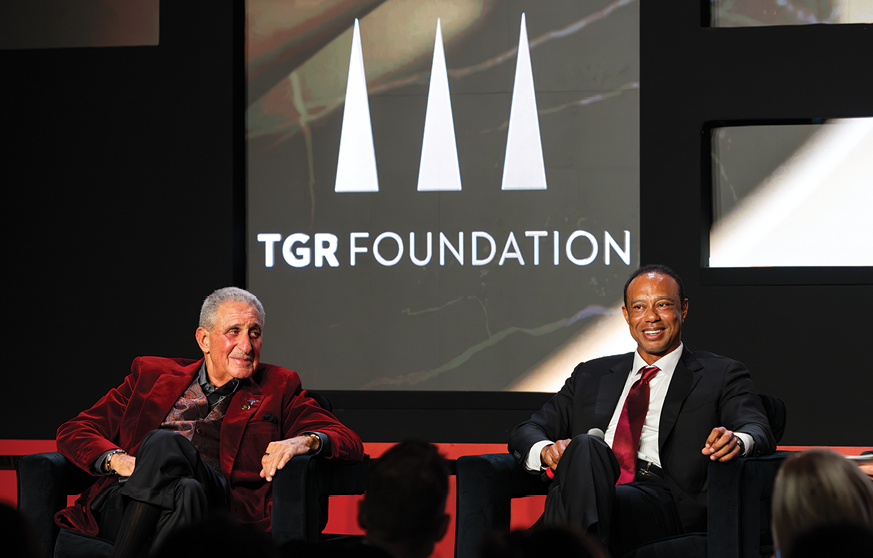
Arthur Blank and Tiger Woods announcing partnership
to bring a new TGR Learning Lab to Atlanta
What led to TGR Foundation’s partnership with the Arthur M. Blank Family Foundation to transform a historic school into the TGR Learning Lab Atlanta?
This partnership is a perfect example of how our model comes to life. Arthur Blank – co-founder of Home Depot and a leading Atlanta philanthropist – has long worked to expand opportunity across the city. Together with his foundation, Atlanta Public Schools, and other partners, we’re revitalizing a long-vacant historic school into a modern TGR Learning Lab for the local community. The project brings together philanthropists, corporations, and educators to build something that will create brighter futures for kids in Atlanta. It’s a powerful demonstration of collaboration and shared values fully realized.
How critical is it for TGR Foundation to align with values-driven partners like the Arthur M. Blank Family Foundation and EY US?
Tiger has opened countless doors for this foundation through his platform, but he can’t do it alone. We need partners to help us scale our impact and bring this unique educational model to more communities in need. Arthur M. Blank Family Foundation and EY US are great examples – values-driven organizations that believe in the power of education and actively help us make it real.
What are your priorities for TGR Foundation as you look to the future?
My top priority is ensuring we meet our mission and deliver impact with fidelity. That means scaling thoughtfully, staying focused on the factors that drive meaningful work, and growing in communities where we can create sustainable, long-term results.
It also means engaging the right partners to help us bring our mission and vision to life, so TGR Foundation’s work continues to change lives for generations to come.