- Home
- Media Kit
- MediaJet
- Current Issue
- Past Issues
- Ad Specs-Submission
- Reprints (PDF)
- Photo Specifications (PDF)
- Contact Us
- PRIVACY POLICY
- TERMS OF USE
Loading

ONLINE


Gayle M. Horwitz
Something For Everybody
Editors’ Note
Gayle Horwitz brings over 30 years of experience in strategy, operations, and finance to her role as Chief Executive Officer of JASA. She is a highly accomplished C-suite leader with a proven track record of driving growth and innovation across public, private, and not-for-profit organizations. Her previous roles include leadership positions at the City University of New York (CUNY), Federation Employment and Guidance Services (FEGS), Nardello & Co., the Hugh L. Carey Battery Park City Authority, the New York City Comptroller’s Office, and the New York City Board of Education. Most recently, as Senior Vice Chancellor and Secretary of the Board at CUNY, Horwitz served as a strategic partner and advisor to the Board and Chancellor, supporting the institutional agenda and ensuring good governance. Concurrently, she was selected to also serve as Interim President of the Research Foundation of the City University of New York (RFCUNY), managing the operations of the fiscal agent that supports CUNY in administering sponsored awards. Horwitz’s lifelong commitment to service is evident in her participation as a Board Director and Advisory Board Member for various New York organizations dedicated to improving the lives of New Yorkers. She is currently a Trustee of the Community Service Society, serving on the Finance and Investment Committees. Additionally, she is a Member of Impact 100 NYC, a global women-led philanthropic movement harnessing the power of collective giving and collaborative action, where she co-chairs the Finance Review Committee and participates on the Grant Review Committee. Horwitz holds an AB degree in politics from Mount Holyoke College and an MPA from New York University’s Robert F. Wagner Graduate School of Public Service, where she received the Major Raymond J. Lepesqueuer Award for Highest Scholastic Standing.
Organization Brief
JASA (jasa.org) is one of New York’s largest and most respected nonprofits serving older adults, and continues to shape the city’s future of aging with innovation, compassion, and advocacy. For nearly 60 years, JASA has provided essential programs, from affordable housing and home care to social services and creative engagement, that empower more than 40,000 older New Yorkers each year.
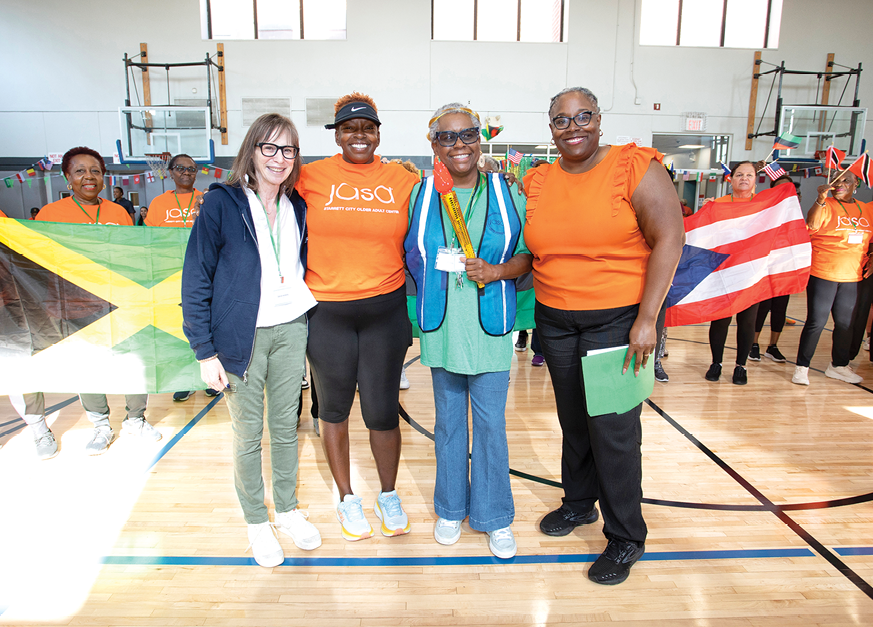
JASA Senior Olympics in Starrett City in September 2025
Will you discuss your career journey?
I’ve been very lucky to build a career in public service that has spanned government, the nonprofit sector, and a few brief stops in the private sector. I always find myself coming back to public service because I’m driven by mission-focused work and the chance to do things that truly matter in people’s lives. In college, I worked for a Congressman in Washington and realized this was the kind of work I wanted to dedicate my life to, and I’ve been fortunate to be able to do that ever since.
What excited you about the opportunity to lead JASA and made you feel it was the right fit?
I’ve known about JASA for almost 40 years, and the organization has been around for nearly 60 years, so it has long had a strong reputation. The chance to lead an agency that is so well-regarded for serving older adults – the fastest-growing population in New York City – was incredibly compelling.
JASA is known for its innovation and for constantly developing new ways to support older adults, and that kind of creative, forward-looking work really appealed to me. At a time of so much change in the world, I wanted to be part of an organization that is giving back to such a large and important part of our city.
How do you define JASA’s mission?
We describe JASA as the go-to agency serving older adults in New York City. Older adults are not a monolith: from age 60 on, the needs of someone in their 60s can look very different from someone in their 70s, 80s, or 90s, and we strive to meet people where they are with what they need. Our programs reflect that range. Through JASA NextAct, for example, older adults can take college-level courses on Sunday afternoons just for the joy of learning. If someone can’t leave their home and needs a meal, we can deliver one – and we deliver nearly a million meals a year to homebound older adults who can’t prepare food for themselves. We also have a licensed home care agency for people who are coming out of the hospital or who need more hands-on support at home.
We operate older adult centers that offer connection and activities – everything from dominoes and bingo to more creative programming. At one center I visited, a program called Museum in a Box brought the museum experience directly to older adults who were painting and engaging with art in ways they otherwise might not have the chance to do. To me, that really captures JASA’s spirit: we can be something for everybody.
Will you elaborate on the scope of services JASA provides and how they make a difference?
We have more than 50 locations across New York City, including older adult centers, housing sites, and naturally occurring retirement communities. Across these locations, we offer more than 20 services, delivered by nearly 1,300 staff members who collectively speak over 15 languages, which helps us reach and support a very diverse population. Our services cover a wide spectrum. In addition to meals, home care, and older adult centers, we provide mental health services, including mental health clinics in the Bronx for those who are really struggling. We have an elder justice and elder law program, and a helpline that allows us to connect people to services, whether provided by JASA or by trusted partners, so they don’t have to navigate complex systems alone.
We also manage about 2,500 units of affordable senior housing. What’s powerful about our housing portfolio is that we don’t just provide a place to live; we also offer on-site services. Residents can connect with social workers for benefits enrollment or help with issues they may be facing, so the support really runs the gamut.

Gayle Horwitz surrounded by Valentine’s boxes created by
student participants in JASANextGen for JASA clients
Since you started with JASA in 2025, you’ve examined your programs and even launched a new one that illustrates JASA’s breadth of programming. Will you highlight this program?
When I started in July and was learning about our programs, it struck me how central food is to our connection with older adults. We serve meals at our older adult centers and deliver meals to people at home, but I realized that beyond the meal itself, there’s a deeper connection being made. Every driver who delivers a meal is doing more than dropping off food; they’re checking in, noticing whether someone seems okay, and communicating any concerns. I kept asking myself what more we could do, especially for older adults who are isolated or live alone, and I thought of their birthdays and how to mark their special day. When I brought the idea to the staff, they embraced it and figured out how to make it work. So we launched JASAcakes with the goal of delivering 2,000 birthday cakes and celebrations this year to our clients. It’s a great example of the innovation and “let’s figure it out” mindset at JASA, and it’s been one of the joys of joining the organization.
How critical are metrics to measure the impact of JASA’s work?
Metrics are vital. They help us understand our reach and ensure we’re making a meaningful difference. We’re about to issue our impact report which will show that every year, through all of our programs, we reach roughly 40,000 older adults in New York City, a significant number by any measure. Tracking our reach and outcomes by program and by community helps us see where we’re having the greatest impact and where additional services or adjustments might be needed. It also ensures that we stay grounded in the real needs of the communities we serve, rather than relying on assumptions.
How critical is it to have such an experienced and committed team?
I was fortunate to step into an organization with a very strong, experienced team. Many people come to JASA and stay, which speaks volumes about the culture and commitment to the mission. One of our co–chief program officers, whom I recently promoted to be my chief of staff, has been with JASA for nearly 25 years; she started as a social worker and worked her way up, which is a powerful example of growth within the organization. It sends a clear message to staff that there are real opportunities to build a career at JASA. I also have senior leaders who have been here a decade or more, along with long-tenured staff across many programs. That depth of experience and dedication helps us carry out our mission with consistency, compassion, and strength.
As you look to the future, what are your priorities for JASA?
In my first year, my priority has been to really get to know the organization, which is why I launched a listening tour across our sites. I still have a few locations left to visit, but spending time with staff and participants has been essential in understanding where we are today and how we can position JASA for future growth. I believe we have a strong foundation, but we need it to be even stronger as we face uncertainties in city and state budgets and other external pressures. My focus is on making sure we can adapt, no matter what happens, and that means investing in the core of the organization, our people, systems, and programs, so we’re prepared for the future.
At the same time, like many nonprofits, we’re navigating staffing challenges, from recruiting social workers to attracting people who want to build careers in human services. Looking ahead, a key priority is to explore new ways to strengthen career pathways and professional development for people who work with us, so they can grow while continuing to serve older adults. This includes thinking creatively about how education and training can support both retention and quality of care. For JASA, under my leadership, this focus on developing talent is essential to sustaining and expanding our ability to meet the needs of older adults across New York City.