- Home
- Media Kit
- MediaJet
- Current Issue
- Past Issues
- Ad Specs-Submission
- Reprints (PDF)
- Photo Specifications (PDF)
- Contact Us
- PRIVACY POLICY
- TERMS OF USE
Loading

ONLINE

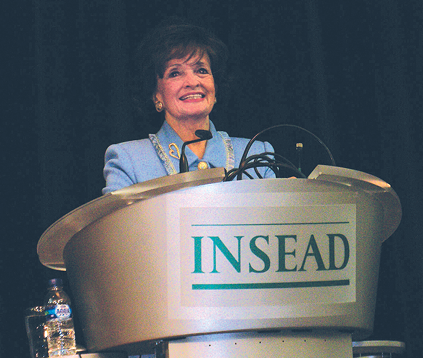
Marilyn Carlson Nelson
speaking at INSEAD
Living With Purpose
Editors’ Note
Marilyn Carlson Nelson has served on the boards of the UN Global Compact, the Committee Encouraging Corporate Philanthropy, the National Endowment for Democracy, and the Kennedy Center for the Performing Arts, and is a past Chair of the Mayo Clinic Board and a former board member of ExxonMobil. She has taught corporate responsibility at the Carlson School of Management at the University of Minnesota and is the author of the bestselling book, How We Lead Matters: Reflections on a Life of Leadership. Nelson graduated with honors from Smith College with a degree in international economics and attended the Institute des Hautes Etudes Economiques et Politiques in Geneva.
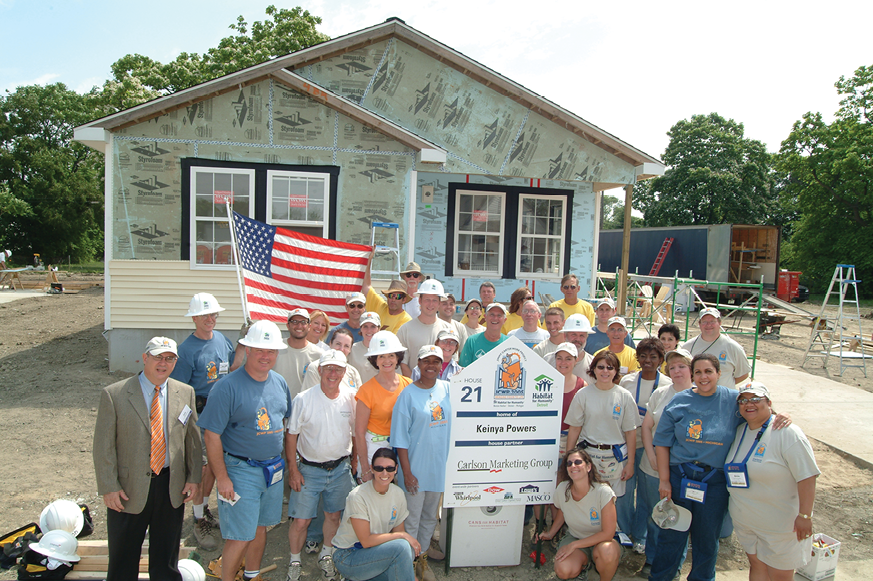
Marilyn Carlson Nelson at a Habitat for Humanity home site
Will you discuss your career journey?
My career journey has been varied and exciting with opportunities to lead in the for-profit and not-for-profit world. I was CEO of Carlson Companies, our multi-national travel, marketing, and hospitality business. I chaired Inspire Medical Systems, Inc., a med-tech company from venture to IPO. And, I was privileged to be elected Chair of the Mayo Clinic Board of Trustees, the National Women’s Business Council, the Minnesota Orchestra, and the United Way.
My honors degree in economics from Smith College mattered little in my lengthy job search as women in the 1960s were not welcome in business except in secretarial roles. I was fortunate to be hired by Paine Webber. I was a Junior Analyst and was directed to use only my initials, MCN, on my stock recommendations as “no one would buy stock recommended by a woman.” This job actually honed my analytical and communication skills. My success there led to my being recruited to two public company boards as the first woman director. The amazing opportunity to serve on these boards at a relatively young age taught me the difference between governance and management as well as the challenge of being marginalized as a lone representative of any group.
Concurrently, I was volunteering and my work ethic and financial acumen earned me larger and larger opportunities in the nonprofit sector; for example, in 1982-83 the Minnesota leadership of Scandinavia Today, on behalf of the National Endowment for the Arts and the National Endowment for the Humanities and the five Scandinavian countries. In 1983, our governor asked me to chair the successful bid committee and then to lead the Host Committee for Minnesota’s first Super Bowl in 1992. I then later co-chaired the Minnesota Super Bowl in 2018. These experiences, leading several thousand unpaid volunteers, taught me to create an inspiring vision, clear directions, and expectations, and to communicate, communicate, communicate.
I joined our family business, Carlson Companies, in 1988 and became CEO in 1998 and retired in 2008. Carlson was a multinational hospitality company with operations in hotels, restaurants, travel, cruise lines, marketing, and events. Several years after retirement, I chaired Inspire Medical Systems, Inc. for 10 years. After years of striving to keep Carlson Companies a private family business, I enjoyed the IPO process with Inspire. It was thrilling to “ring the bell.”
How do you define Carlson’s mission and values?
Carlson’s mission and values are based on our Carlson Family Values which state, in part, “we will corroborate to preserve, grow and share our family wealth, contribute broadly to society,” and we will “create a platform from which future generations can continue to fulfill that mission.” As a wholly-owned family business, our corporation lives by what we call the Carlson Credo:
Whatever you do, do with Integrity.
Wherever you go, go as a Leader.
Whoever you serve, serve with Caring.
Whenever you dream, dream with your All.
And never, ever give up.
What have been the keys to Carlson’s strength and leadership over the decades?
At Carlson, the third generation of our family is now in the leadership roles, and two members of the fourth generation have just been elected to the Board of Directors. The company was founded in 1938 on the eve of the second World War and has proven to be resilient through its 88 years. Our culture of integrity, service, and community engagement has contributed to our sustainability. Of course, as a family business our planning is for long-term growth combined with short-term rigor. We do monitor quarterly performance, but our metrics are based on three- and five-year goals as well as multigenerational family engagement. Both contribute to our resilience.
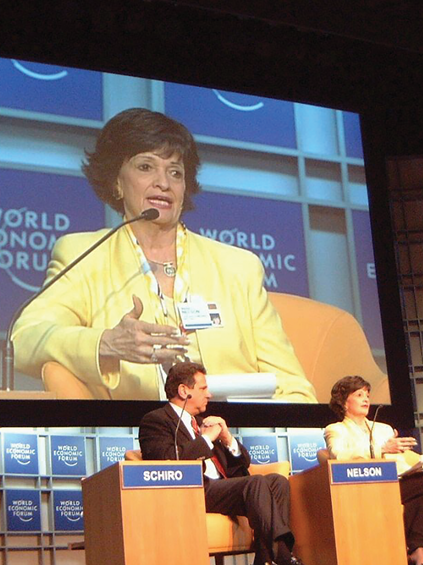
Marilyn Carlson Nelson participating on a panel
at the World Economic Forum in Davos, Switzerland
Where did your interest and passion for philanthropy develop?
My passion for philanthropy was probably born of the admonition of John Wesley, founder of the Methodist Church: “Do all the good you can, by all the means you can, to all the people you can...” Attendance at Hennepin Avenue United Methodist Church was a weekly event for our family. In addition, my father encouraged accountability and action. He would often teach us “if you don’t like it, fix it!” This expectation that I would be accountable and should be a “change agent” prompted me to be active in the community and inspired a desire to make a positive difference. I have fought for women’s rights, civil rights, and for gay marriage. And, along with Carlson Companies and our Carlson Family Foundation, I have been a 21st century abolitionist in the fight against sex trafficking of children.
What do you feel are the keys to being effective and making an impact in philanthropic work?
First, know the facts and identify the need. Continue to gather any new information and be flexible as new facts come to light. Formulate a theory of change and decide metrics for measuring impact. Articulate a vision and a strategy. Identify and recruit partners, and communicate, communicate, communicate. Be patient and courageous in the face of opposition. Change takes time. Share power and share credit for success.
How do you decide where to focus your philanthropic efforts?
As a corporation, I believe the key to being effective and having an impact is to engage only in issues where your team’s competencies and your platform have a unique ability to bring about change. For example, Carlson being in the hotel business and travel business, and being involved in the hospitality industry leadership, could use its network to interrupt the movement of and facilitation of child sex trafficking. Also, being in global service businesses was consistent for us to be among the first to cover partner benefits, and to take an anti-racist, inclusive approach to hiring, culture, and advocacy. We wanted the best employees regardless of gender, race, religion, or sexual orientation.
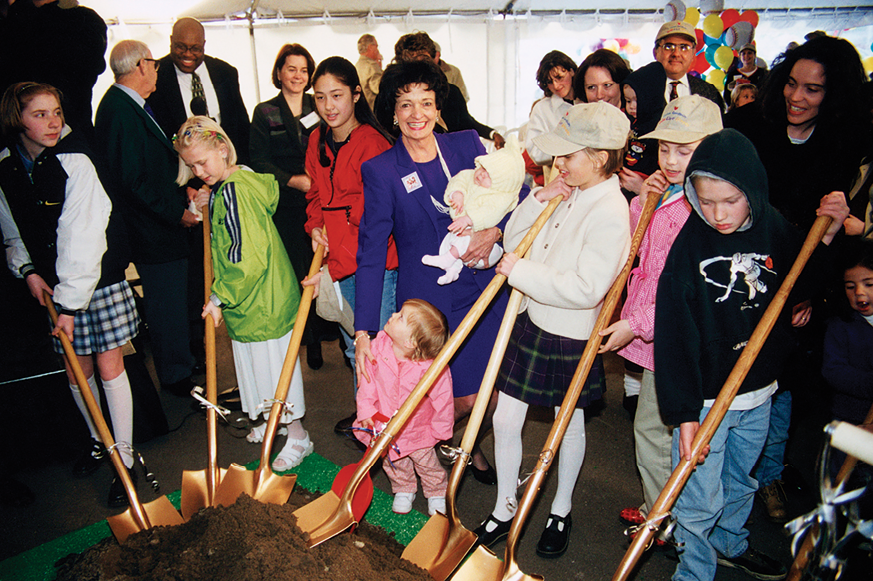
Marilyn Carlson Nelson at the groundbreaking for
a new child care center
While much of philanthropy is focused on writing checks, you give your time, energy, and ideas to the causes you support. How important is it for your philanthropic activities be more than just about donating money?
Both are important. Problems and challenges need “experts” to address them. Writing a check is a way to enable those “experts” and should provide us with the satisfaction of “partnering” or being “vested” in outcomes we could not ourselves bring about. Writing a check allows us to focus on our own work so, in a sense, it extends what we can accomplish in a given time period.
There are many times when our corporate team has the expertise required to address problems. Then we must take the lead, engage, and encourage others to support us. When it comes to fighting for Democracy – the rule of law, freedom of the press, freedom of speech and for human rights – as corporate individuals and as citizens, we must be prepared to both take a stand and write checks. Our individual voice matters and our collective voices amplify our impact.
Personally, I derive great satisfaction when I can create a vision for positive change and work collaboratively across disciplines to address a problem. I believe we can do together what none of us can do alone.
What does success mean to you?
Success is living with purpose. If I lead with love, assume good intent, stand up for my values, and become a model for my children and the next generation, and never give up, I should consider my work well done. If I have built an ethical business, created well-paying jobs, fulfilled needs, and created value for shareowners, I should be humbly grateful. If I have refused to compromise on the things I should continue to fight for, I count it as a success.
With all that you have achieved in your career, are you able to enjoy the process and take moments to celebrate the wins?
It’s fair to say I am frustrated and concerned right now. So much of what I believe and what I have fought for is at risk. At this time, women’s rights, civil rights, the fight against pedophilia – our fundamental human rights are being threatened, so I cannot celebrate. How heartbreaking it is to be over 80 years old and witness the dismantling of the vibrant, inclusive society that one has helped to build? My hope lies in the next generation.
What advice do you offer young people beginning their careers?
Never take democracy and freedom for granted. Take yourself, take your values, and take your skills seriously. Work hard and be a force for good. Let me echo my father’s advice: “If you don’t like it, fix it.”