- Home
- Media Kit
- MediaJet
- Current Issue
- Past Issues
- Ad Specs-Submission
- Reprints (PDF)
- Photo Specifications (PDF)
- Contact Us
- PRIVACY POLICY
- TERMS OF USE
Loading

ONLINE


Jonathan Alpert and Salimah Velji
An Urgent Public
Health Challenge
Editors’ Note
Jonathan Alpert, MD, PhD, is Dorothy and Marty Silverman Chair, Psychiatry and Behavioral Sciences at Montefiore Einstein and Professor, Psychiatry, Neuroscience and Pediatrics at the Albert Einstein College of Medicine. Alpert’s clinical focus centers on the evaluation and treatment of complex mood and anxiety disorders. After obtaining his Bachelor of Arts at Yale College, Alpert earned his Doctor of Medicine at Yale University. He earned his Doctor of Philosophy in behavioral pharmacology at the University of Cambridge in Cambridge, England, on a Marshall Scholarship. Alpert completed residency training in pediatrics at the Boston Children’s Hospital. He then completed his psychiatry residency at McLean Hospital, where he was Chief Resident in psychopharmacology in his final year. He then held faculty and leadership roles at Massachusetts General Hospital and Harvard Medical School. Alpert’s research focuses on the treatment and biomarkers related to major depressive disorder and bipolar disorder. He has been principal investigator and co-investigator on numerous funded research projects, and his work has been published in many peer-reviewed publications. Alpert serves on the editorial board of several psychiatry journals and has over 240 publications. He has also given many national and international invited presentations. Alpert is a member of the American Psychiatric Association (APA), the American Society of Clinical Psychopharmacology, the American College of Psychiatrists, the Association of Chairs of Departments of Psychiatry, the Society of Biological Psychiatry and the Anxiety and Depression Association, among others. He chairs the Council on Research of the APA, the Association for Behavioral and Cognitive Therapies and the American Psychiatric Association.
Salimah Velji is Unified Executive Administrator in the Department of Psychiatry and Behavioral Sciences at Montefiore. In 2023, she was also selected as the inaugural Executive Director of Strategy and Operations in the Department of Medicine. Prior to joining Montefiore Einstein, Velji served as Program Administrator in the Smilow Cancer Hospital at Yale New Haven, Senior Administrative Director for Clinical Operations and New Initiatives in the Department of Psychiatry at Massachusetts General Hospital, and Departmental Administrator/Chief Financial Officer in the Department of Urology at Columbia University Irving Medical Center. She earned her undergraduate degrees in business administration and health sciences from Ivey Business School of Western University in Ontario, graduating with honors. She later received her MBA from Yale School of Management and her Master of Public Health from Yale School of Public Health.
Institution Brief
Montefiore Einstein (montefiore.org) is a leading academic medical organization comprised of Montefiore Health System and Albert Einstein College of Medicine. Together they are pioneering patient-centered research and providing exceptional personalized care with over six million patient interactions a year in communities across the Bronx, Westchester and the Hudson Valley. Montefiore Health System is comprised of 10 member hospitals, including the Children’s Hospital at Montefiore, Burke Rehabilitation Hospital, White Plains Hospital, and more than 200 outpatient ambulatory care sites that provide coordinated, comprehensive care to patients and their families. Albert Einstein College of Medicine, home to nearly 1,000 students in its MD, PhD, and combined MD/PhD programs, is one of the nation’s preeminent centers for research, medical education and clinical investigation.
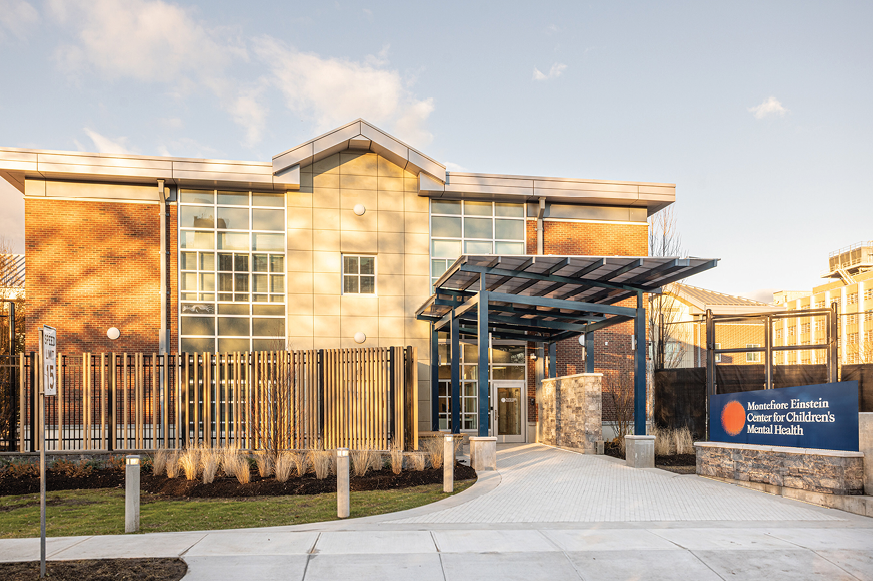
Montefiore Einstein Center for Children’s Mental Health
Will you discuss your views on the youth mental health crisis?
Over the past decade, the number of children experiencing mental health challenges has risen sharply, and the number of skilled providers has not kept pace. The COVID-19 pandemic further intensified this trend by disrupting routines, limiting social connections, increasing family stress, and accelerating reliance on technology and social media. As in prior public health crises, the mental health fallout has extended beyond the acute phase, with sustained increases in anxiety, depression, and social disconnection among youth. As a result, many young people come to care with higher acuity needs and less protective support. Many kids and teens across the country wait hours – or even days – in emergency departments or face delays for outpatient care. This growing gap demands innovation.
More than one in five youth in the Bronx, nearly 60,000, are estimated to have a behavioral health diagnosis. At Montefiore Einstein, we’ve been collaborating closely with our patients and their families to establish a comprehensive suite of services so every person who comes through our doors feels safe, respected, supported and hopeful for the future. This starts by ensuring access to culturally attuned care that is connected to their schools and communities, and is tailored to individual needs, including emergency evaluation, weekly outpatient individual and therapy groups and intensive half-day programs.
Partnering closely with our colleagues in pediatrics is critical to ensuring appropriate mental health screening and timely expert care to children and adolescents, as approximately half of all mental illnesses begin as early as age 14, and 75 percent by age 24. Early identification and effective treatment can interrupt symptom progression, reduce severity, and in some cases, prevent conditions from causing chronic impairment and distress into adulthood. We have a powerful opportunity to create programs that will not only bring skills and healing to our community, but can improve the overall quality and trajectory of a person’s life.
What are some of the programs you’ve created to help address this challenge?
One of the most significant developments in 2025 was the launch of the Montefiore Einstein Center for Children’s Mental Health, a state-of-the-art 21-bed inpatient psychiatric unit. This new center nearly doubled the number of child and adolescent inpatient psychiatric beds in the Bronx, directly addressing a critical gap in access to intensive mental healthcare.
In parallel, we continue research, program development and dissemination to expand evidence-based interventions for youth including treatments like Adolescent Dialectical Behavior Therapy. Montefiore Einstein has introduced new care models including the Arts and Integrative Medicine Program, led by Jenny Seham, PhD, in the Child Outpatient Psychiatry Division, which integrates gardening, mixed media arts, songwriting, and digital art. Teens collaborate with community artists and licensed mental health professionals, culminating in public exhibitions. This groundbreaking fine arts program has demonstrated reductions in stress, increased social connection, and positive impacts on mental health stigma. Artwork from these patients adorns the walls of our new inpatient center for teens and children.
Additionally, Montefiore Einstein offers specialized programs for youth focusing on streamlining access to assessments for autism and attention and learning challenges. Our eating disorders treatment team uses evidence-based approaches to stress and anxiety surrounding nutrition and food scarcity, while partnering with physicians from the Children’s Hospital at Montefiore Einstein to provide comprehensive care. We also have a new Sports Mental Health & Performance Institute designed to support youth athletes in pre-professional and early careers.
Upcoming programs in development include an Intensive Outpatient Women’s Mental Health Program, recognizing that supporting mothers and caregivers is a critical upstream intervention for youth mental health. When women receive timely, effective treatment for mood, anxiety, and trauma-related conditions, they are better able to support their children’s emotional regulation, stability, and development. Additionally, we will add an Intensive Outpatient Program and Partial Hospital Program focused on eating disorders, which will be the first-of-its-kind in the Bronx, as well as a new child outpatient psychiatry clinic in the South Bronx.
“More than one in five youth in the Bronx,
nearly 60,000, are estimated to have a
behavioral health diagnosis.”
Will you highlight Montefiore Einstein Center for Children’s Mental Health, and what makes this center unique?
In a borough where families have long faced prolonged emergency department waits or been forced to travel out of the Bronx for care – Montefiore Einstein Center for Children’s Mental Health represents a watershed moment for youth mental health access. The Center provides care for youth with severe depression, anxiety, trauma, psychosis, suicidal thoughts, and other mental health conditions, as well as support for their families.
Built to meet the needs of children and adolescents, the state-of-the-art inpatient unit offers 21 beds, the majority in private rooms, creating a more therapeutic, dignified, and healing environment for youth in crisis. The unit also has classrooms, community and dining spaces, a gym, an outdoor playground, and abundant natural light.
The Center’s patient-, family- and community-centered model sets it apart from traditional inpatient programs. From the outset, we partnered with peer advisors and families to design our programs to incorporate their insights, knowledge about the local communities, and feedback from hospitalizations elsewhere. Our security staff, dressed casually rather than in uniform, are integral to a welcoming and respectful culture on the unit. Daily programing is designed to provide both structure and flexibility; healthy and tasty meal options are offered.
Admission to a psychiatric hospital is often confusing and wrenching for youth and families during a time of crisis; we are dedicated to transforming a potentially traumatic experience into one that offers support, hope and enduring skills. Montefiore Einstein Center for Children’s Mental Health was supported by NY state funding, legislative leadership, and philanthropy to address one of New York State’s most urgent public health challenges. At its core, the Center reflects our commitment to delivering the most advanced, culturally attuned care possible. No matter the magnitude of the challenge, we stand alongside our patients and families – working together toward healthier futures for each child and their community.
How critical is it to focus on both inpatient and outpatient services to most effectively address youth mental health?
In the Bronx, like much of New York and our nation, there is a significant shortage of mental health providers for children and adolescents – including psychiatrists, psychologists, social workers and other clinicians. Montefiore Einstein is working to create programs where patients with higher acuity will have the opportunity to receive care outside of the hospital, but within our own system through intensive outpatient programs. Offering step-up and step-down care for a range of conditions and severity levels means patients will receive the right level of care at the right time. Our aim is to provide care that will reduce emergency department wait times, improve timely access to care, and provide truly tailored treatments, enhancing the system for all.
What more needs to be done to attract mental health professionals to the profession?
As an academic medical center, we’re proud to train the next generation of psychiatrists, psychologists, and other mental health professionals and researchers. Our approach has been to start early, including from within the communities we serve, and to inspire students and early career clinicians. Our mission is to partner with urban communities who have historically had high mental health needs but limited access to expert mental healthcare. We have pathway and mentorship programs for local students from high school to post-doctoral trainees with an interest in pursuing medicine, mental health, nursing, social work, or neuroscience. Montefiore Einstein students learn about the growing understanding of mental illness and its evidence-based treatments, as well as about systems of care, cultural humility, and collaboration with community stakeholders.
Our department supports opportunities for early career clinicians and scientists for mentorship and professional growth. We are deeply proud to be known as a major training ground for future mental health clinicians and researchers who have the knowledge, skills and values to make a significant contribution to the health and well-being of current and future generations.